
Who This Guide Is For
This guide is for people who keep hearing that anyone can launch a "memecoin" in a minute and want to know what that really means before they click anything. You do not need to know what a bonding curve, a perp, a buyback or a burn is. We explain each word the first time it appears, with an everyday comparison.
It is also for readers who already know the old Pump.fun, the simple page where you launched and bought coins, and want to know what the product is now. The app we opened has a coin feed, a social feed of "callouts", a leaderboard, perpetual futures, trading card packs, live streams, bounties, holder rewards, referrals, take profit and stop loss orders, and a page for the PUMP token with a daily buyback record.
We did not only read the marketing. We opened the live site, the app and the developer docs on a desktop, a tablet and a phone. We connected a fresh MetaMask wallet, opened every page we could reach, and compared the numbers on the screen against CoinGecko and DefiLlama. We deposited nothing, bought nothing, created no coin and placed no order. Where we could not test something, we say so.
How We Tested Pump.fun
| Device | Viewport | What we did |
|---|---|---|
| Desktop | 1440 x 900 | Coin feed, create coin page, perps, packs, PUMP token page, holder rewards, referrals, orders, sign-in, developer docs |
| Tablet | 1024 x 768 | Coin feed, perps, PUMP token page, create coin page, developer docs |
| Phone | about 430 px wide | Perps, PUMP token page, create coin page, developer docs |
A note about access. The site sits behind a Cloudflare check. In our first automated pass, the homepage and the board page returned the "Just a moment" screen on all three device sizes, and the create coin page loaded only on desktop. In a later session with our usual browser profile, every page loaded. This is a feature of our test setup and not a flaw of the site, but a reader on a restricted network might see the check too.
decoding="async" referrerpolicy="no-referrer" decoding="async" src="/wp-content/uploads/2026/11/articles-screenshots-pump.fun-pump-fun-cloudflare-check-desktop.jpg" alt="Pump.fun security verification page shown by Cloudflare before the site loads" title="">
The Wallet We Used
We used a brand new, throwaway MetaMask profile with no funds. On the sign-in window we picked the second MetaMask entry, the one for Solana. MetaMask then showed a pop-up that said the site could see addresses, balances and activity and could ask for transactions, and that it cannot move funds without permission.
We need to be open about one step. After we pressed Connect, our test helper pressed Confirm on a second MetaMask prompt without us reading it first. The site then signed us in to a new account and showed a balance of 0 dollars. We believe the second prompt was the site's sign-in message, because nothing else happened: no transaction, no deposit and no trade. The wallet is empty, so there was nothing to lose. It still breaks our usual rule of reading every prompt before approving, and we tell you so you can judge the rest of our notes. Everything below about the signed-in account comes from that empty account.
Quick Verdict
Pump.fun is no longer just a place to launch coins. It is a busy trading app with a feed, a leaderboard, perps, card packs and a token that is bought back and burned every day, and the public daily burn record is one of the more transparent things we have seen from a launchpad. Our concerns are about numbers and risk. The site's own PUMP page warns that its fee dashboard "does not correctly reflect" revenue and buyback amounts since custom pairs were added. Its circulating supply and market cap differ from CoinGecko by about 14 percent. The developer docs cover only a read-only social API and say nothing about fees or audits, and we found no audit page. A 2024 incident cost about 1.9 million dollars. The PUMP token is about 68 percent below its high, and the coins launched on the platform are, by nature, extremely risky. It is a polished tool for people who already accept that risk, and not a place for a beginner to test with money they need.
| Item | Detail |
|---|---|
| Project | Pump.fun (app at pump.fun, developer docs at docs.pump.fun) |
| Products | Memecoin launches, coin feed, callouts, leaderboard, perps, packs, live streams, bounties, holder rewards, referrals, orders, PUMP token page |
| Chain | Solana |
| Token | PUMP |
| Our editorial score | 3.3 out of 5 |
| Wallet needed to browse | No |
| Money at risk in our test | None |
What Is Pump.fun (Plain English)
Think of a street market where anyone can set up a stall in one minute for free. A stall owner announces a new item, for example a joke mascot, and hands out tickets. A crowd forms around the stall that gets the most attention. A few people sell their tickets at a high price. Many others are left holding tickets that nobody wants. The market takes a small cut of every sale.
Pump.fun is that market for crypto coins on the Solana network. A "memecoin" is a coin built around a joke, an image or a trend, with no product behind it. The site makes launching one very easy and gives every coin an automatic place to trade from the first second.
In Plain Terms
- A bonding curve is a price formula that the site uses at the start. The more people buy, the higher the price goes, and the more people sell, the lower it goes. Think of a stall that raises its price a little with every ticket sold.
- Graduation is the moment a coin has been bought enough that it moves from the starting formula to a normal trading pool. The site has its own pool called PumpSwap, and DefiLlama also tracks older fee notes about moves to Raydium.
- A perp (perpetual future) is a bet on a price with no end date. You can use borrowed money, called leverage, to make the bet bigger. A 40x label means a gain or a loss is multiplied by 40. That also means a small move against you can wipe out your deposit.
- A buyback and burn means the company uses part of its income to buy its own token on the open market and then destroys it, so fewer tokens exist. Think of a shop that buys back its own vouchers and shreds them.
- Creator rewards are a share of trading fees that goes to the person who made a coin.
The Four Roles on Pump.fun
| Role | What they do | Example from the app |
|---|---|---|
| Creator | Launches a coin and can earn a share of its fees | The Create new coin page |
| Trader | Buys and sells coins, perps and packs | The Coins feed and the Perps page |
| Holder | Holds a coin or PUMP and may get rewards | The Holder rewards page |
| Referrer | Invites friends and earns a share of their fees | The Invite your friends page |
Key Facts at a Glance
| Fact | Value | Source and date |
|---|---|---|
| PUMP price | $0.002818 | CoinGecko, November 17, 2026 |
| Market capitalization | $1.29 billion | CoinGecko, November 17, 2026 |
| Fully diluted valuation | $2.32 billion | CoinGecko, November 17, 2026 |
| 24 hour volume of the token | $73.26 million | CoinGecko, November 17, 2026 |
| CoinGecko rank | 60 | CoinGecko, November 17, 2026 |
| Circulating supply | 458.08 billion PUMP | CoinGecko, November 17, 2026 |
| Total supply | 822.34 billion PUMP | CoinGecko, November 17, 2026 |
| Maximum supply | 1 trillion PUMP | CoinGecko, November 17, 2026 |
| Fees, last 24 hours | $1.38 million | DefiLlama, November 17, 2026 |
| Fees, last 30 days | $45.90 million | DefiLlama, November 17, 2026 |
| Fees, last year | $437.86 million | DefiLlama, November 17, 2026 |
| Fees, all time | $1.33 billion | DefiLlama, November 17, 2026 |
| Total bought back and burned | $508.28 million, 177.40 billion PUMP | Pump.fun PUMP page, November 2026 (self-reported) |
| Holders | 445.3 thousand | Pump.fun PUMP page, November 2026 (self-reported) |
| Audits listed | 0 | DefiLlama |
| Hacks listed | 1 (May 2024) | DefiLlama hacks database |
Why the Numbers Differ
This is where the project's own page and the outside sources disagree, and the gaps are large enough to matter.
| Metric | Pump.fun PUMP page | CoinGecko | What it means |
|---|---|---|---|
| Circulating supply | 399.46 billion | 458.08 billion | A gap of 58.6 billion, about 14.7 percent of the page figure (our calculation) |
| Market cap | $1.13 billion | $1.29 billion | Follows from the supply gap |
| Fully diluted value | $2.82 billion | $2.32 billion | The page multiplies by 1 trillion, which includes burned tokens. CoinGecko multiplies by 822 billion (our calculation) |
| 24 hour volume | $2.75 million | $73.26 million | Our reading is that the page counts one venue and CoinGecko counts all markets, but the page does not say |
| Price | $0.002820 | $0.002818 | Same within rounding |
The fully diluted value gap has a clear cause. One trillion PUMP minus the 177.40 billion burned is about 822.6 billion, which matches CoinGecko's total supply of 822.34 billion (our calculation). So CoinGecko treats burned tokens as gone, and the page's headline FDV does not. We cannot say which circulating supply is right. Neither source explains what it counts as circulating.
The fee numbers also need care. DefiLlama shows $437.86 million over the past year. The PUMP page says "annualized revenue" of $625.24 million, based on a 90 day average of $1.71 million per day (about 1.71 million times 365, our calculation). One is a trailing year and the other is a projection from the last three months, so they should not match. Also, DefiLlama's "fees" include money paid on to coin creators and traders, while "revenue" is the part Pump.fun keeps. Do not read the fee number as company profit.
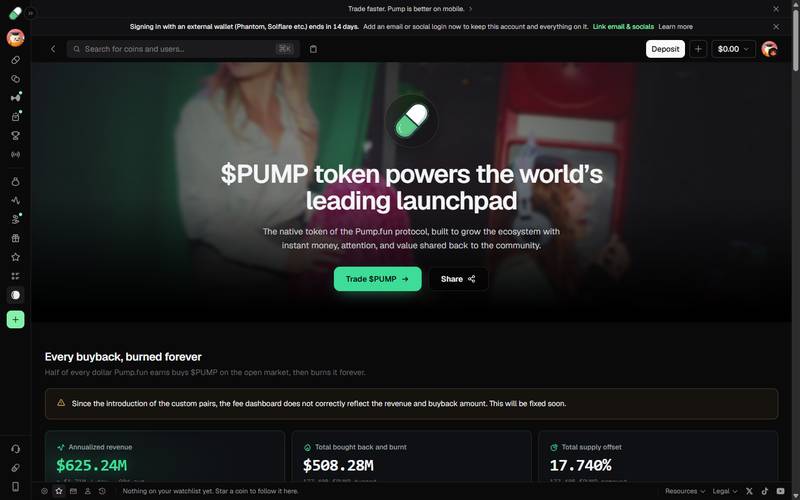
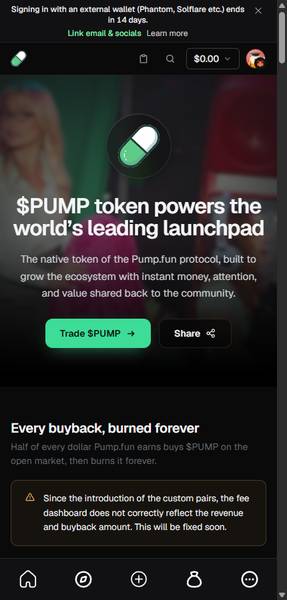
The page also carries its own warning: since the introduction of custom pairs, the fee dashboard "does not correctly reflect the revenue and buyback amount", and this "will be fixed soon". That means the biggest numbers on the PUMP page are, by the project's own statement, possibly off. We treat them as approximate.
The Big Drop
PUMP reached $0.00882 on September 14, 2025. It trades at about $0.00282 today, which is about 68 percent below that high (our calculation). Its low was $0.00115 on June 25, 2026, so today's price is about 2.4 times the low (our calculation). CoinGecko shows about -3.4 percent in 24 hours, -21.1 percent in 7 days, -35.2 percent in 30 days and -17.7 percent in one year. The 30 day fees on DefiLlama are about 25 percent lower than the 30 days before them, which fits the fall in the price.
Related Entries
If you came from our other Solana guides, Marinade covers staking and Orca covers a trading pool. Pump.fun is very different from both. It is closer to a casino floor with a shop attached than to a savings tool.
How Pump.fun Looks on Your Device
Desktop
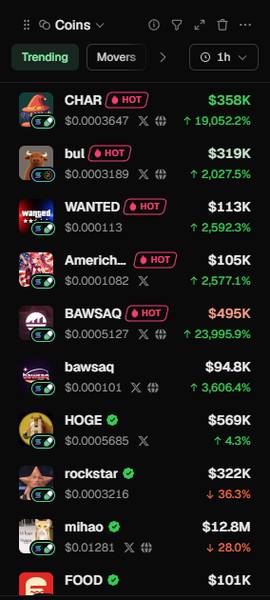
The app is dark with a thin icon bar on the left. The home page has three columns: a Coins feed that you can sort by Trending, Movers, Mayhem and New, a Callouts feed (posts from other users about coins), and a Leaderboard of traders. We show only the Coins column here, because the other two show other people's usernames.
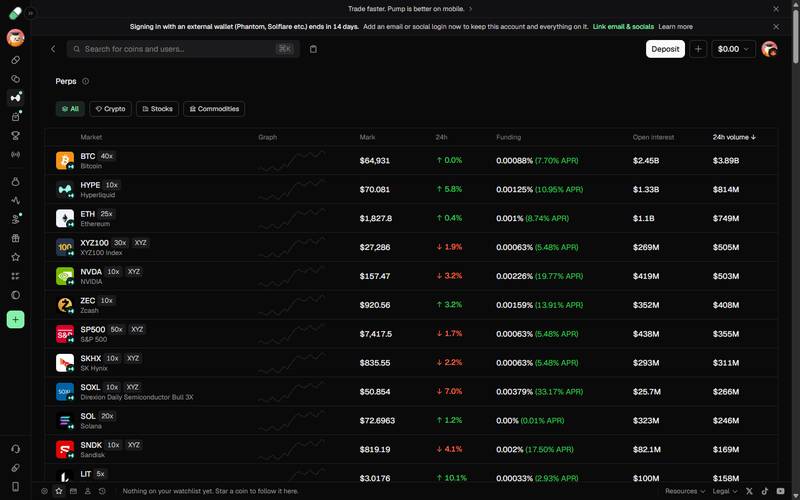
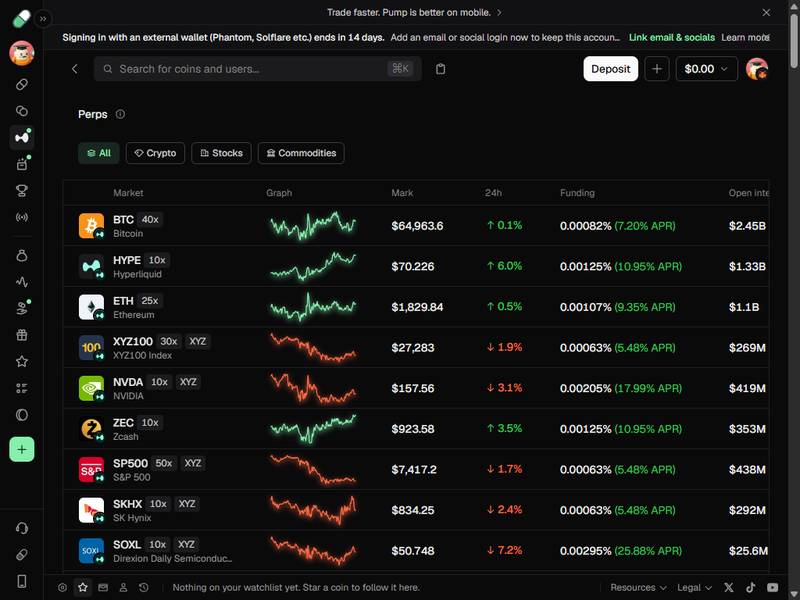
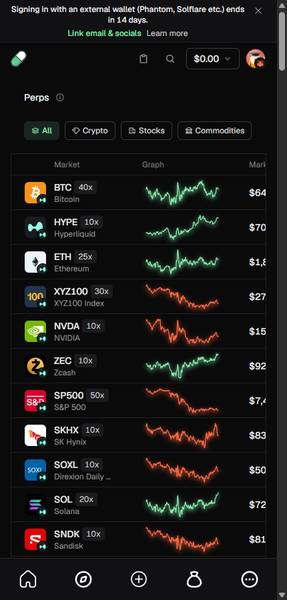
The Perps page is a clean table with market, chart, price, 24 hour change, funding, open interest and volume, and filters for Crypto, Stocks and Commodities. At the time we looked, BTC showed a 40x label, ETH 25x and SP500 50x.
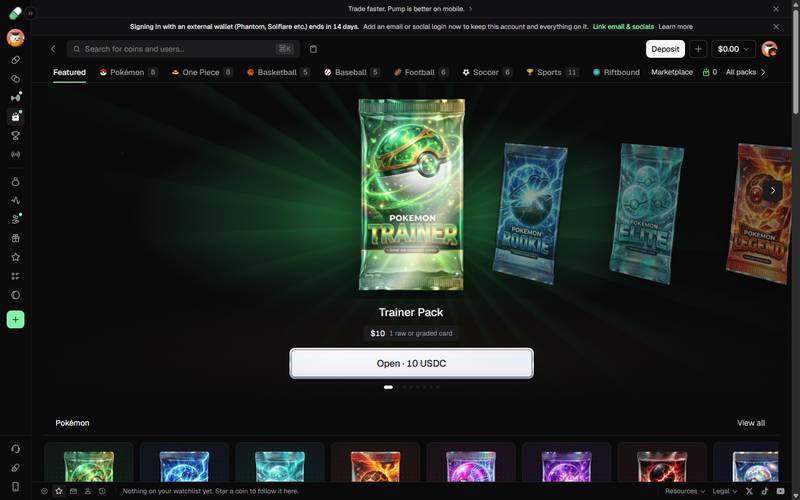
The Packs page sells trading card packs. The featured Trainer Pack costs 10 USDC and says it contains one raw or graded card.
Tablet
At 1024 pixels wide the app keeps the left icon bar. The three columns of the feed become narrower, and the perps table cuts off the open interest column on the right, so you need to scroll sideways to see all of it.
Phone
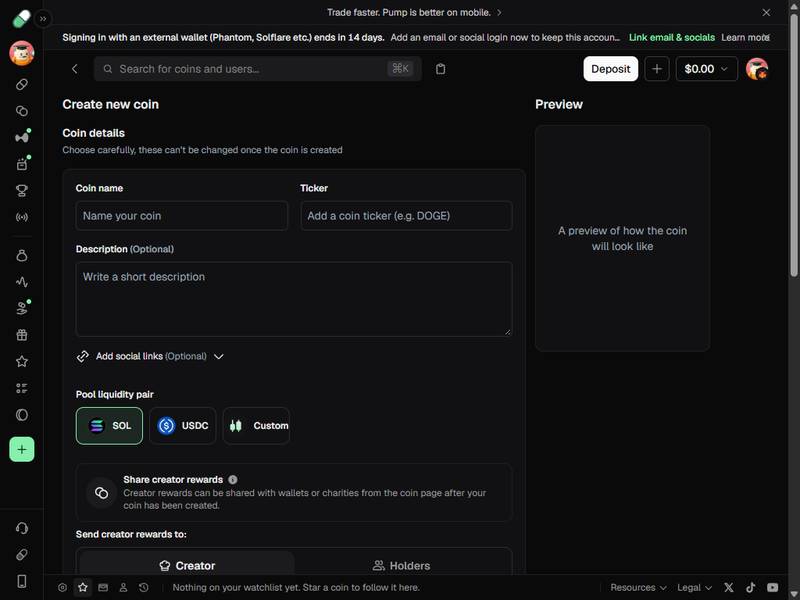
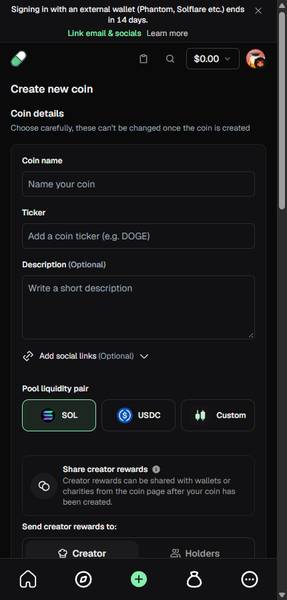
On a phone the left bar turns into a bottom bar with five icons, and the layout changes to a single column that feels like a social app. The perps table still has the right columns cut off.
Bugs and Rough Edges We Found
| Where | What we saw | How much it matters |
|---|---|---|
| PUMP page | A yellow notice says the fee dashboard does not correctly reflect revenue and buyback since custom pairs were added | High, because the headline numbers are affected |
| PUMP page | The active wallets chart shows a message that wallet data is temporarily unavailable | Low |
| PUMP page chart | The y axis of the "Revenue allocated to buyback" chart starts with a label of 3532 percent next to a 50 percent target | Low, but it makes the chart harder to read |
| PUMP page versus CoinGecko | Circulating supply, market cap and volume differ | Medium, see above |
| Banner | A banner says signing in with an external wallet ends in 14 days, while the sign-in window says it ends on November 30, 2026 | Low, it is roughly the same date from our test day, but the wording differs |
| Perps on tablet and phone | The table is cut off on the right | Low |
Connecting Your Wallet
- Click Sign in at the top right.
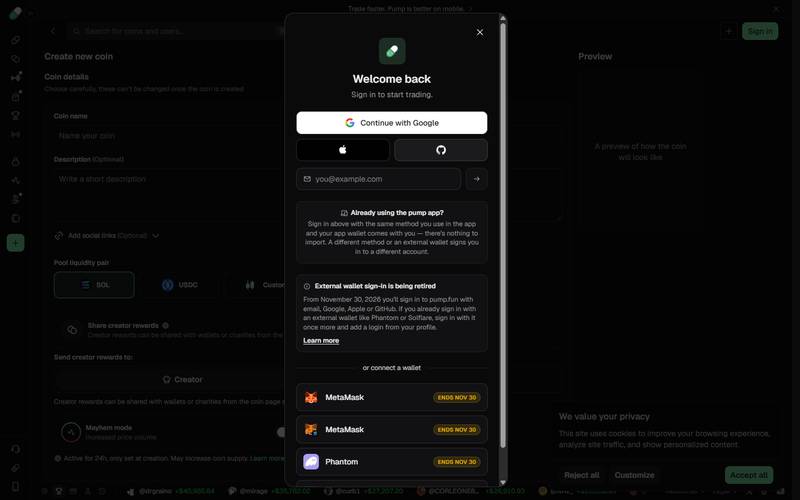
- A window offers Continue with Google, Apple, GitHub or an email address. Below that it says "or connect a wallet" and lists two MetaMask entries (one for Ethereum style networks and one for Solana), Phantom, and More wallets.
- A box in the window says external wallet sign-in is being retired. From November 30, 2026, users sign in with email, Google, Apple or GitHub, and people who already use an external wallet like Phantom or Solflare should add a login from their profile.
- Each wallet entry is tagged "ENDS NOV 30".
- We picked MetaMask for Solana. MetaMask asked us to connect, then the site signed us in and showed a balance of 0 dollars with a Deposit button.
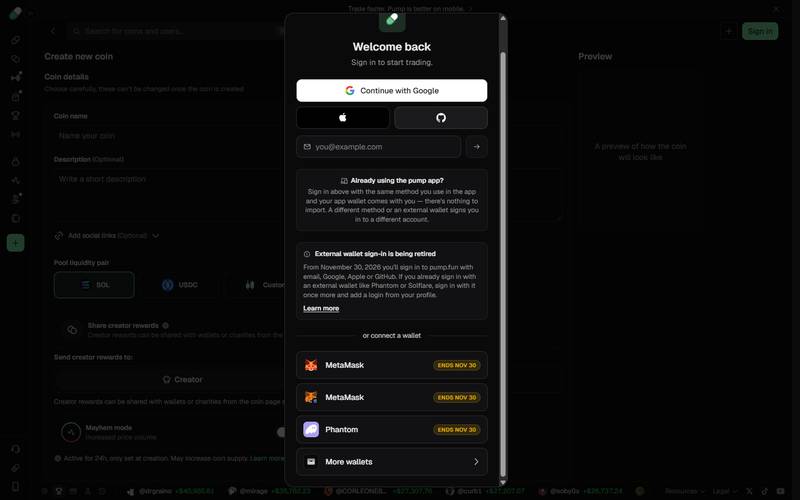
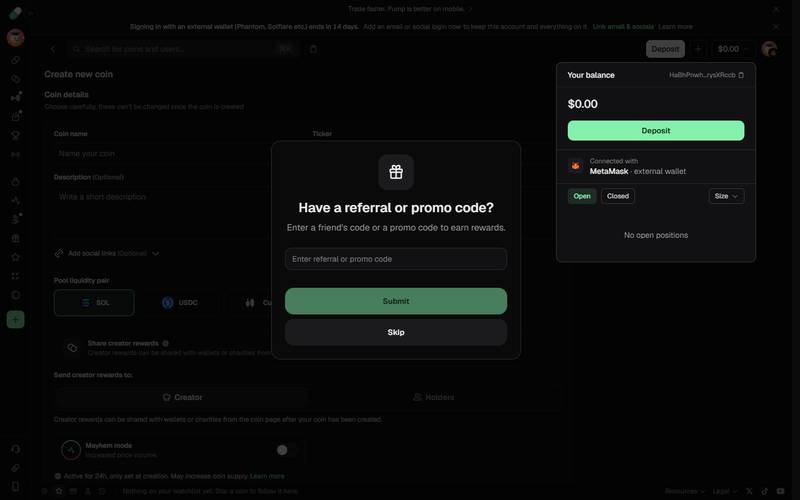
The signed-in panel shows our own shortened address, "Connected with MetaMask, external wallet", and tabs for Open and Closed positions with the message "No open positions". A banner at the top tells external wallet users to add an email or social login "to keep this account and everything on it".
Our reading: the site is moving to accounts that live inside Pump.fun (an app wallet that "comes with you" when you sign in with the same method), and treating external wallets as a legacy sign-in. That is a real change for people who think of the site as a place to connect a wallet and nothing else. It also means an account can matter as much as a wallet, so protect the email or social login you choose.
A beginner safety tip: the site has the same name and look as many copycats. Type the address or use a bookmark. Do not sign in from a link in a chat, a post or an ad. And never share the recovery phrase of your wallet with anyone, including anyone who says they work for the site.
Core Features at a Glance
| Feature | What it does | Tested by us |
|---|---|---|
| Create new coin | Launches a memecoin with a name, ticker, image and settings | Form opened, no coin created |
| Coins feed | Lists coins by Trending, Movers, Mayhem, New and more | Yes, viewed |
| Callouts and leaderboard | Social posts and a ranking of traders | Opened, not shown here |
| Perps | Leveraged bets on crypto, stocks and commodities | Page opened, no position |
| Packs | Trading card packs paid in USDC | Page opened, no pack bought |
| Live streams | Streams tied to coins | Opened, not shown here |
| Bounties | Tasks that pay coins for posts or actions | Opened, not shown here |
| Holder rewards | Coins that share fees with holders | Yes, viewed |
| Referrals | Share of fees from invited friends | Yes, viewed |
| Orders | Take profit and stop loss orders | Yes, viewed, empty |
| PUMP token page | Buyback and burn record and market data | Yes, viewed |
| Developer API | Read-only social data for approved teams | Docs only |
Feature 1: Create a Coin
What it is. The original feature. A form that lets you launch a coin.
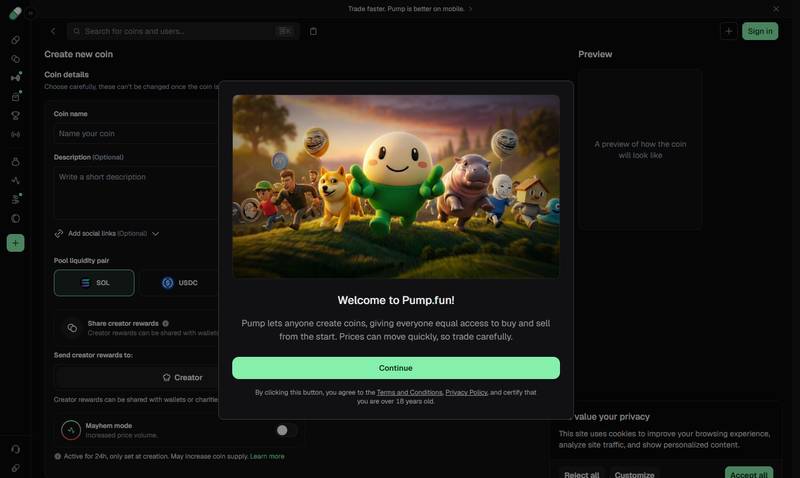
What we saw. The page is titled "Create new coin" and says to choose carefully because the details cannot be changed once the coin is created. The fields are a coin name, a ticker, an optional description and optional social links. You choose a "pool liquidity pair" of SOL, USDC or Custom. A section called "Share creator rewards" says rewards can be shared with wallets or charities after the coin is created, and a switch lets you send creator rewards to the Creator or to Holders. There is also a "Mayhem mode" switch described as increased price volume, active for 24 hours and only set at creation, which "may increase coin supply". You upload an image (at least 1000 by 1000 pixels, up to 15 MB) or a video (up to 30 MB), and can add a banner. A note says coin data like social links and banner can only be added at creation and cannot be changed later.
When the page first opened, a welcome window said that Pump lets anyone create coins and give everyone equal access to buy and sell from the start, and that prices can move quickly, so trade carefully. The button text says that by clicking you agree to the terms and conditions and the privacy policy, and certify that you are over 18. A cookie box also appeared with Reject all, Customize and Accept all.
We did not create a coin, so we cannot tell you what it costs to launch or what the next steps look like. We also did not open the terms, because we did not reach the legal pages.
Our rating: 3.5 out of 5. The form is clear and the warning about permanent details is good. We could not check the launch cost, and "Mayhem mode" is a feature that a new creator might switch on without understanding what a changed coin supply means.
Feature 2: The Coins Feed
What it is. A live list of coins, with a price, a market cap and a percent change.
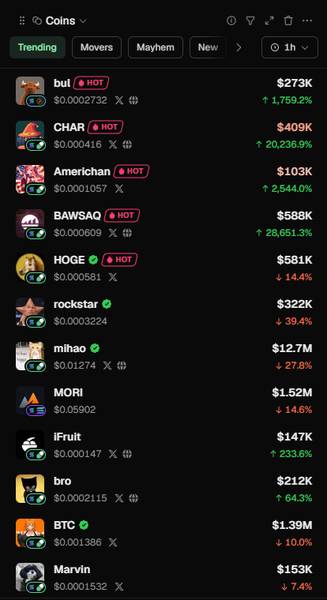
What we saw. Tabs for Trending, Movers, Mayhem and New, plus a time window selector of 1 hour. Coins marked HOT sat at the top with moves such as +20,236.9 percent and +28,651.3 percent in the hour. A green check mark appears next to some names, and small icons link to X and a website. The list on our first visit was led by coins with market caps from about 103 thousand dollars to 1.5 million dollars, and one coin near 12.7 million.
Our reading: these percent moves are what a market looks like when a coin starts near zero. A rise of 20,000 percent from a tiny base can be a few hundred dollars of buying, and it can reverse in minutes. The feed is built to make these numbers look exciting, so treat them as a reason to be careful and not as a signal.
We did not open any coin page. Coin pages list holders and trades, and we avoid showing other people's addresses.
Our rating: 4 out of 5 for the design and the speed. A separate caution applies to the content, which is outside the site's control and which we did not judge.
Feature 3: Perps
What it is. Perpetual futures on Crypto, Stocks and Commodities, in one table.
What we saw. Rows for BTC (40x), HYPE (10x), ETH (25x), XYZ100 (30x), NVDA (10x), ZEC (10x), SP500 (50x), SKHX (10x), SOXL (10x), SOL (20x), SNDK (10x) and LIT (5x), with funding in percent and in a yearly rate. On the desktop screenshot, BTC showed a mark price of about 64,931 dollars, an open interest of 2.45 billion dollars and a 24 hour volume of 3.89 billion dollars. Some rows carry an XYZ tag. We did not find a page that explains who runs the markets behind the table or where prices come from, and DefiLlama lists "pump.fun Perps" as a separate interface entry.
The numbers are on screen only. We did not open a position, so we did not see the order form, the fees, the margin rules or the liquidation rules.
Our rating: 3 out of 5. The table is easy to read. The leverage is very high for a beginner, and we found no explanation of the rules in the pages we visited.
Feature 4: Packs
What it is. Trading card packs sold for USDC. The page has tabs for Pokemon, One Piece, Basketball, Baseball, Football, Soccer, Sports, Riftbound, Dragon Ball and Yu-Gi-Oh, plus a Marketplace tab.
What we saw. The featured pack was the Trainer Pack at 10 USDC, with the text "1 raw or graded card" and a button reading "Open . 10 USDC". The number of packs per tab was shown as small numbers next to each name.
We did not buy a pack. We found no explanation on the page of how the cards are stored, shipped or sold back, so we cannot say what you own after you open a pack.
Our rating: 2.5 out of 5. It is a clear shop page, but it is outside the memecoin core and the page does not explain what the buyer actually receives.
Feature 5: Callouts, Leaderboard, Live Streams and Bounties
What it is. The social layer. Callouts are short posts where a user shows a coin they bought, with their position size and profit. The leaderboard ranks traders by profit over a day, week or month. Live streams are video streams tied to coins. Bounties are tasks where a coin's creator or backer pays for posts or actions.
What we saw. The home page puts Callouts in the middle and a Leaderboard on the right. Each callout card shows a coin, a position and a profit. The Bounties page showed summary numbers at the top: 51 live bounties, about 8 thousand dollars in an unclaimed pool, 725 submissions and about 1 million dollars paid out. These are the site's own figures. The bounty cards we scrolled past offered small prizes, for example a few dollars for buying a coin and holding it for a week, and some bigger prizes tied to a coin with a market cap of a few hundred thousand dollars.
We are not showing these pages. They list other users' names, posts and profits, and some posts we saw were long claims by individual users that we could not verify.
Our reading: callouts show profits, and the feed is sorted to show winners. That is a standard feature of social trading, and it creates a skewed picture. People who lost money rarely post. A bounty that pays you to promote a coin you hold is also a way of paying people to advertise, and a beginner should read such posts as marketing and not as advice.
Our rating: 3 out of 5. It adds life to the app. It also adds a lot of noise and some promotional pressure.
Feature 6: Holder Rewards
What it is. A list of coins whose trading fees are automatically paid to people who hold them.
What we saw. The page header says holder rewards are paid to holders in the quote token. Totals at the top read $41,652,066 in holder rewards, $28,531,998 "at today's prices", and 784,982 wallets rewarded. A table of "Top paying coins" showed the coin, the age, the token it paid in (for example PUMP, WBTC, TTWO and SOL), the amount paid, the market cap and the number of holders paid. The top coin had paid its holders $710,000 and had a market cap of $512K. A green button reads "Launch a holder rewards coin".
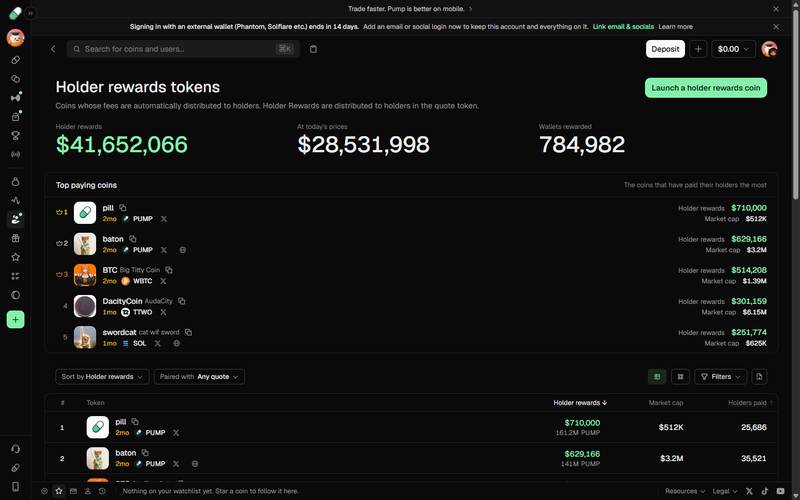
Our reading: the gap between the first total (41.65 million dollars) and the second (28.53 million dollars) suggests that the rewards were paid in tokens whose value has fallen since. That is our inference from the labels, and the page does not explain it. It is also a reminder that a reward paid in a volatile token can lose value after you receive it.
Our rating: 3.5 out of 5. It is transparent about amounts and the number of wallets. It does not say how the fees are split, so we cannot judge whether a typical holder gets a meaningful amount.
Feature 7: Referrals
What it is. A page called "Invite your friends" where you share a link and a code and earn a share of the fees your friends pay.
What we saw. Our new account got a ready-made handle and code, and a link in the form pump.fun/u/ followed by the handle. The page shows Total earned ($0.00), the number referred (0), a Claim rewards box ("Nothing to claim yet"), a place to enter a referral or promo code of your own, and a table of referral payouts reading "No referral payouts yet". A heading says "Deposit match & lifetime rewards". We did not find the exact percentages on the page, so we cannot tell you what share you would earn.
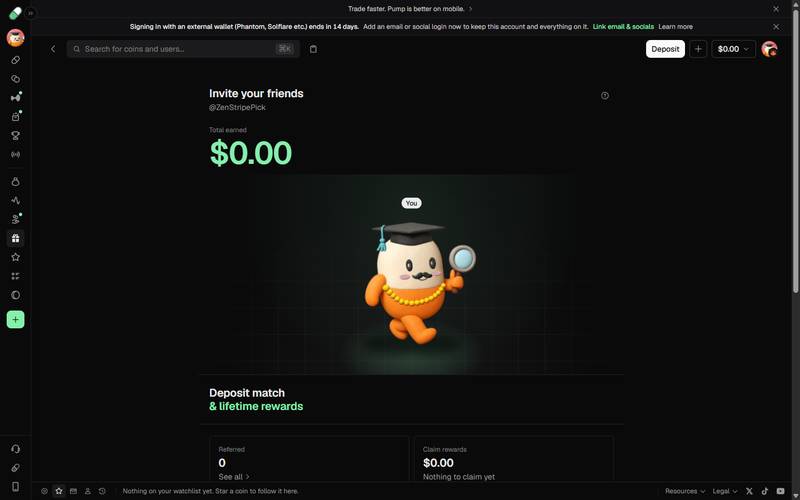
Our rating: 3 out of 5. The page is tidy, and the rates are not shown where we looked.
Feature 8: Orders (Take Profit and Stop Loss)
What it is. A page to manage orders that close a position automatically when a target price is hit.
What we saw. An "Active orders" tab and an "Order activity" tab, and the message "No active orders. Set a take profit or stop loss on a position to auto-execute when your target hits", with a View positions button. We had no positions, so the page was empty.
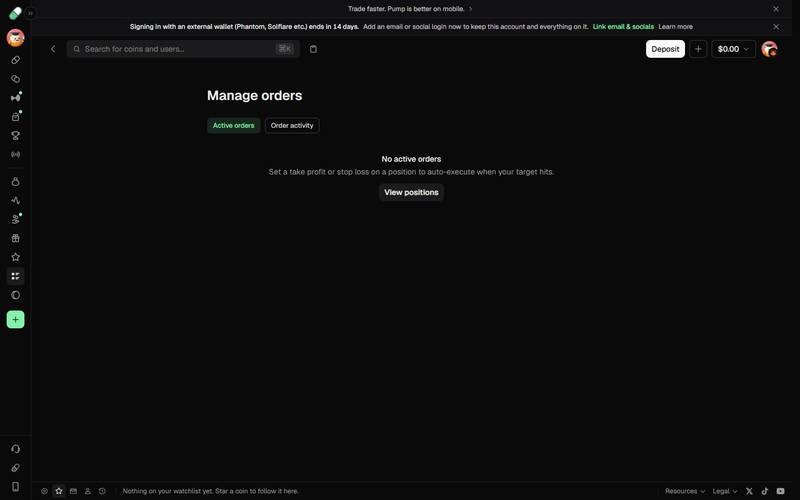
Our rating: 3.5 out of 5. These are standard tools for any leveraged trading, and it is good that they exist. We could not test how reliably they trigger.
Feature 9: The PUMP Token Page
What it is. A public page about the PUMP token with a buyback and burn record.
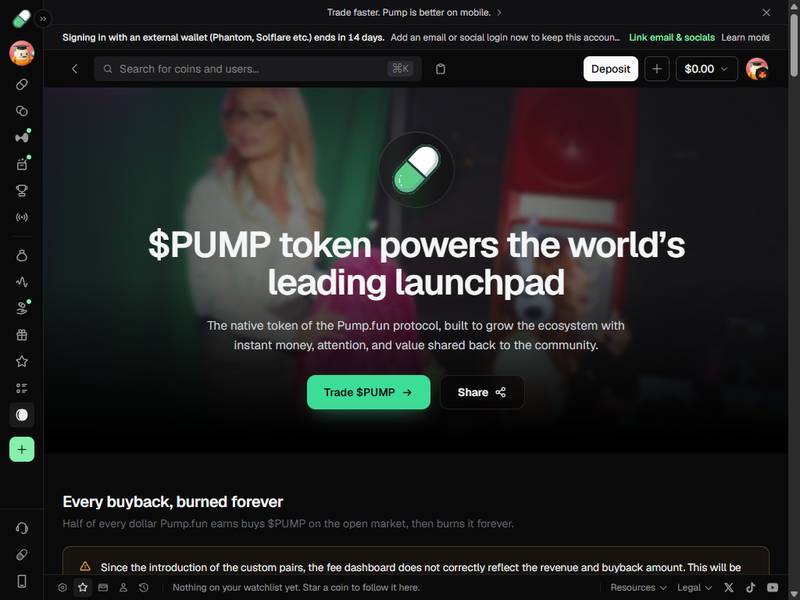
What the page says. The headline reads that the PUMP token powers the world's leading launchpad. A subheading says half of every dollar Pump.fun earns buys PUMP on the open market and then burns it forever. Key numbers were $625.24 million of annualized revenue (a 90 day average of about $1.71 million per day), $508.28 million bought back and burned (177.40 billion PUMP), and a supply offset of 17.74 percent.
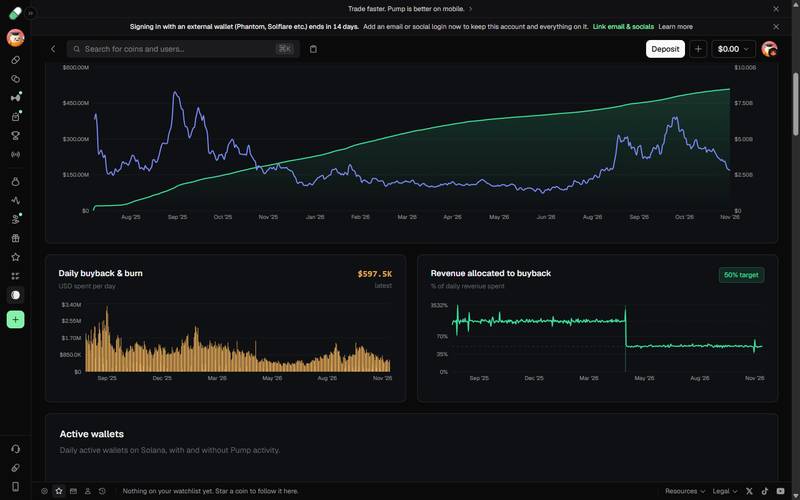
What the daily table shows. A table lists each day's burn: the amount of PUMP burned, SOL spent, dollars spent, price and the percent of revenue. For November 7 to November 16, 2026, the daily percent of revenue ran between 47.97 and 50.40 percent. Their average is about 49.5 percent (our calculation), and the total spent over those ten days is about 5.34 million dollars (our calculation from the table). That fits the "half of revenue" claim for these days. The table runs to 491 rows, so the history is long.
An interesting check: 508.28 million dollars divided by 177.40 billion PUMP is about 0.002865 dollars per PUMP burned (our calculation). That is close to the price on the day we looked (0.00282 dollars). In other words, on average the buybacks were made at about today's price. We did not test whether the table agrees with the chain, which is the kind of check the page invites ("settled on Solana"), and we did not click through the records.
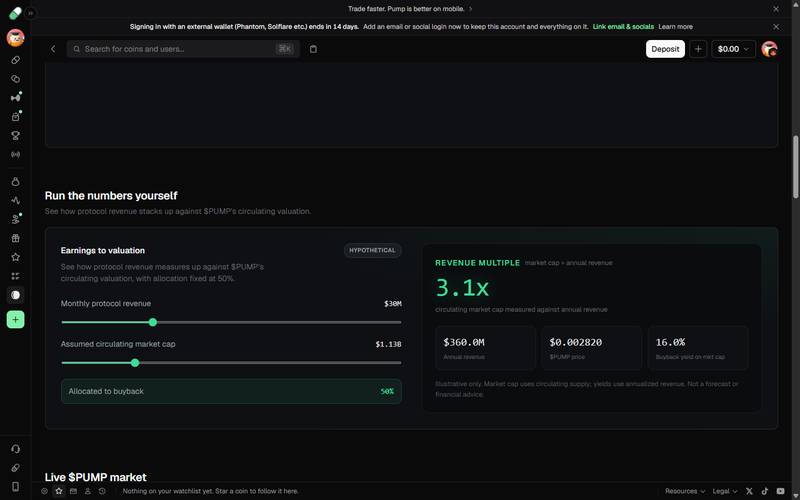
The page also has a "Run the numbers yourself" calculator marked HYPOTHETICAL. With monthly revenue set to 30 million dollars, a market cap of 1.13 billion dollars and 50 percent for buybacks, it showed a revenue multiple of 3.1 times and a "buyback yield" of 16 percent. It states that this is illustrative and not a forecast. Treat the 16 percent as a what-if from the project's own tool, not as a return you can expect.
A weekly newsletter below the table, presented as written by Baton Corporation for the Pump Foundation, reports that protocol fees for the week of September 28 to October 4 were $16.32 million, and that $4.72 billion was traded that week across the bonding curve and PumpSwap. These figures are self-reported and we did not check them.
Our rating: 4 out of 5. The daily record is the strongest transparency feature we found. We take a point off for the warning about the fee dashboard and the gaps with CoinGecko.
Feature 10: Developer API and Docs
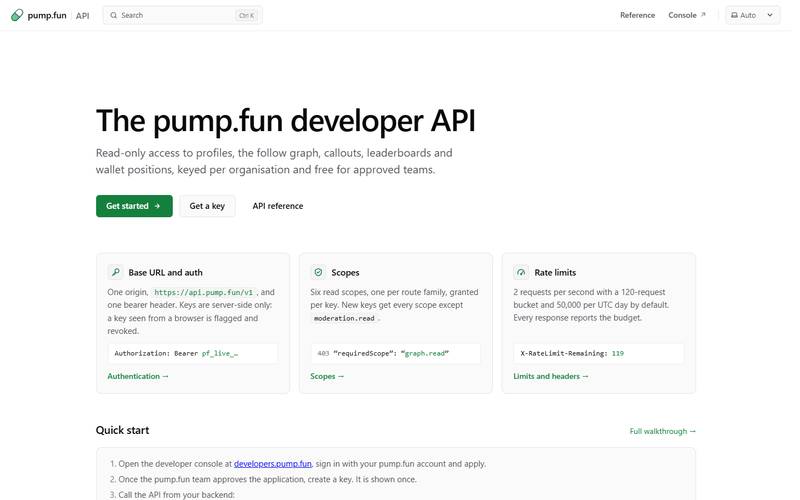
What it is. The docs site at docs.pump.fun. It is not a guide for traders. It documents a read-only API.
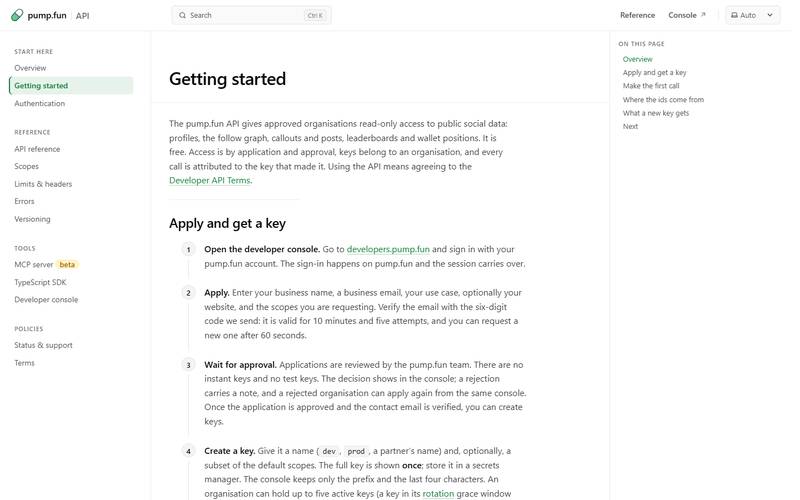
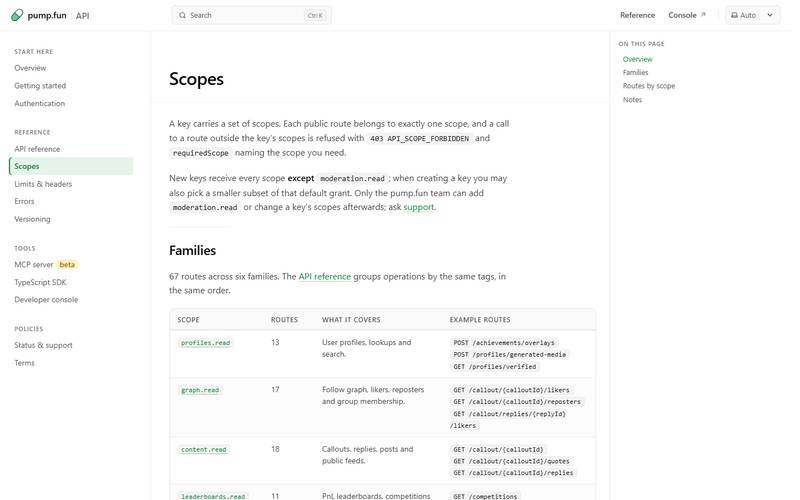
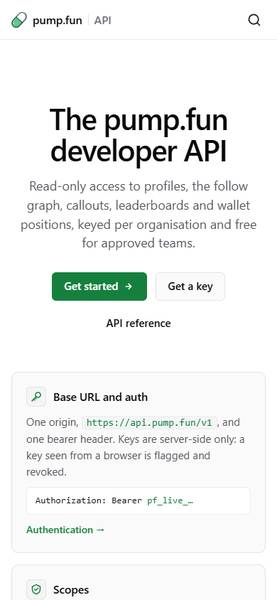
What the docs say. The API gives approved organizations read access to public social data: profiles, the follow graph, callouts and posts, leaderboards and wallet positions. It is free but needs an application and approval. The getting started page says there are no instant keys and no test keys. The base address is api.pump.fun, keys must be used from a server (a key seen from a browser is flagged and revoked), and the default limit is 2 requests per second with a 120 request bucket and 50,000 requests per UTC day. The scopes page says there are 67 routes across six scope families, and an MCP server (beta) and a TypeScript SDK are offered. The terms page is dated October 22, 2026.
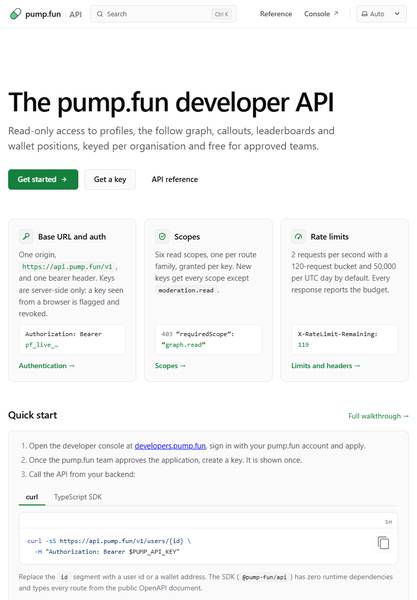
What is missing. The docs say nothing about trading fees, the bonding curve, token distribution, audits or a bug bounty. We looked for those topics in the docs index and found none. A beginner who wants to learn how the site works will not find it here, and we found no other first-party guide in the pages we reached.
Our rating: 3.5 out of 5. For a developer, the docs are clear and the limits are exact. For a trader, they are not the right place, and the trader-facing docs do not seem to exist.
Fees and Costs
We found no trader-facing fee page on the site or in the docs. The only detailed public description we found is in DefiLlama's methodology notes for Pump.fun, which are written by a third party and describe how it counts the fees. We list them here as DefiLlama's reading, not as Pump.fun's own statement.
| Fee | What DefiLlama says | Where we saw it |
|---|---|---|
| Protocol slice of the bonding curve fee | 1 percent before May 13, 2025, then 0.95 percent | DefiLlama methodology |
| Creator slice of the bonding curve fee | 0.05 percent from May 13, 2025, then 0.30 percent from September 2025 | DefiLlama methodology |
| Cashback coins | A slice paid back to traders, in the same 0.30 percent slot as the creator fee, from February 2026 | DefiLlama methodology |
| Mayhem mode fees | Collected at a separate fee wallet | DefiLlama methodology |
| Graduation fees | Paid when a coin moves from the bonding curve to a trading pool | DefiLlama methodology |
| App fee | 0.45 percent on trades made on the pump.fun website since October 16, 2026 | DefiLlama methodology |
| Perps and packs fees | Not found | Not shown on the pages we visited |
Adding the 0.95 percent protocol slice and the 0.30 percent creator or cashback slice gives about 1.25 percent per trade on the bonding curve (our calculation from the methodology). If the 0.45 percent website app fee applies on top, a website trade could cost about 1.7 percent in fees before the price itself moves (our calculation, and only if both fees apply to the same trade, which we could not confirm). On a 100 dollar buy, that is roughly 1.70 dollars. We did not make any trade, so we did not see a fee line on a real order, and we cannot say whether the app shows these costs before you confirm.
Who keeps what: DefiLlama says the protocol's kept share after the buyback has changed over time (all of it before July 14, 2025, none of it from July 14, 2025, and half from April 28, 2026). Its notes say buybacks are paid by all Pump.fun products. We read this as the buyback share moving over time, with the current target being 50 percent, which matches the "half of every dollar" line on the PUMP page.
The PUMP Token
PUMP is the token of the Pump.fun protocol. The site's page says it "powers" the platform, and that half of the money the platform earns is used to buy it back and burn it. We found no page in the docs we read that describes other uses, such as voting or fee discounts, so we do not claim any.
| Metric | Value | Source and date |
|---|---|---|
| Price | $0.002818 | CoinGecko, November 17, 2026 |
| Market capitalization | $1.29 billion | CoinGecko, November 17, 2026 |
| Fully diluted valuation | $2.32 billion | CoinGecko, November 17, 2026 |
| 24 hour volume | $73.26 million | CoinGecko, November 17, 2026 |
| Circulating supply | 458.08 billion | CoinGecko, November 17, 2026 |
| Total supply | 822.34 billion | CoinGecko, November 17, 2026 |
| Maximum supply | 1 trillion | CoinGecko, November 17, 2026 |
| Circulating share of maximum | about 45.8 percent | Our calculation |
| Circulating share of total | about 55.7 percent | Our calculation |
| Volume divided by market cap | about 5.7 percent | Our calculation |
| All-time high | $0.00882, September 14, 2025 | CoinGecko |
| All-time low | $0.00115, June 25, 2026 | CoinGecko |
Why the Numbers Differ
We covered the main gaps above. In short: the project's page gives a circulating supply of 399.46 billion and CoinGecko gives 458.08 billion, and the page's fully diluted value counts tokens that have already been burned. CoinGecko lists a maximum supply of 1 trillion even though 177.40 billion have been burned, so the "maximum" no longer describes what can exist. We did not find a page that says whether new PUMP can be minted.
How to Read This
Our reading: the token is large (rank 60) and trades heavily. About 5.7 percent of the market cap changes hands each day, which is normal for a token of this kind. The burn is real money spent each day, which is a point in its favor, but a buyback only supports a price when the buying is larger than the selling. Over a year the price is down about 18 percent, and over 30 days it is down about 35 percent, even with daily buybacks of around 0.5 to 0.6 million dollars. Also, the buyback follows the platform's income, which follows how many people trade memecoins. When memecoin trading slows, as the 25 percent drop in 30 day fees suggests, the buyback slows too.
Distribution and Governance
We found no token distribution table, vesting schedule or governance process in the pages we read. The weekly newsletter is described as presented by Baton Corporation for the Pump Foundation, and the weekly updates are the only organizational information we saw. This is a gap: you cannot see from the pages we reached who holds the unlocked supply, when team or investor tokens unlock, or how decisions are made.
Security
| Area | What we found | Source |
|---|---|---|
| Audit reports | None listed on DefiLlama, and none found in the docs or on the pages we visited | DefiLlama and our search |
| Bug bounty | Not found | Our search of the docs |
| Hack history | One entry, May 2024, about 1.9 million dollars | DefiLlama hacks database |
| Sign-in | Email, Google, Apple, GitHub or an external wallet until November 30, 2026 | The sign-in window |
| Wallet permissions | The wallet pop-up said the site cannot move funds without permission | MetaMask pop-up |
| Account recovery | Not described in the pages we reached | Our search |
Audits and Bug Bounty
DefiLlama lists zero audits for Pump.fun, and the docs we read do not mention audits or a bug bounty. The site's legal and help pages were not captured in our test. For a platform that holds user balances (the signed-in view shows a balance and a Deposit button), a visible audit list would be a sensible thing to publish. Its absence in the pages we saw does not prove that no audit exists.
Track Record
DefiLlama lists one incident for the main product.
| Date | Entry | Amount | Type | What the database says |
|---|---|---|---|---|
| May 16, 2024 | pump.fun | about 1.9 million dollars | Key compromise | A former employee kept access to a service account after leaving. The attacker flash-loaned SOL, used it to push bonding curves to 100 percent, then drained the released liquidity, about 12,300 SOL, to repay the loans |
Our reading: this was a case of access that should have been removed when someone left. It was not a flaw that an ordinary user could cause. Neither does it tell us how the company handles access today. We did not find a post-mortem or a policy page in the pages we reached. The database entry is the only source we have, and it has no link that we followed.
Risks
| Risk | What it means | Our view |
|---|---|---|
| Memecoin risk | Coins launched here have no product behind them, and prices can fall to near zero fast | Very high, and it is the core of the product |
| Leverage risk | Perps with 10x to 50x labels can lose a whole deposit on a small move | Very high for beginners |
| Fake site risk | Many copies of the site exist | Use a bookmark and never sign in from a link |
| Platform risk | The platform holds balances and had a 2024 incident, and we found no audit list | Medium to high |
| Data risk | The project's own warning says the fee dashboard is not accurate, and supply numbers differ from CoinGecko | Medium |
| Account change risk | External wallet sign-in ends November 30, 2026, and accounts move to email or social logins | Medium, protect that login |
| Token risk | PUMP is about 68 percent below its high | High |
| Regulatory risk | We did not read the terms or any country restrictions | Unknown |
| Social risk | Callouts and bounties push promotion, and profit posts give a skewed picture | Medium |
Pump.fun vs Competitors
Pump.fun is a launchpad by DefiLlama's category. DefiLlama shows no value locked for it, so we compare by fees over the last 30 days. This measures how much users paid in fees, which tracks activity but is not the same as profit. Figures are from DefiLlama on November 17, 2026.
| Launchpad | Chain | Fees, last 30 days |
|---|---|---|
| PumpSwap (Pump.fun's own trading pool) | Solana | $73.74 million |
| Pump.fun | Solana | $45.90 million |
| Flap | BSC, X Layer, Monad, Robinhood Chain | $17.41 million |
| Pons V2 | Robinhood Chain | $7.34 million |
| LaunchLab | Solana | $3.57 million |
| StonkFun | Solana | $3.27 million |
| BONK.fun Launchpad | Solana | $2.99 million |
| Meteora Dynamic Bonding Curve | Solana | $1.25 million |
PumpSwap belongs to the same company, so we leave it out of the share. Among the seven other launchpads, Pump.fun holds about 56 percent of 30 day fees (our calculation: 45.90 divided by the 81.73 million total). It is the largest by a wide margin, and PumpSwap, its own trading pool, earns more than the launchpad itself. For other Solana products in this series, see Marinade for staking and Orca for a trading pool.
Pros and Cons
| Pros | Cons |
|---|---|
| By far the largest launchpad by 30 day fees, with $45.90 million | Coins launched here are extremely risky and most have no product |
| Daily public buyback and burn record, about 49.5 percent of revenue on the days we checked | The project's own page warns its fee dashboard is not accurate |
| Clear, fast app on desktop, tablet and phone | Circulating supply and market cap differ from CoinGecko by about 14 percent |
| Many extras: perps, packs, holder rewards, referrals, take profit and stop loss | No audit or bug bounty found, and one 1.9 million dollar incident in 2024 |
| Honest warnings in the create flow about trading carefully | Docs cover only a developer API, with no trader guide or fee page |
| Public stats on holder rewards and bounties | Perps leverage up to 50x, with no rules page found |
| Signed-in account shows balance and positions in one place | External wallet sign-in ends November 30, 2026 |
Who Should Use Pump.fun
- Experienced traders who already understand memecoins, bonding curves and leverage, and who treat every position as money they can lose.
- Creators who want a quick way to launch a coin and accept the reputation and legal side of doing so (we did not review those).
- Researchers who want to watch a large launchpad and its public burn data.
- Developers who want read-only social data and are willing to apply for a key.
It is not suited to beginners who want to learn crypto with real money, to anyone who cannot afford to lose what they put in, or to people who want a long-term savings product.
Verdict
Pump.fun is a polished, busy and clearly successful product. We liked the public daily buyback record, the fast layout and the honest warnings in the create flow. We did not like the open warning that its fee numbers are not right, the supply gaps with CoinGecko, the missing audit and fee pages, and the very high leverage with no rules page. The nature of the coins on the platform makes it risky whatever the quality of the app, and we cannot judge that part from a test with no money.
Our editorial score: 3.3 out of 5. It is a strong tool for people who already accept the risk, and a poor first stop for beginners.
FAQ
What is Pump.fun?
It is a website and app on Solana where anyone can launch a memecoin and where people trade those coins. It has grown to include perps, trading card packs, a social feed, rewards and a token called PUMP.
Is Pump.fun safe?
The app worked well in our test, and the wallet pop-up said the site cannot move funds without permission. But DefiLlama lists a 1.9 million dollar incident in 2024, we found no audit list, and the coins sold on the platform are very risky. Safe use means a bookmark, a small amount and no sign-ins from links.
What is the PUMP token?
It is the token of the protocol. The site says half of the money it earns is used to buy PUMP and burn it. We found no page on other uses such as voting.
Does the buyback and burn really happen?
The site publishes a daily table with the amount burned, SOL spent and the percent of revenue, and for the ten days we read it was near 50 percent each day. We did not check the table against the chain, and the page itself warns that its fee dashboard may not be correct.
How much does it cost to trade?
We found no fee page. DefiLlama's notes describe a bonding curve fee of about 1.25 percent and a 0.45 percent website app fee since October 16, 2026. We made no trade, so we did not see the fee on a real order.
Why do the supply numbers differ between Pump.fun and CoinGecko?
The page shows a circulating supply of 399.46 billion and CoinGecko shows 458.08 billion. Its fully diluted value also counts burned tokens. Neither source explains its definition.
Can I still sign in with Phantom or MetaMask?
For now yes, but the sign-in window says external wallet sign-in ends on November 30, 2026, and asks users to add an email or social login to keep their account.
Do I need a wallet to look around?
No. You can browse without signing in. A sign-in lets you see your balance, positions and referral page.
What did you not test?
We did not deposit, buy, sell, create a coin, open a perp, buy a pack, set an order or claim a reward. We did not open any coin page, the terms of service or any country restrictions. We did not check the burn table against the chain. We signed in with an empty wallet, and a second MetaMask prompt was confirmed by our helper without us reading it first.
Quick Links
Disclaimer
This article is an independent editorial review for information only. It is not financial advice. Memecoins, perpetual futures and other products on this site are extremely risky, and you can lose all of your money quickly. We made no trade and no deposit in this test, so we cannot confirm how any order is filled. Figures come from CoinGecko, DefiLlama and the project's own pages on the dates shown and may have changed. Always check the address of the site you are on, and only use money you can afford to lose.
Editorial credits
Checked by NFTenex QC Team before publishing on November 18, 2026 for headline accuracy, original value, factual consistency, metadata, commercial disclosure, authorship claims, review evidence and risk disclosure: our AI review system checks every article before it goes live, and our duty editor monitors it after publication. Report an error.
NFTenex uses AI for research, drafting and review. Our editorial team is responsible for every article and corrects or withdraws articles when needed. How we review.