

Six ways to trade crypto without creating a verified exchange account, compared on account requirements, custody and limits stated on their official sites, plus the legal and tax risks you still carry.
Published November 9, 2026 | Last updated November 9, 2026, 09:45 UTC
Commercial disclosure: This article contains no affiliate or referral links, and the order reflects our editorial judgment only. No platform paid for inclusion.
Legal risk warning: Whether you may use a platform that does not verify identity depends on the law where you live. Some countries require all crypto services to identify customers, and using an unlicensed service can expose you to frozen funds, loss of access or legal consequences. Not collecting your ID does not change your tax obligations or anti-money-laundering rules that apply to you. Check your local law, and get legal advice if you are unsure. This article is for information only and is not legal, tax or financial advice.
How we sourced this guide: platform details come from each project's official website, FAQ or support pages, retrieved on November 9, 2026. Claims we could not confirm on an official page have been removed, including no-KYC withdrawal limits for centralized exchanges, platform closure dates and user reviews. We did not trade on these platforms ourselves, so this is a comparison guide, not a hands-on review.
How We Chose These Platforms
A platform made the list only if its own website or docs state that it works without an identity-verified account, and it explains how custody works. We left out centralized exchanges because we could not confirm their current no-KYC limits on an official page. The order reflects platform type, not a ranking of safety.
Quick Comparison Table
| Platform | Type | Account needed (official site) | Custody | Official links |
|---|---|---|---|---|
| Uniswap | Spot DEX | No, connect a wallet | Self-custody | App / Fees |
| edgeX | Perpetuals and spot DEX | Wallet-based | Self-custody, per edgeX | Site |
| Bisq | P2P Bitcoin exchange | "No registration required" | Peer-to-peer, open-source desktop app | Site |
| RoboSats | Lightning P2P exchange | Single-use robot avatar | Lightning hold invoices as bonds and escrow | Learn RoboSats |
| Godex | Instant swap | No account or registration | You send coins to the service, which sends the swapped coin back | Site / FAQ |
| GhostSwap | Instant swap | No account, no email | You send coins to the service; read its terms first | Site |
1. Uniswap: Spot Swaps From Your Own Wallet
decoding="async" referrerpolicy="no-referrer" decoding="async" src="/wp-content/uploads/2026/11/articles-screenshots-no-kyc-uniswap_app-1.jpg" alt="Uniswap app interface" title="">
Official links: app.uniswap.org | Uniswap Labs fees page
Uniswap is a decentralized exchange. You connect a self-custody wallet and swap tokens against on-chain liquidity pools, so there is no exchange account to verify.
Fees (Uniswap Labs support, retrieved November 9, 2026): Uniswap Labs states that as of December 27, 2025 it does not charge interface fees. Protocol-level pool fees and network gas still apply.
Things to know: buying crypto with a card through third-party on-ramps inside wallets is a separate service, and those providers set their own identity checks.
Suited to: token swaps from a wallet you already control.
2. edgeX: Self-Custody Perpetuals
Official site: edgex.exchange
edgeX describes itself as a decentralized trading platform for perpetual futures (commodities, stocks and crypto) and spot markets that combines self-custody with a centralized-style trading experience. Its site says deposits first land in the user's own wallet and only move to a trading account after the user authorizes the transfer.
Things to know: leveraged perpetuals can be liquidated quickly, and smart contract risk applies. Check edgeX's terms for any regional restrictions before you connect a wallet.
Suited to: experienced traders who want perpetuals without a centralized exchange account.
3. Bisq: Peer-to-Peer Bitcoin Trading
Official site: bisq.network
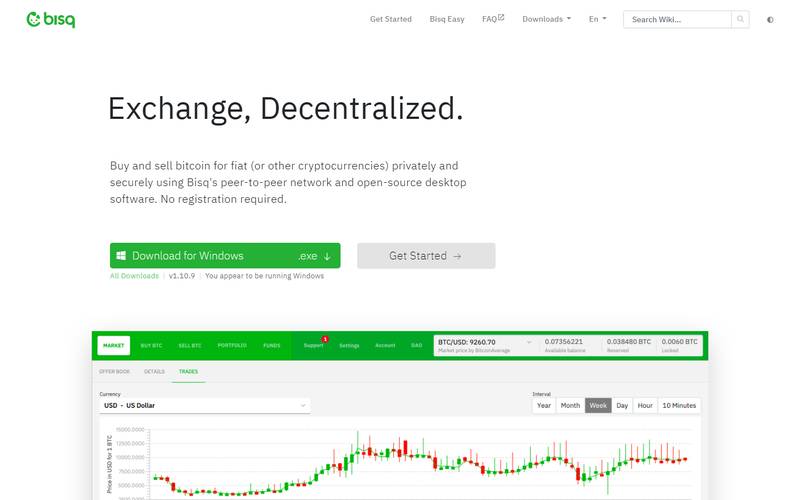
Bisq's site says you can buy and sell bitcoin for fiat or other cryptocurrencies using its peer-to-peer network and open-source desktop software, with "No registration required".
Things to know: you trade with another person, so you share payment details with your counterparty when paying by bank transfer. Read Bisq's own documentation on fees and security deposits before your first trade.
Suited to: buying or selling bitcoin directly with other people using a desktop app.
4. RoboSats: Lightning P2P Exchange
Official site: learn.robosats.org
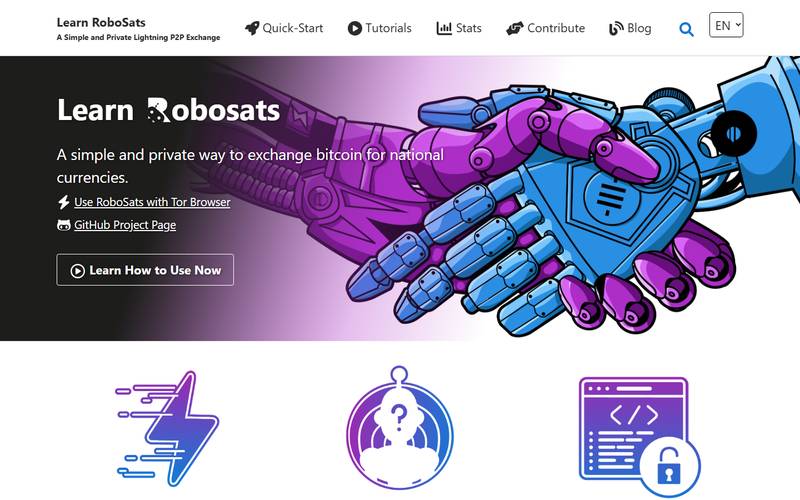
RoboSats calls itself a simple and private Lightning P2P exchange for swapping bitcoin and national currencies. Its site says it is KYC-free, that each user gets a random single-use robot avatar, and that the exchange is Tor-only. Lightning hold invoices serve as bonds and escrow.
Things to know: you need a Lightning wallet and Tor Browser, and fiat payments still pass between you and your counterparty.
Suited to: Lightning users buying or selling bitcoin with fiat.
5. Godex: Account-Free Instant Swaps
Official links: godex.io | FAQ
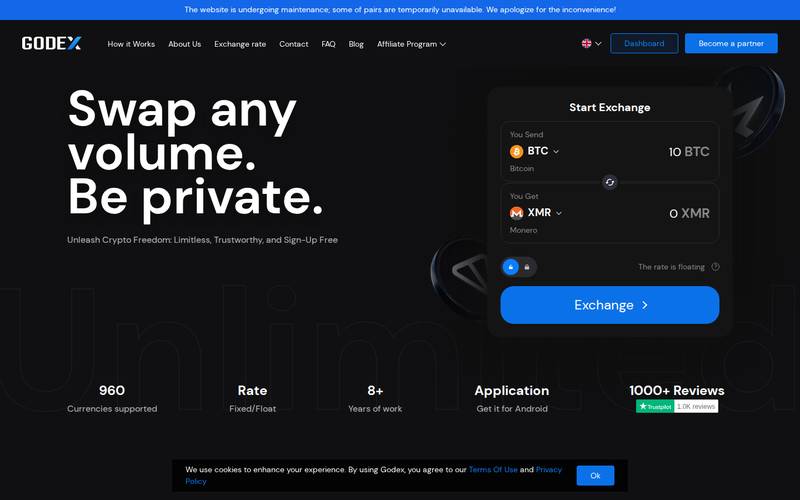
Godex's FAQ says it does not require personal data, accounts or registration, and that there are no upper limits on exchange amounts, only network minimums. The FAQ also says Godex keeps some data, such as an email if provided, transaction hash and addresses, for support and refunds.
Things to know: your coins are held by the service while the swap completes, so you rely on Godex to deliver the other side. On November 9, 2026 its site showed a maintenance notice saying some pairs were temporarily unavailable.
Suited to: one-off crypto-to-crypto swaps without an account.
6. GhostSwap: Account-Free Instant Swaps
Official site: ghostswap.io
GhostSwap's homepage advertises swaps with no KYC, no account and no email, and says it supports 1,600+ coins (self-reported, retrieved November 9, 2026).
Things to know: you send your coins to the service and rely on it to send the swapped coin back. Read its terms and privacy policy before you send funds.
Suited to: one-off swaps across a wide coin list.
What No-KYC Does Not Mean
Your transactions are still public. Bitcoin and Ethereum transactions are recorded on public blockchains, and anyone can follow fund flows between addresses.
Services can still screen funds. A service that skips ID checks can still block or hold deposits under its own terms. Read the terms before you send funds.
Your tax duties do not change. Whether or not a platform collects your ID, you are responsible for reporting gains under your local tax rules. Keep your own records of every trade.
Safety Checklist
- Check that using the platform is legal where you live.
- Open the platform only from its official website, and bookmark it.
- Test with a small amount first.
- Prefer self-custody options for anything you plan to hold.
- Do not leave balances on any service longer than needed.
- Keep records of every trade for tax purposes.
FAQ
Is it legal to use a no-KYC platform?
It depends on your country. Some jurisdictions require every crypto service to verify customers, and some platforms block users from certain regions in their terms. Check your local law before you use one.
Can tax authorities see no-KYC trades?
On-chain transactions are public, and wallet addresses can be linked to you through other services you use. Report your gains as your local rules require.
Can I buy crypto with fiat without KYC?
Peer-to-peer platforms such as Bisq and RoboSats let you trade fiat for bitcoin directly with another person. Card purchases through on-ramp providers have their own identity checks.
What is the difference between a DEX and an instant swap?
On a DEX such as Uniswap, you swap from your own wallet through smart contracts. An instant swap service such as Godex or GhostSwap receives your coins and sends you a different coin, so you rely on that service to complete the swap.
Sources (retrieved November 9, 2026): Uniswap Labs fees, edgex.exchange, bisq.network, learn.robosats.org, godex.io, Godex FAQ, ghostswap.io.
Editorial credits
Checked by NFTenex QC Team before publishing on November 9, 2026 for headline accuracy, original value, factual consistency, commercial disclosure, authorship claims and risk disclosure: our AI review system checks every article before it goes live, and our duty editor monitors it after publication. Report an error.
NFTenex uses AI for research, drafting and review. Our editorial team is responsible for every article and corrects or withdraws articles when needed. How we review.