
Who This Guide Is For
This guide is for readers who have seen the name Orca next to Solana and want to know what it does before connecting a wallet. You do not need to know what a "concentrated liquidity pool" or a "tick" is. We explain each term when it first appears.
We cover the whole product: the marketing website, the Orca app (Pools, Trade, Vaults, Portfolio, Stake and Wavebreak), the documentation, the audit list, the ORCA token and xORCA staking, and two big events: the shutdown of Orca on Eclipse and the merger with Loopscale into a company called Formation. For every part we say what we opened ourselves and what we only read in the docs.
How We Tested Orca
We opened every page below on three screen sizes. The app was used with a connected wallet.
| Device | Screen size used | What we opened |
|---|---|---|
| Desktop | 1440 x 900 | Website, app (all tabs), docs, Formation site |
| Tablet | 1024 x 1366 in the app, about 820 px wide on the marketing site | Website, Pools, pool page, Vaults, Portfolio, Stake, Trade |
| Phone | 430 x 932 in the app, about 390 px wide on the marketing site | Website, Pools, pool page, Vaults, Portfolio, Stake, Trade |
The Wallet We Used
Orca runs on Solana, so we needed a Solana wallet. We used a throwaway MetaMask account that holds no funds. MetaMask now offers a Solana account, and Orca listed MetaMask in its "Please connect a Solana wallet" box. The account was created only for testing, and part of its address ("HaBh…Rccb") is visible in some screenshots.
We pressed the Connect button and approved the connection request in the wallet. The Orca connect box says that connecting means you agree to the Terms of Use, so connecting counts as accepting them. After that we browsed every tab and opened pool and vault pages. We did not deposit, did not swap, did not stake, did not create a position and did not sign any transaction.
What this means for you: everything we say about trading, adding liquidity, harvesting fees, staking and withdrawing comes from the docs and from what the interface displayed. We did not run any real transaction, so we cannot tell you how fast, smooth or costly those steps are in practice.
Quick Verdict
Orca is a mature, well-audited and easy-to-use trading and liquidity app on Solana, and it is one of the biggest DEXs on the chain by volume. It has no recorded exploit on DefiLlama and a long audit list that keeps growing. The weak points are a fall of about 82% in locked value from the 2021 peak, a token that is down about 94% from its high, very thin pools with eye-catching yields in the tokenized-stock section, and the uncertainty that comes with a merger. Orca also shut down its Eclipse service in March 2026. Our editorial score is 4.0 out of 5.
| Item | Detail |
|---|---|
| Category | Decentralized exchange (DEX) and liquidity layer on Solana |
| Main chain | Solana (Eclipse service closed in March 2026) |
| Website | orca.so |
| App | orca.so/pools, /trade, /vaults, /portfolio, /stake, /tokens |
| Docs | docs.orca.so |
| Native token | ORCA, with a staked version called xORCA |
| Bug bounty | Immunefi (amount not verified by us) |
| Hack record | None in the DefiLlama hacks database (checked November 16, 2026) |
| Parent company | Formation, after a merger with Loopscale (see below) |
| Our editorial score | 4.0 / 5 |
What Is Orca (Plain English)
Imagine a currency exchange booth with no staff. Anyone can swap one coin for another at the booth, and the booth is stocked by ordinary people who put their coins in and earn a small fee on every swap. Orca is that booth for Solana.
In plain terms: if you want to swap SOL for another token, you use Orca's Trade page. If you want to earn fees, you can become a "liquidity provider" (LP): you put two tokens into a pool, and every swap that uses your tokens pays you a small cut. The risk is that if the price of one token moves a lot, you may end up with less value than if you had simply held the tokens. The docs call this "impermanent loss" or "divergence loss".
Orca's special feature is the "Whirlpool", a concentrated liquidity pool. Instead of spreading your money over every possible price, you choose a price range, for example "SOL between 68 and 72 USDC". Inside that range your money works harder and earns more fees. Outside the range it earns nothing until the price comes back. The docs say each position is a token (an NFT) in your wallet.
Orca launched in 2021. The docs say it started as two builders in Tokyo with no venture funding and launched Whirlpools in 2022. The company later merged with Loopscale to form Formation (see the section on Formation).
The Four Roles
| Role | What they do | Everyday comparison |
|---|---|---|
| Trader | Swaps tokens and pays a fee | The customer at the booth |
| Liquidity provider | Supplies tokens to a pool and earns fees | The person who stocks the booth |
| Token creator | Launches a token and a pool for it | The business opening a new booth |
| Vault manager | Runs an automated strategy for depositors | The fund manager |
Key Facts
| Fact | Value | Source and date |
|---|---|---|
| TVL (Orca DEX) | $252.85M | DefiLlama, Nov 16, 2026 |
| TVL 7 days change | down 8.67% | DefiLlama, Nov 16, 2026 |
| TVL 30 days ago | $298.35M | DefiLlama, our calculation of about 15% fall |
| TVL 90 days ago | $241.29M | DefiLlama, our calculation of about 5% rise |
| Peak TVL | $1.41B on Nov 9, 2021 | DefiLlama, our calculation of about 82% below peak |
| Volume, last 24 hours | $175.06M | DefiLlama, Nov 16, 2026 |
| Volume, last 30 days | $6.46B | DefiLlama, about $215M a day (our calculation) |
| Volume, all time | $510.4B | DefiLlama, Nov 16, 2026 |
| Fees, last 30 days | $5.82M | DefiLlama, Nov 16, 2026 |
| Fees, all time | $245.8M | DefiLlama, Nov 16, 2026 |
| Chains | Solana $252.85M, Eclipse $8,255 | DefiLlama, Nov 16, 2026 |
| App figures | TVL $237.4M, 24h volume $167.8M, 24h fees $113K | orca.so/pools, Nov 16, 2026 |
| Funding listed | None on DefiLlama | The docs say Orca started with no venture funding |
Why the numbers differ. The homepage claims "$500m+" in fees earned by liquidity providers, "500B+" in trading volume and "$250M+" daily volume. DefiLlama shows $245.8M in all-time fees, $510.4B in all-time volume and about $175M volume in the last 24 hours (about $215M a day over 30 days). The Formation site says more than $550 billion in volume. The volume claims are in the same range, but the fee claim is about twice what DefiLlama shows, and we could not reconcile the two. It may be a difference in what counts as a "fee" (for example, a measure that includes other products), but we do not know. We use DefiLlama numbers in this guide and mark the website numbers as claims.
A note on the fall from the peak. TVL was about $1.4 billion in November 2021 and is about $253 million now. That is a long fall, but part of it reflects the market cycle, and in the last 90 days TVL has actually risen by about 5% (our calculation). DefiLlama shows the numbers but not the reasons.
Related entries. DefiLlama also lists "Orca Wavebreak" (launchpad, no TVL data), an old "OrcaDAO" lending entry with about $8,661 on Avalanche that is unrelated to the Solana product, and a "Kujira Orca" liquidation entry that is a different project with a similar name. Do not mix them up.
How Orca Looks on Your Device
Desktop
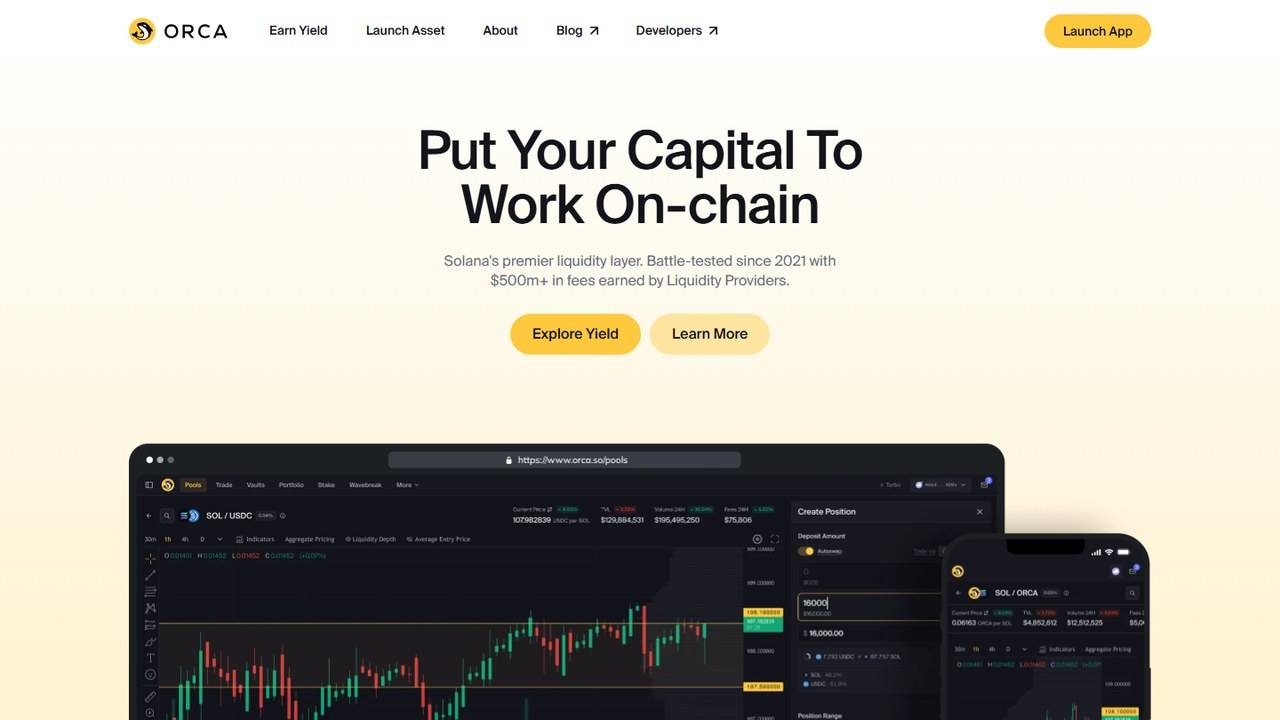
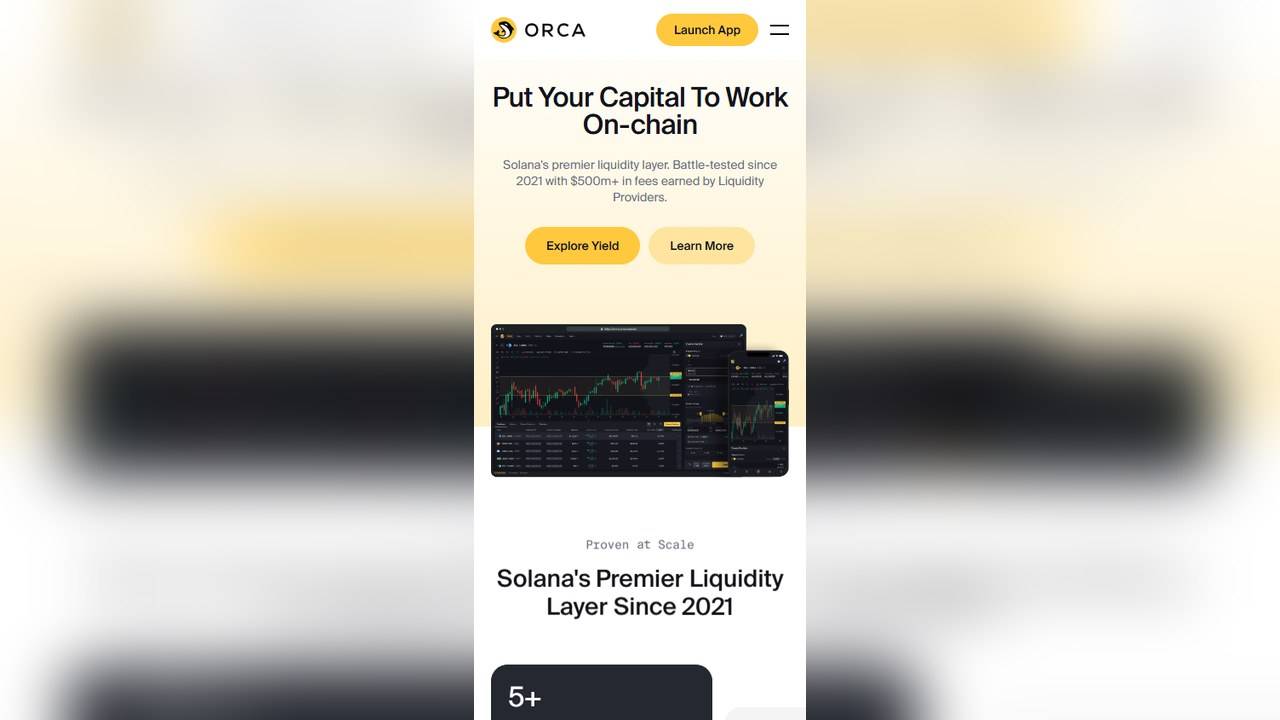
The marketing homepage is light yellow with a black headline, "Put Your Capital To Work On-chain", a mock-up of the trading screen and a stats section: 5+ years with zero exploits, $500m+ fees earned, 500B+ trading volume, $250M+ daily volume and $236M+ TVL. The top menu has Earn Yield, Launch Asset, About, Blog and Developers, plus a yellow Launch App button.
The app itself is dark. The top bar has Pools, Trade, Vaults (with a "New" label), Portfolio, Stake, Wavebreak and More, plus the wallet button.
Tablet
At about 820 px wide the homepage keeps the same content in one column. Below the heading "Proven at Scale" there was a large blank area in our screenshot. It may be an animation that starts when you scroll, and we did not check further.
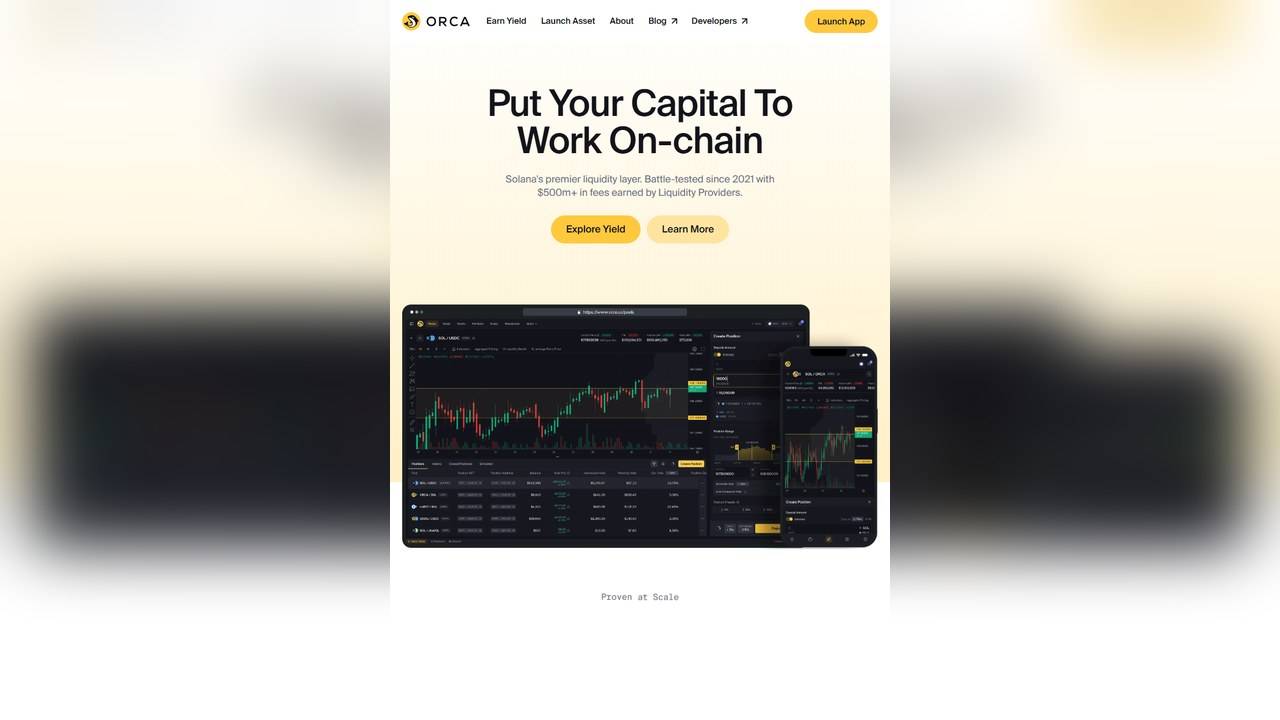
In the app at 1024 x 1366 the Pools page keeps the full table and the menu. The pool page shows the chart on the left and the Create Position panel on the right, as on desktop.
Phone
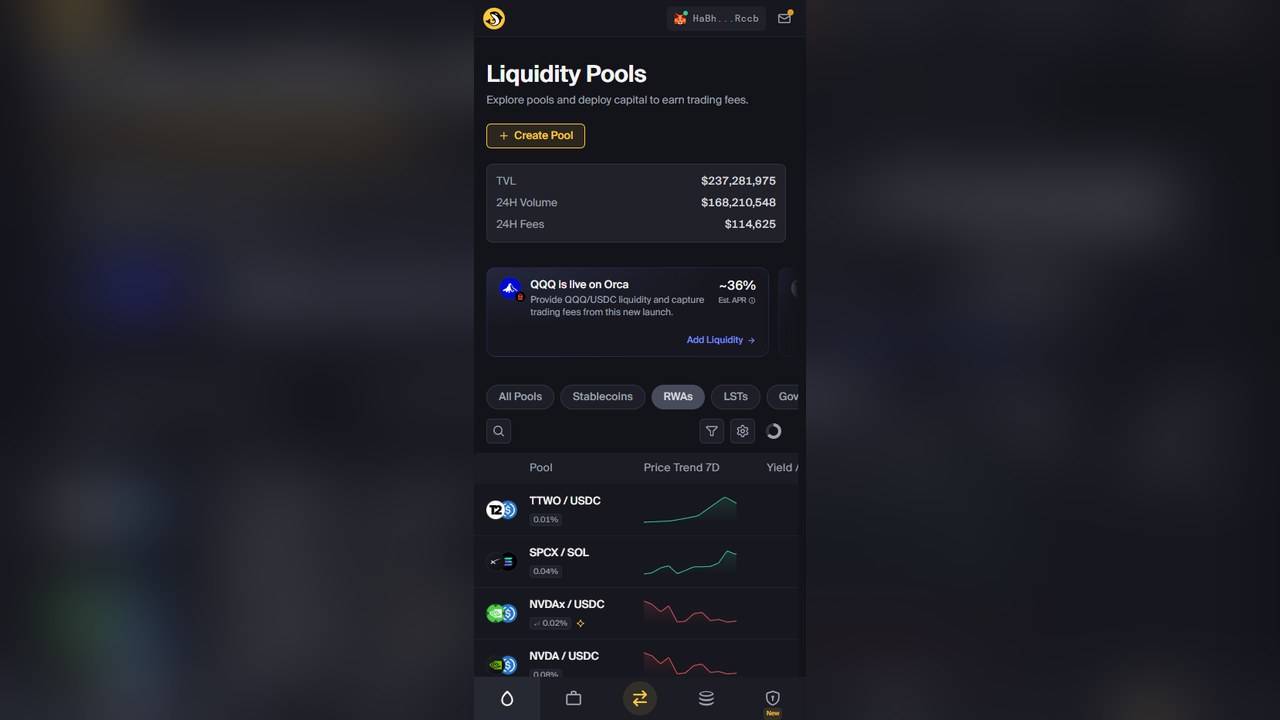
On a phone the app drops the top menu and uses a bottom bar with five icons: Pools, Portfolio, Trade, Stake and Vaults (marked New). We did not find Wavebreak or the More menu in the bottom bar. The pool page shows the chart first and puts a yellow "Create Position" button at the bottom, which opens the panel. We did not see a "Page not found" error on any page we opened.
Connecting Your Wallet
- Open orca.so/pools. You can see all pools without a wallet.
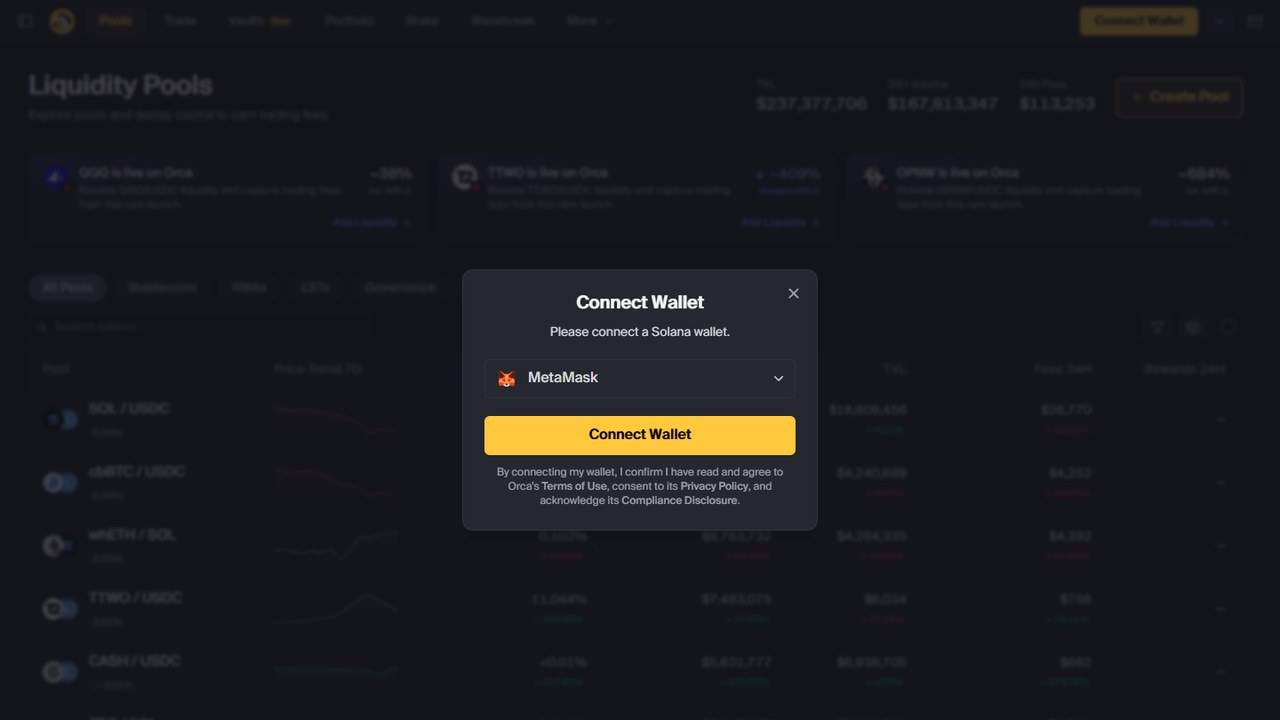
- Click the yellow Connect Wallet button. A box says "Please connect a Solana wallet".
- Choose your wallet. We chose MetaMask.
- Your wallet opens a request that lists your account and its permissions. Approve only the connection.
- The app shows a shortened Solana address and, in the pools table, a balance column for each token.
Beginner safety tip: connecting is not the risky step. The risky steps are "approve" and "sign". Orca is a Solana app, so use a Solana wallet and check that you are on the real orca.so address. Use a separate wallet with a small amount for your first swap, and read every prompt before confirming. Orca's docs say the terms and any wallet screening apply to your use of the app.
Core Features at a Glance
| Feature | What it does | Tested by us |
|---|---|---|
| Trade | Swap tokens with a quote and a slippage setting | Opened page, typed nothing, did not swap |
| Pools | Browse liquidity pools and filter by type | Yes |
| Pool page and Create Position | Chart, liquidity depth, price range, deposit panel | Opened, did not deposit |
| Position Simulator | Shows profit and loss at different prices | Opened, no position to simulate |
| Vaults | Automated strategies run by Orca, Loopscale and Kamino | Opened list and one vault page, did not deposit |
| Portfolio | Positions, history, pending yield, harvest | Yes (empty wallet) |
| Stake | Stake ORCA for xORCA | Opened, did not stake |
| Wavebreak | Token launchpad | Opened |
| Create tools | Token creation, pool creation, liquidity locks, rewards | Docs only |
| Regulated assets | Tokenized stocks and funds with eligibility rules | Pools opened, docs read |
| Developer tools | SDKs, REST API, MCP server | Docs only |
Feature 1: Trade
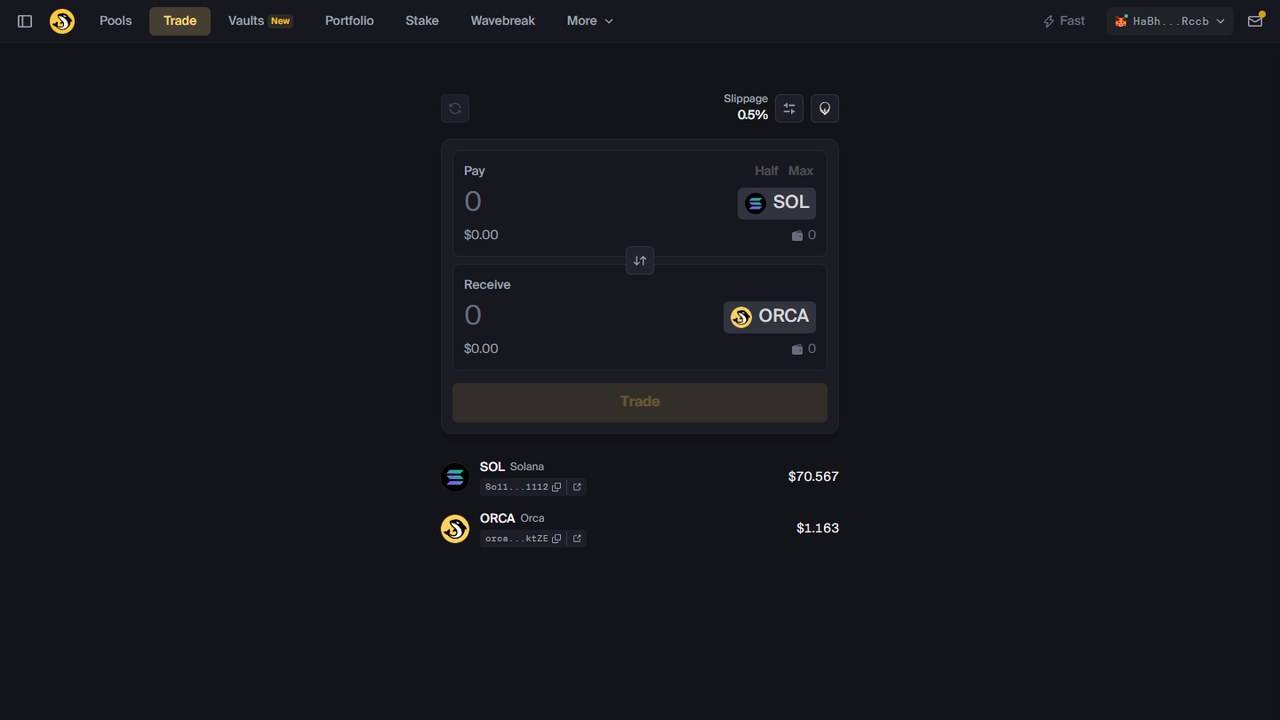
The Trade page is a plain swap box. You choose what you pay with and what you receive, see a dollar value for each side, and press Trade. The default tokens were SOL and ORCA. A slippage setting sits at the top right and showed 0.5%. Below the box the page lists the two tokens with their prices (SOL $70.57 and ORCA $1.163 at the time of capture).
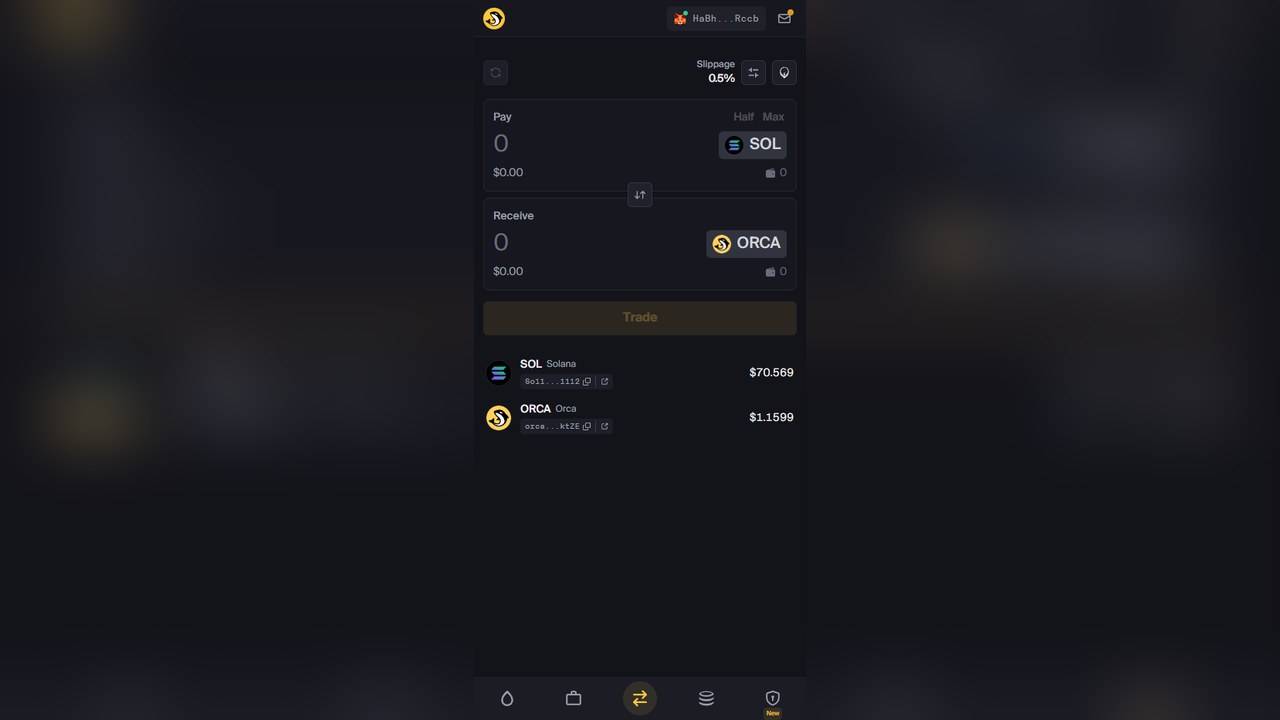
On a phone the same box fills the screen and there is nothing missing compared with desktop.
What is slippage? It is the largest price change you accept between pressing the button and the swap finishing. If the price moves more than the setting, the swap fails instead of giving you a worse deal. The docs have a page on it. We did not run a swap, so we do not know how good the quotes are compared with other apps.
The docs also describe "range orders", a way to use a one-sided liquidity position as a limit-order-style trade. The docs stress that they are not the same as a traditional limit order: you set a price range rather than one price, the conversion is gradual, and you must withdraw the position to finish. We did not test this.
Feature 2: Liquidity Pools
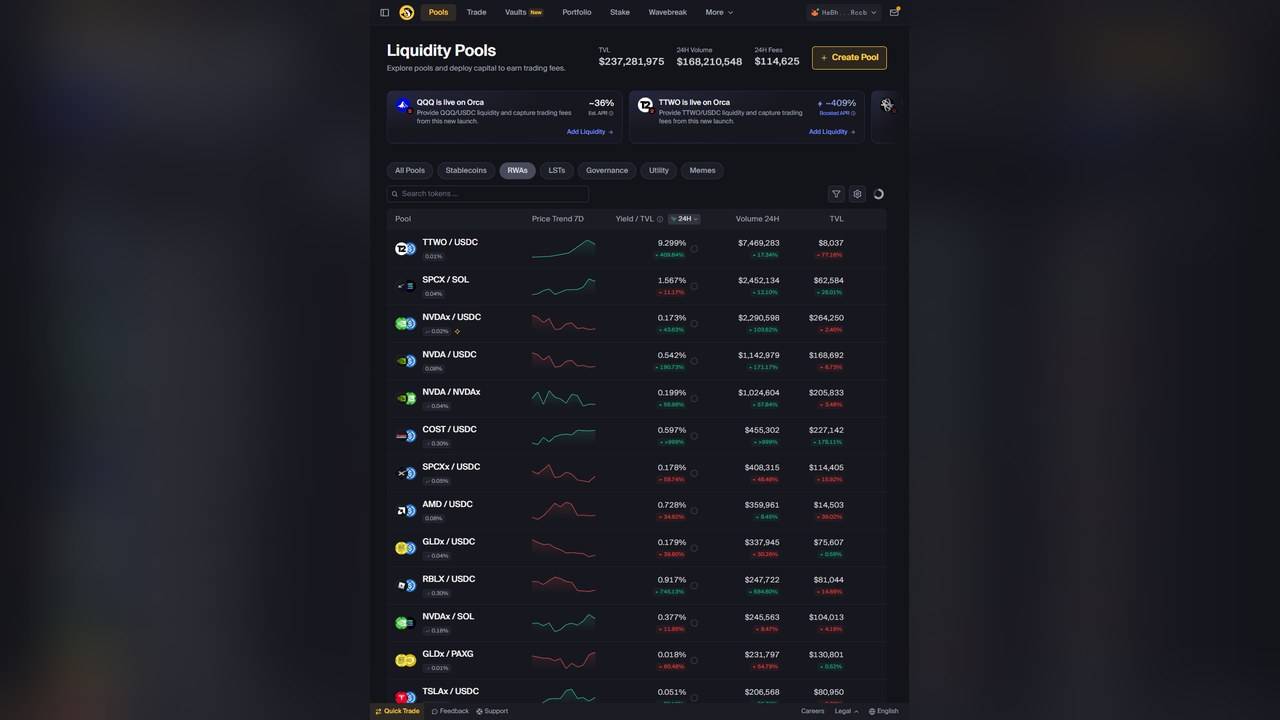
The Pools page is the home of the app. At the top it shows TVL, 24 hour volume and 24 hour fees, then three highlight cards for new launches (QQQ, TTWO and OPNW on the day we looked), then a table with filter tabs: All Pools, Stablecoins, RWAs, LSTs, Governance, Utility and Memes.
The table shows, for each pool, a seven day price trend, "Yield / TVL" (the fees earned in 24 hours as a share of the pool's value), 24 hour volume, TVL, 24 hour fees and rewards. These were the largest pools on November 16, 2026:
| Pool | Fee tier | Volume 24h | TVL | Fees 24h |
|---|---|---|---|---|
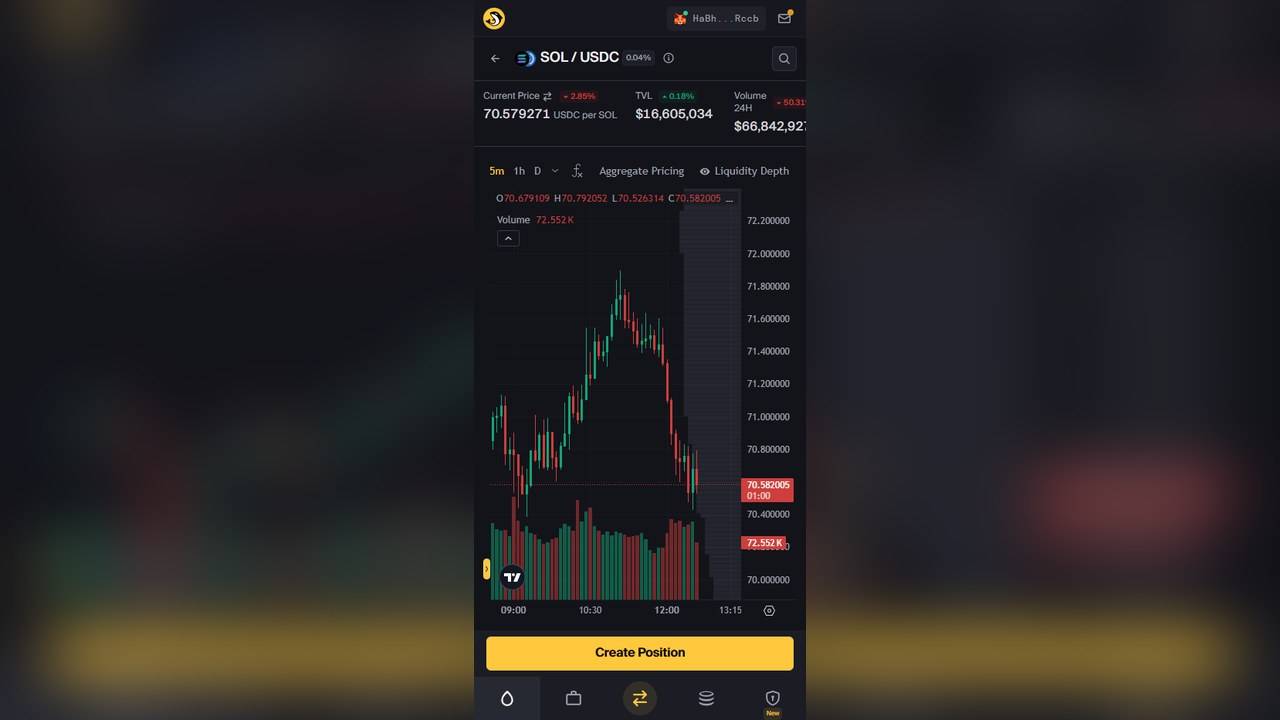
| SOL / USDC | 0.04% | $66.9M | $16.6M | $26,770 |
| cbBTC / USDC | 0.04% | $10.6M | $4.24M | $4,252 |
| whETH / SOL | 0.05% | $8.76M | $4.28M | $4,382 |
| TTWO / USDC | 0.01% | $7.48M | $8,034 | $756 |
| CASH / USDC | 0.01% | $5.63M | $6.94M | $662 |
| ZEC / SOL | 0.16% | $5.35M | $3.52M | $8,554 |
How to read this. The SOL / USDC pool alone does about $66.9M of volume on $16.6M of liquidity, so each dollar in the pool is used about four times a day (our calculation). That is the strength of concentrated liquidity. The TTWO / USDC pool is the opposite: $7.48M of volume on only $8,034 of liquidity. This is a tiny pool where a few traders can move the price, and the highlighted "~409% Boosted APR" on its card is based on that tiny base. High yield on a small pool is a warning sign as much as an opportunity, and we cover this again in the Regulated Assets feature.
The docs list the fee tiers a pool can use, from 0.01% for pegged stable pairs up to 2% for exotic pairs, and a "Splash Pool" type that spreads liquidity over every price (simple and passive, but less efficient). Orca also has "Adaptive Fees", where the fee rises automatically when the market is volatile. For each trade, the docs say 87% of the fee goes to the liquidity providers, 12% to the Orca DAO treasury and 1% to a Climate Fund.
Feature 3: The Pool Page and Create Position
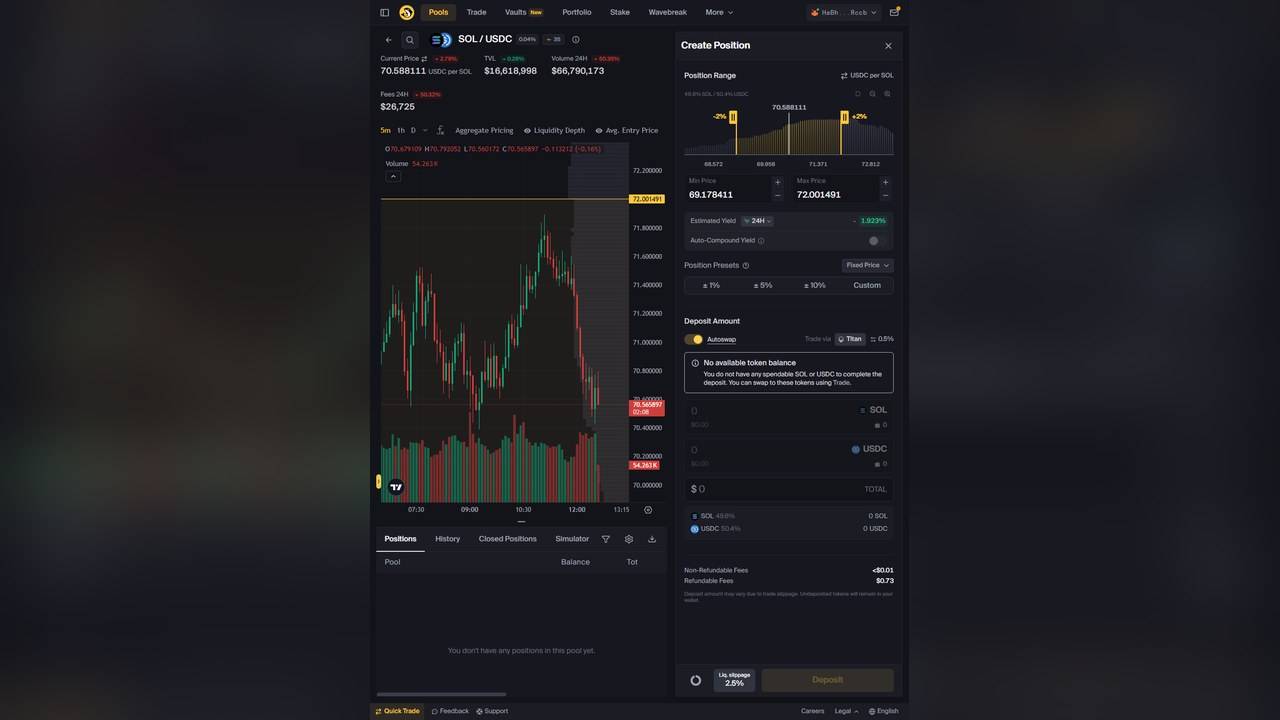
Clicking a pool opens a full trading-style page: price chart with indicators, "Liquidity Depth" and "Aggregate Pricing" buttons, a Positions table below, and on the right a "Create Position" panel.
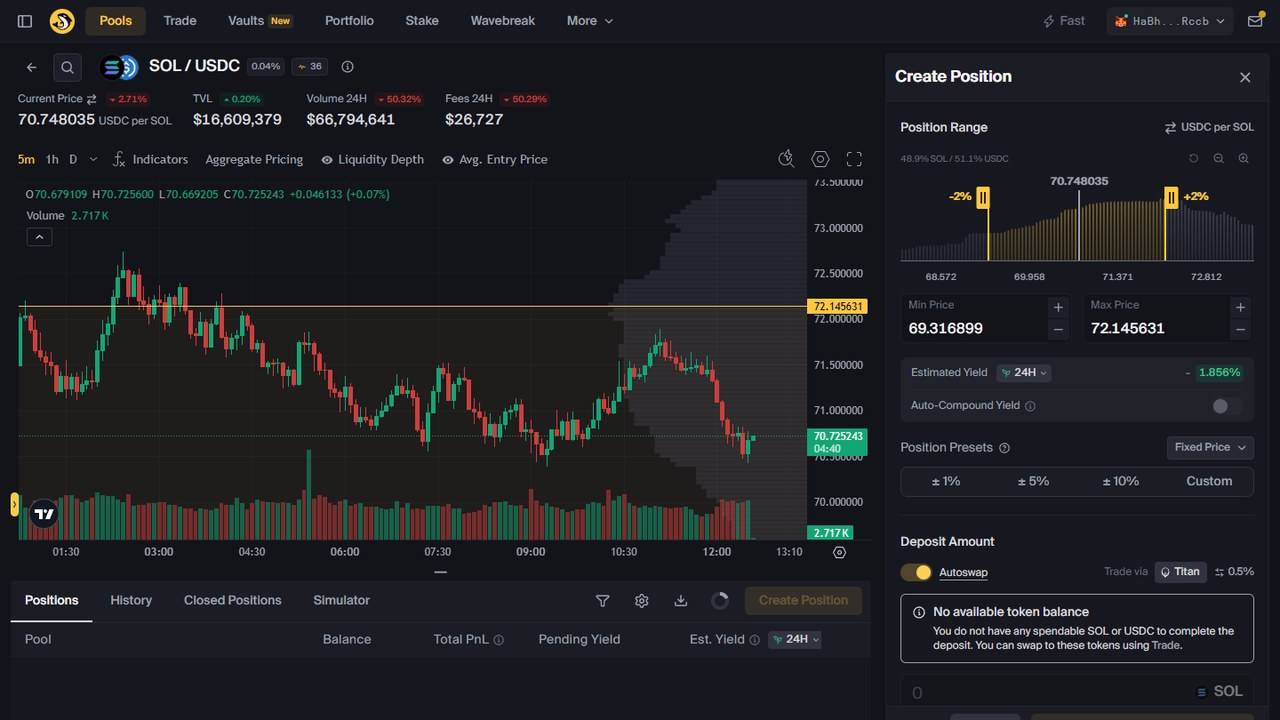
The panel is where you choose your range. For the SOL / USDC pool it showed the current price (about 70.75 USDC per SOL), a draggable range with minus 2% and plus 2% handles, Min Price and Max Price boxes, an estimated 24 hour yield of about 1.86%, an Auto-Compound toggle, presets of 1%, 5%, 10% and Custom, and a deposit section with "Autoswap" switched on (the trade is routed through Titan, with 0.5% slippage). The panel also showed a liquidity slippage of 2.5%.
At the bottom it separated two kinds of cost: "Non-Refundable Fees" of less than $0.01 and "Refundable Fees" of $0.73. The docs list a refundable position rent of about 0.0088 SOL that is returned when you close the position. The $0.73 shown is a little higher than that at the SOL price we saw (our calculation), so it may include other accounts, and we did not check. Because our wallet was empty, the panel said "No available token balance", and the Deposit button stayed grey.
Why this matters to a beginner. A narrow range, such as plus or minus 2%, earns more fees while the price stays inside it, but it goes out of range quickly. Once out of range, the position earns nothing and is fully converted into the weaker token. A wider range earns less but needs fewer adjustments. We did not open a position, so we cannot say how easy it is to adjust a range.
Feature 4: Position Simulator
Next to the Positions table is a "Simulator" tab. It draws a profit and loss curve for a range you choose, with "At Simulated Price", "Initial Deposit Value", "Net PnL" and "Total Position Value" boxes, plus a "Time In-Range" slider and comparison lines for "LP Opportunity Cost" and "LP vs. HODL".
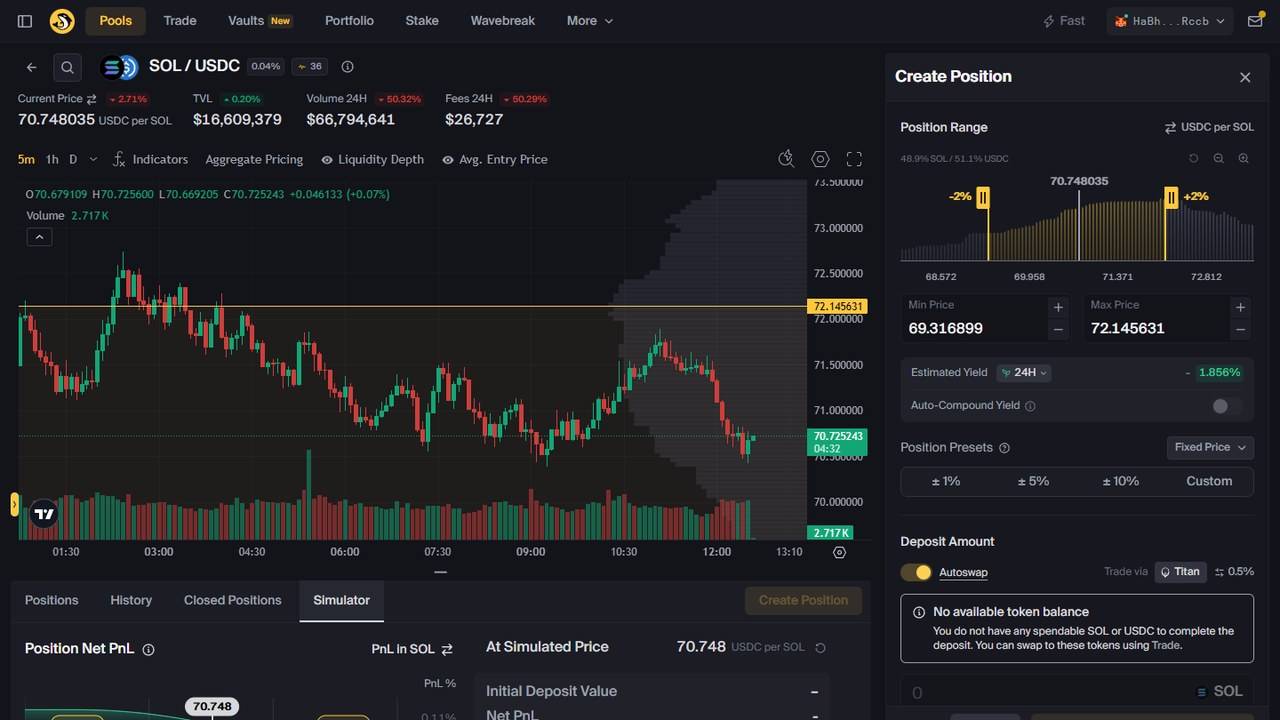
With no deposit amount the numbers stay blank, but the curve already makes the risk clear: the position value falls as price leaves the range. This is one of the most beginner-friendly parts of the product, because it lets you see the trade-off before spending anything. We could not check how accurate its numbers are.
Feature 5: Vaults
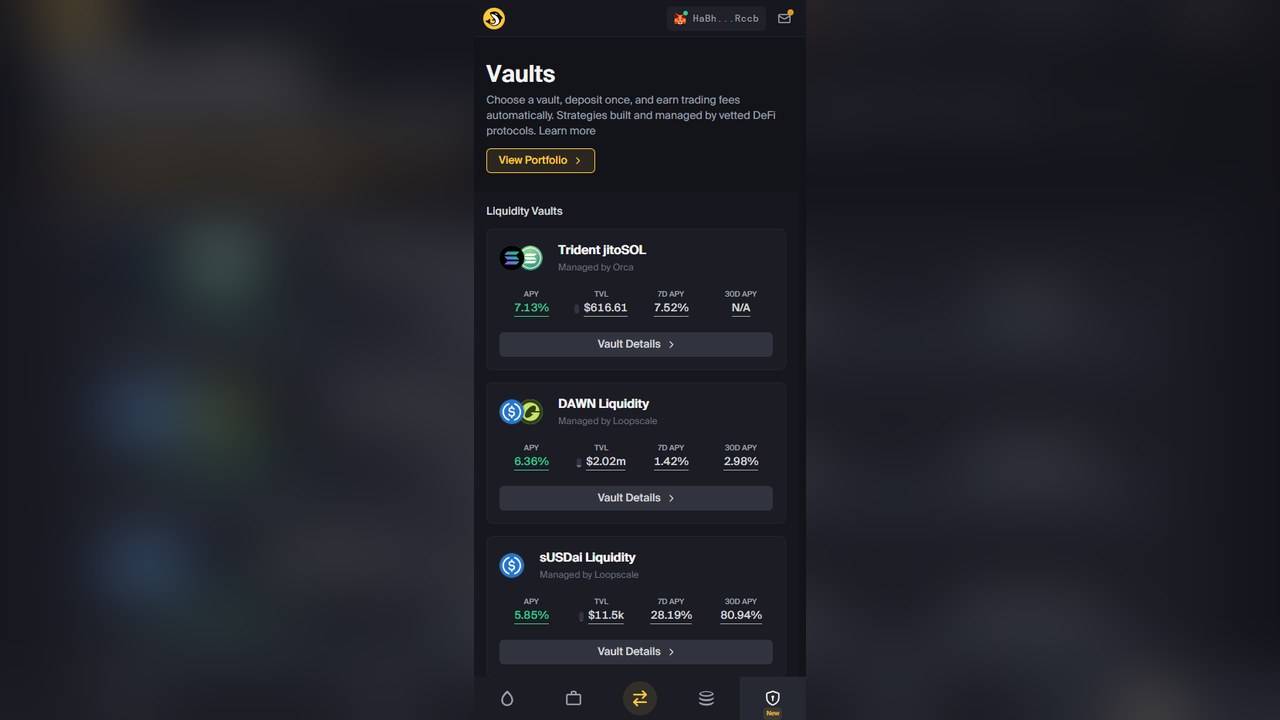
Vaults are new. The page says you can "deposit once and earn trading fees automatically", with strategies "built and managed by vetted DeFi protocols". The docs say a vault runs a strategy that may allocate liquidity across ranges, rebalance and compound yield, and that outcomes are not guaranteed. The list on November 16, 2026 had vaults managed by three groups: Orca, Loopscale and Kamino.
| Vault | Managed by | APY | TVL | 7D APY | 30D APY |
|---|---|---|---|---|---|
| Trident jitoSOL | Orca | 7.12% | $616.91 | 7.54% | N/A |
| DAWN Liquidity | Loopscale | 6.36% | $2.02M | 1.42% | 2.95% |
| sUSDai Liquidity | Loopscale | 5.85% | $11.5K | 28.23% | 80.85% |
| OnRe Growth | Loopscale | 9.50% | $3.33M | 10.16% | 9.79% |
| Doma SOL Internet Vault | Loopscale | 4.56% | $354K | 8.61% | 9.45% |
| SOL Main | Loopscale | -7.55% | $177K | -7.16% | -0.46% |
| JITOSOL-SOL | Kamino | 4.50% | $3.96M | not shown | not shown |
| syrupUSDC-USDC | Kamino | 0.57% | $6.99M | not shown | not shown |
| TRUMP-SOL | Kamino | 32.22% | $123K | not shown | not shown |
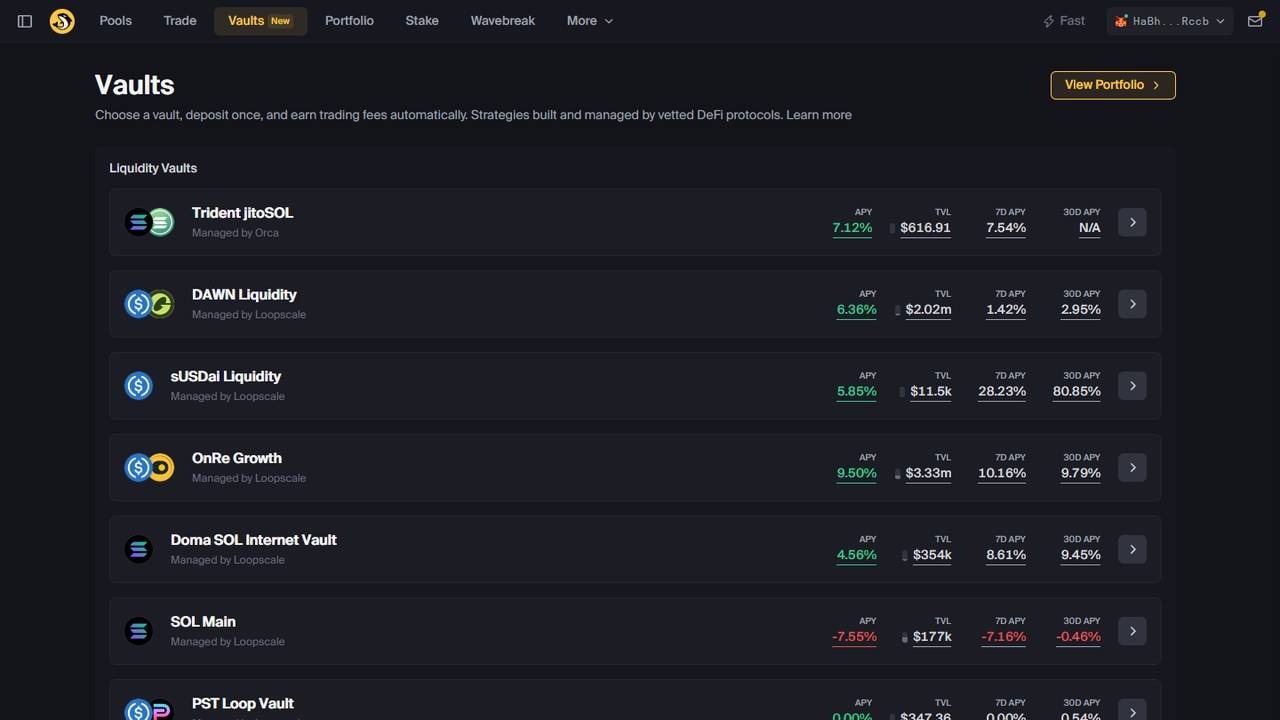
How to read this. Three things stand out. First, the SOL Main vault showed a negative APY of minus 7.55%, which means that at the time of capture the vault was losing value, not earning. Second, the Trident jitoSOL vault managed by Orca itself held only $616.91, so it is more of a pilot than a real product so far. Third, the biggest APY numbers (sUSDai at 80.85% over 30 days, TRUMP-SOL at 32.22%) sit on small balances, and the sUSDai vault holds just $11.5K. Our editorial view: treat the APY on a small vault as a snapshot, not a forecast.
Opening the OnRe Growth vault showed share price 1.06539 USDC, vault TVL 3.334M USDC, 96.79% deployed, a 1D, 1W and 1M chart, and a Deposit and Withdraw box. Before you can deposit, a box says that the vault "carries strategy-specific risk: smart-contract, market, oracle, and external-counterparty exposure" and you must tick "I understand the risks of depositing into this vault". We did not tick it.
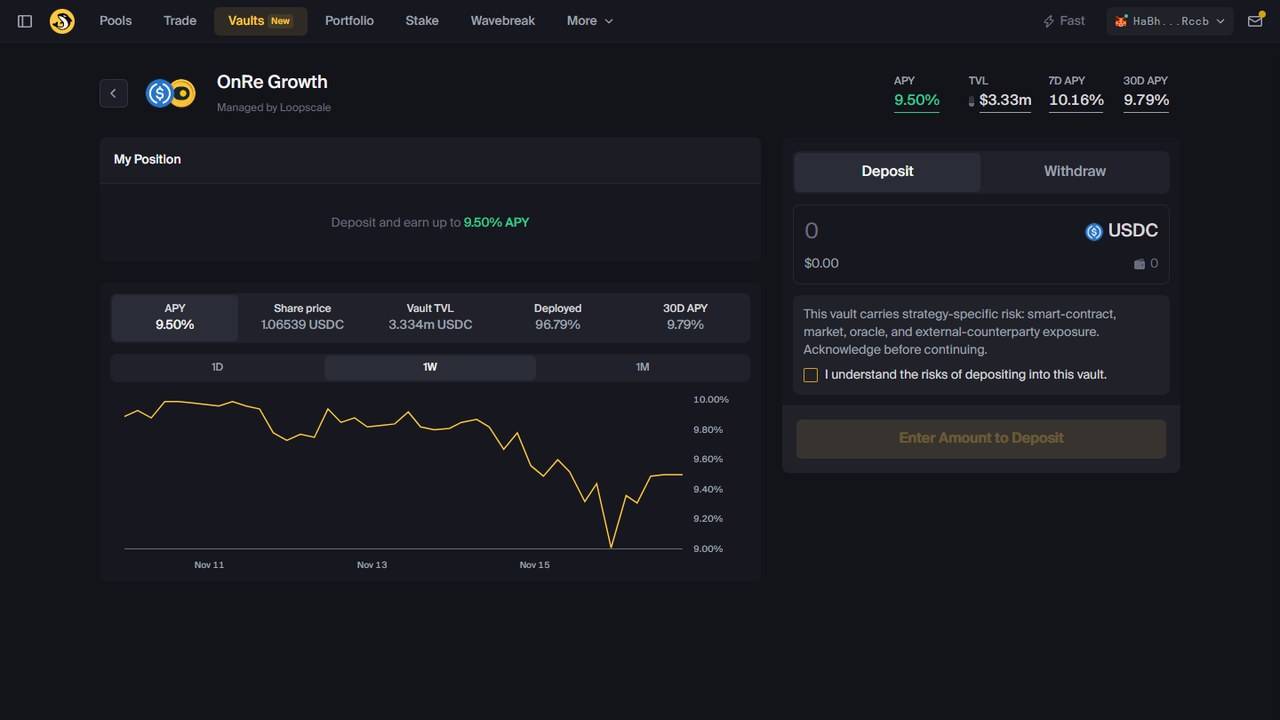
The Loopscale vaults are a result of the merger described below, and the Kamino vaults are a partner product, so part of your risk is with a team other than Orca. On a phone, each vault gets a card with a "Vault Details" button.
Feature 6: Portfolio
The Portfolio page shows total portfolio value, liquidity value, estimated 24 hour yield, pending yield and a "Harvest All" button, then tabs for Positions, History and Closed Positions and a second switch for Liquidity Positions versus Vault Positions. A table lists pool, balance, total profit and loss, pending yield, estimated yield, position range and current price. With our empty wallet it said "You do not have any open positions".
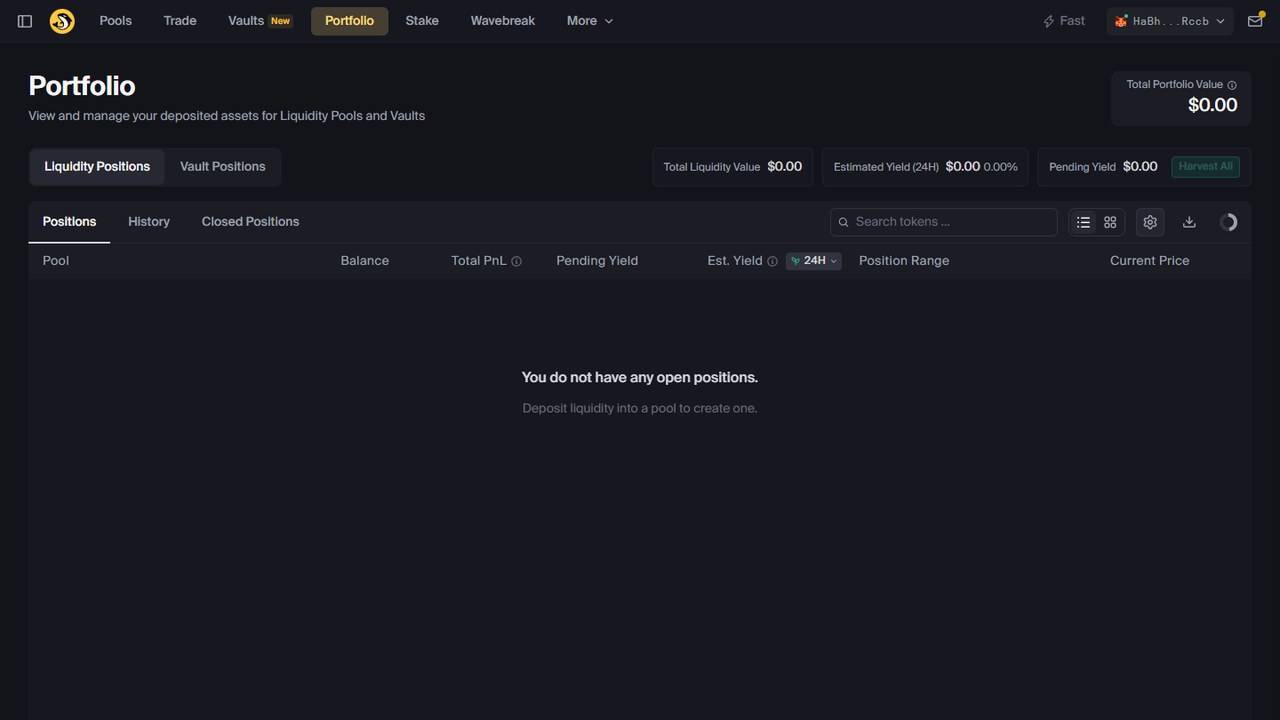
The docs add that you can set alerts, turn on auto-compound, and see position history. We did not test those, and we could not judge how clearly the page shows an out-of-range position once you have one.
Feature 7: Stake ORCA and xORCA
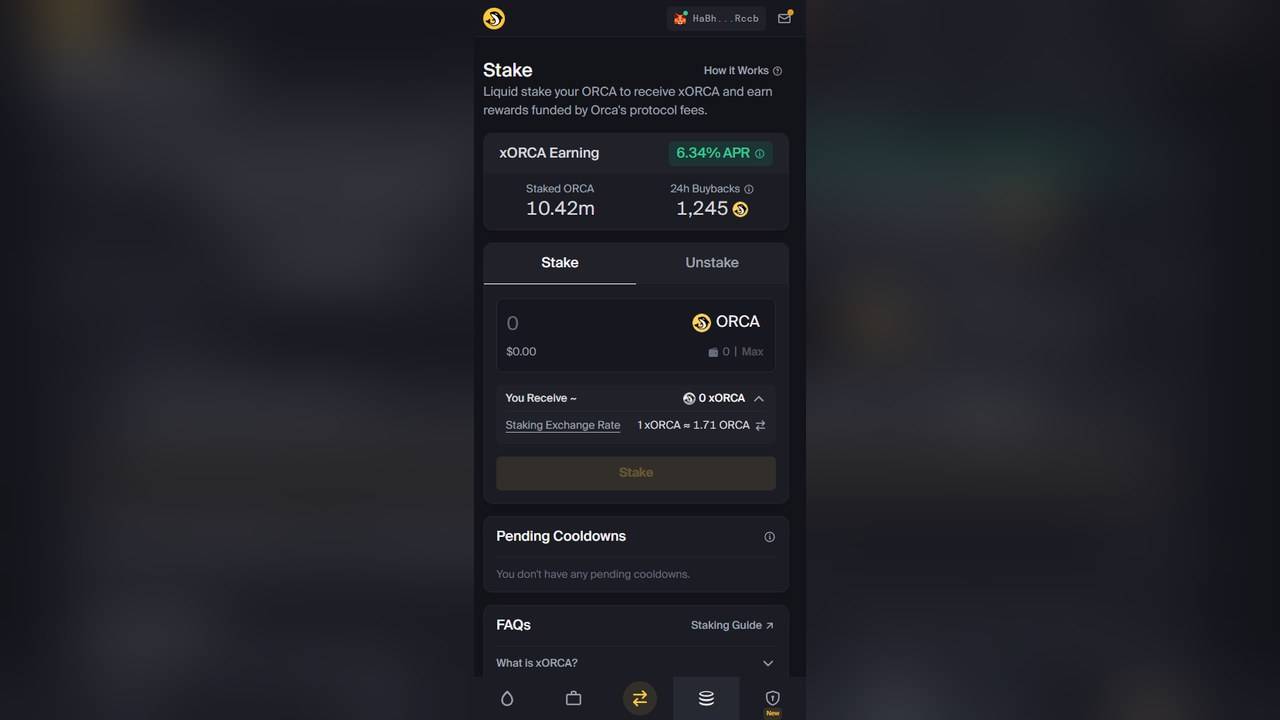
The Stake page lets you "liquid stake" ORCA to receive xORCA. The page showed an earning rate of 6.34% APR, 10.42m ORCA staked, 1,245 ORCA of buybacks in 24 hours and an exchange rate of 1 xORCA for about 1.71 ORCA, plus Stake and Unstake tabs and a section for pending cooldowns.
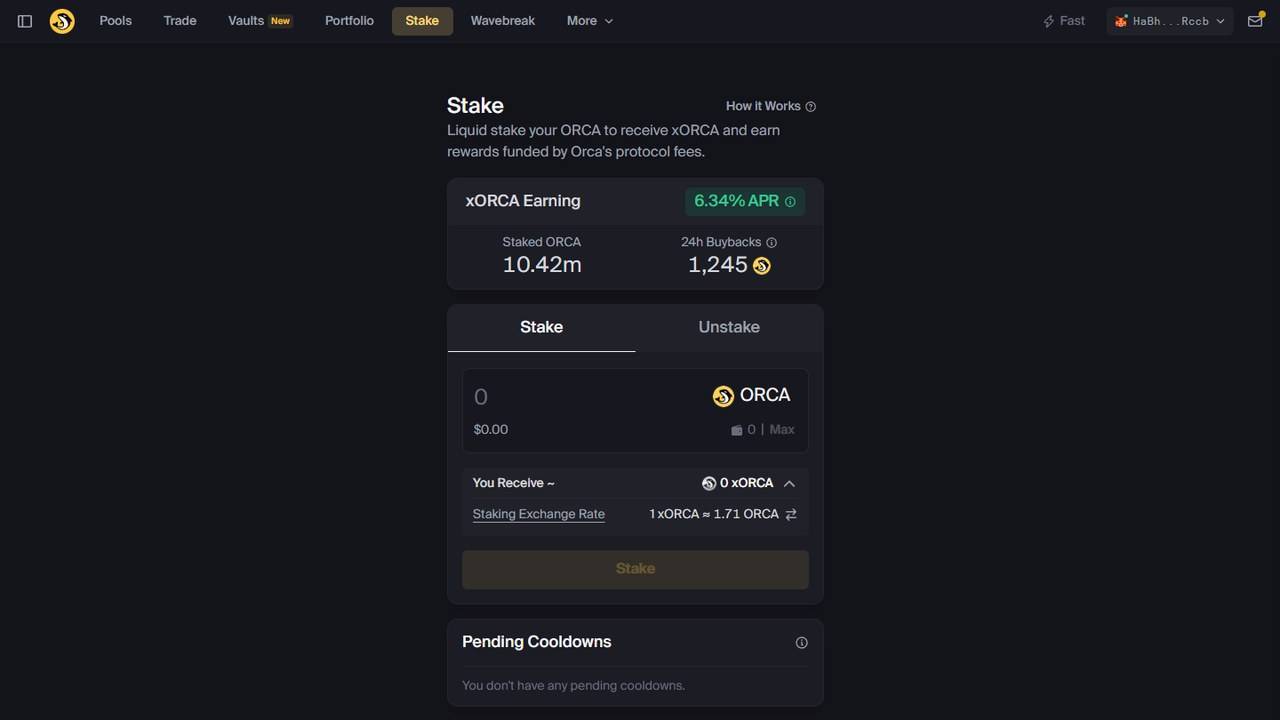
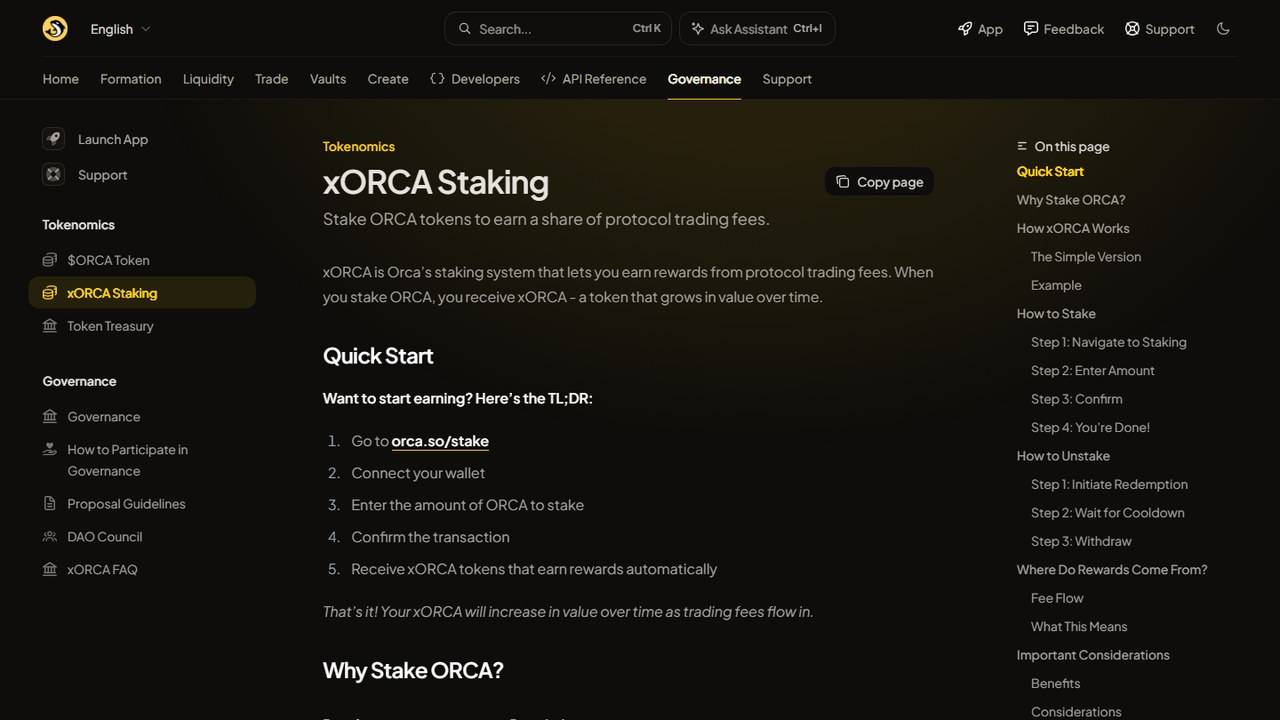
How it works, according to the docs: 12% of trading fees go to the protocol, and 40% of that buys ORCA on the market and adds it to the xORCA pool, so each xORCA becomes redeemable for more ORCA over time. The number of xORCA you hold stays the same, but its value in ORCA grows. Unstaking has a 7 day cooldown, and you receive a claim ticket (an NFT) and the rate is locked when you start.
A number that does not add up. The docs say 40% of the 12% protocol share buys ORCA, which is 4.8% of fees. Using DefiLlama's 24 hour fees of $114,442, that would be about $5,500 of buybacks a day, roughly 4,700 ORCA at $1.17 (our calculation). The app showed 1,245. The difference may come from timing or batching of buybacks, or from a different fee measure, and we cannot tell which. Treat the 6.34% APR as a number that moves with volume and price. It is shown in ORCA terms, so it says nothing about the dollar value of ORCA itself, which fell about 38% in 30 days.
On a phone the Stake page is clear and complete.
Feature 8: Wavebreak (Token Launchpad)
Wavebreak is Orca's launchpad. The page says that in addition to a permissionless launchpad, projects can apply for a "Premier Launch": white-glove support, a custom bonding curve and a funding target. On November 16, 2026 the page said "No active launches". Two past premier launches were listed: G*BOY (11 months ago, $120.00K raised) and DefiTuna (TUNA, one year ago, $1.37M raised).
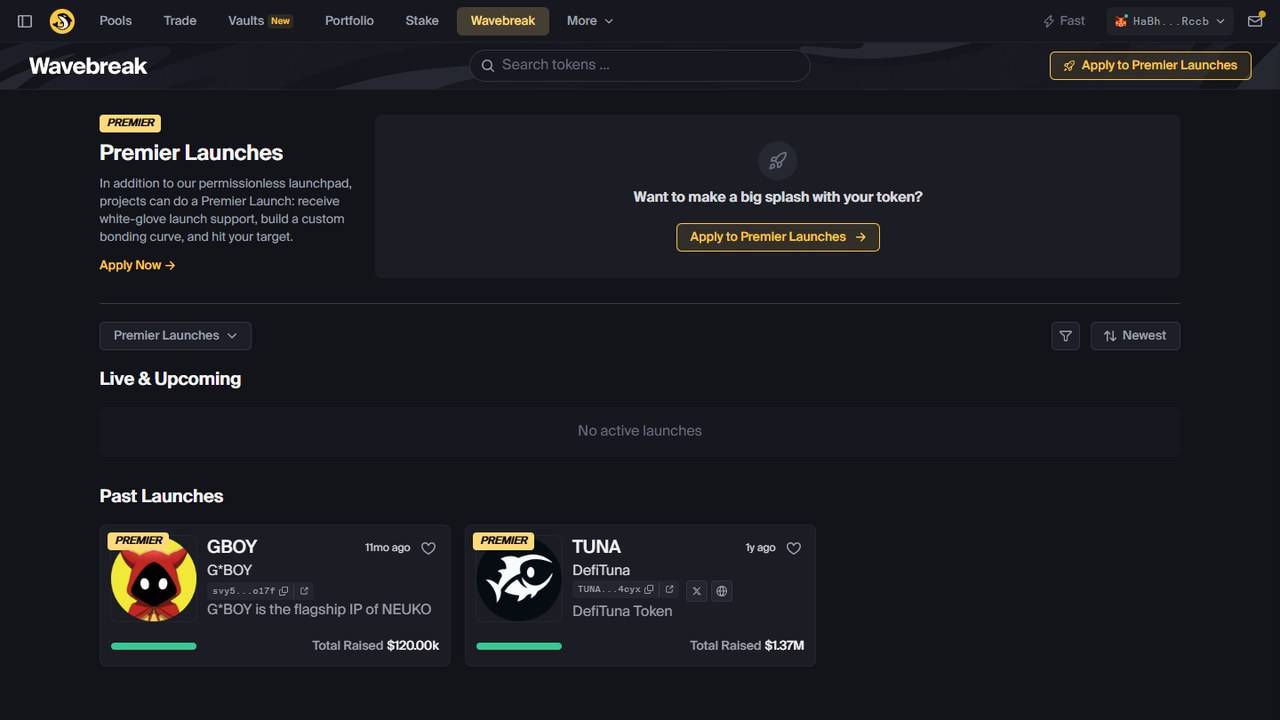
An empty launchpad is a fair sign of how quiet this part is right now, and past launch numbers do not say how those tokens performed later. Wavebreak has its own audit in the docs (Sec3, July 28, 2025). We did not apply for or join a launch.
Feature 9: Create Tools for Token Creators
The docs describe a set of tools for people launching an asset: a token creation tool, a Splash Pool (simple, full-range pool) or a concentrated pool, liquidity locking (so buyers can see that the starting liquidity cannot be pulled), pool rewards, and guides to list a token on CoinGecko and Jupiter. A "Token Badge" review applies to some special token features, and the docs say that a badge does not endorse a project or guarantee liquidity.
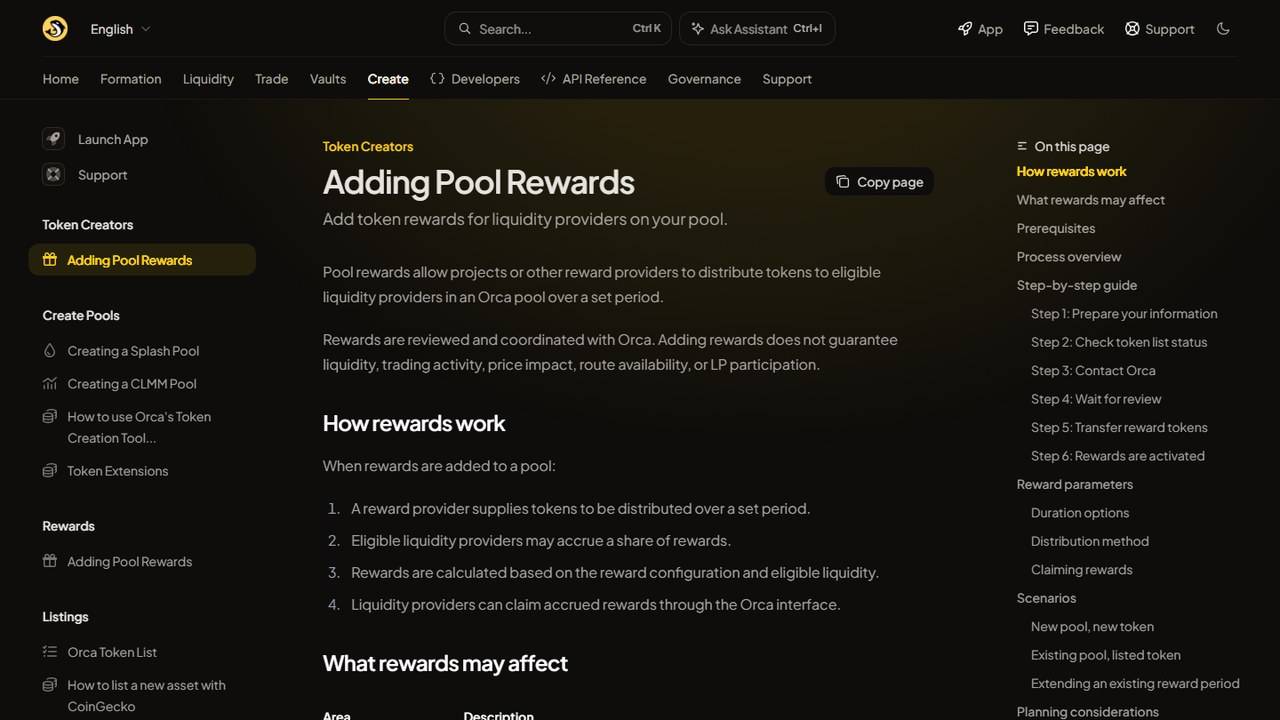
We read these pages but did not create a token or a pool, and the creation tools sit behind a "Create Pool" button in the app, which we did not use.
Feature 10: Regulated Assets and Tokenized Stocks
One of the newest parts of Orca is the RWAs filter in Pools, where we found pools for tokenized shares and funds, such as NVDAx, TSLAx, SPCX (SpaceX), COST, AMD, GLDx and TTWO. The docs have a page on "Regulated Assets and Permissioned Pools". It says some assets carry a Regulated Asset label with eligibility rules set by the asset's servicer (the company that issues and manages it) and not by Orca. In a permissioned pool, token accounts are frozen by default and are unfrozen only for approved users, and Orca shows the servicer's eligibility status before you trade. The docs say clearly that this is general information and not advice.
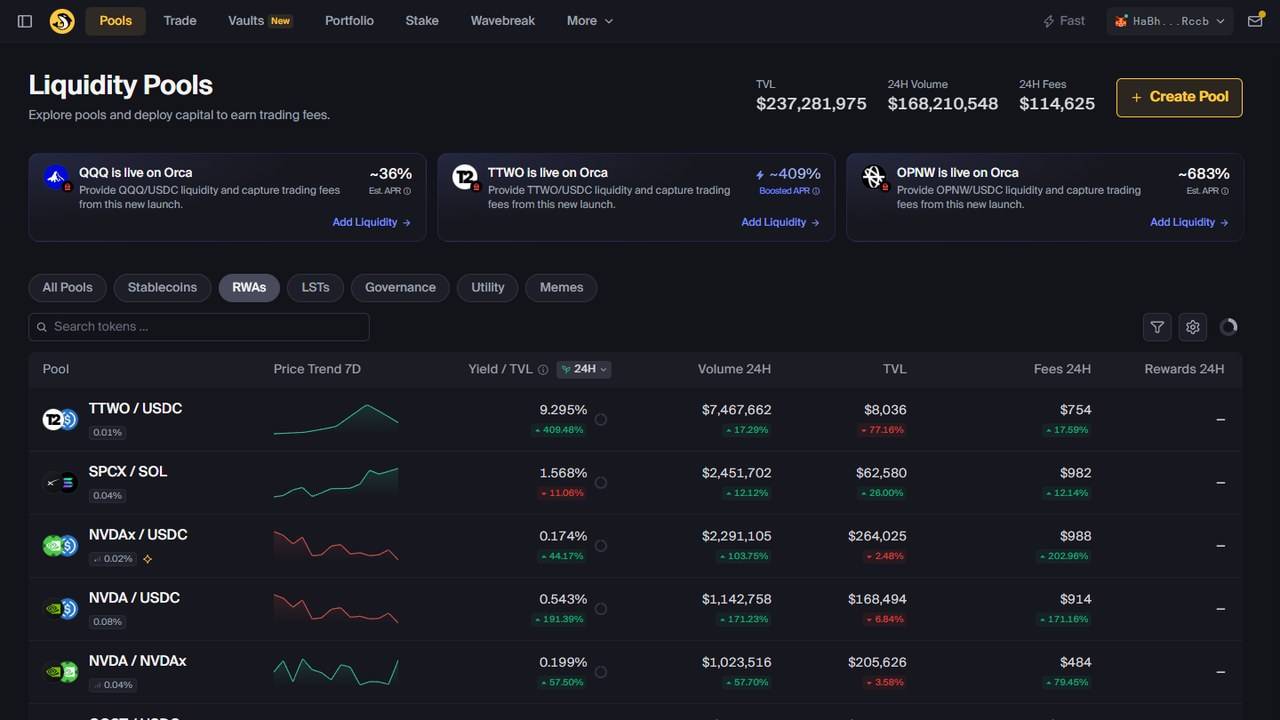
The RWAs list is a good example of why you should read TVL as well as yield. On November 16, 2026 the pool volumes were small compared with the major pairs: TTWO / USDC had $7.47M volume on $8,036 TVL, NVDAx / USDC $2.29M on $264K, and NVDA / USDC $1.14M on $168K. We do not know which of these assets are open to every user, and we did not test eligibility checks. A tokenized stock also brings issuer and legal risk that Orca's code cannot remove.
Feature 11: Developer Tools
For developers the docs list a Whirlpools SDK (TypeScript and Rust), a Python package, a public REST API (api.orca.so) for pool and token data, and a documentation MCP server so AI tools can search the docs. There is also a guide for building automated liquidity or trading agents. These are real strengths for builders. We did not run any of the code.
Orca on Eclipse: The Shutdown
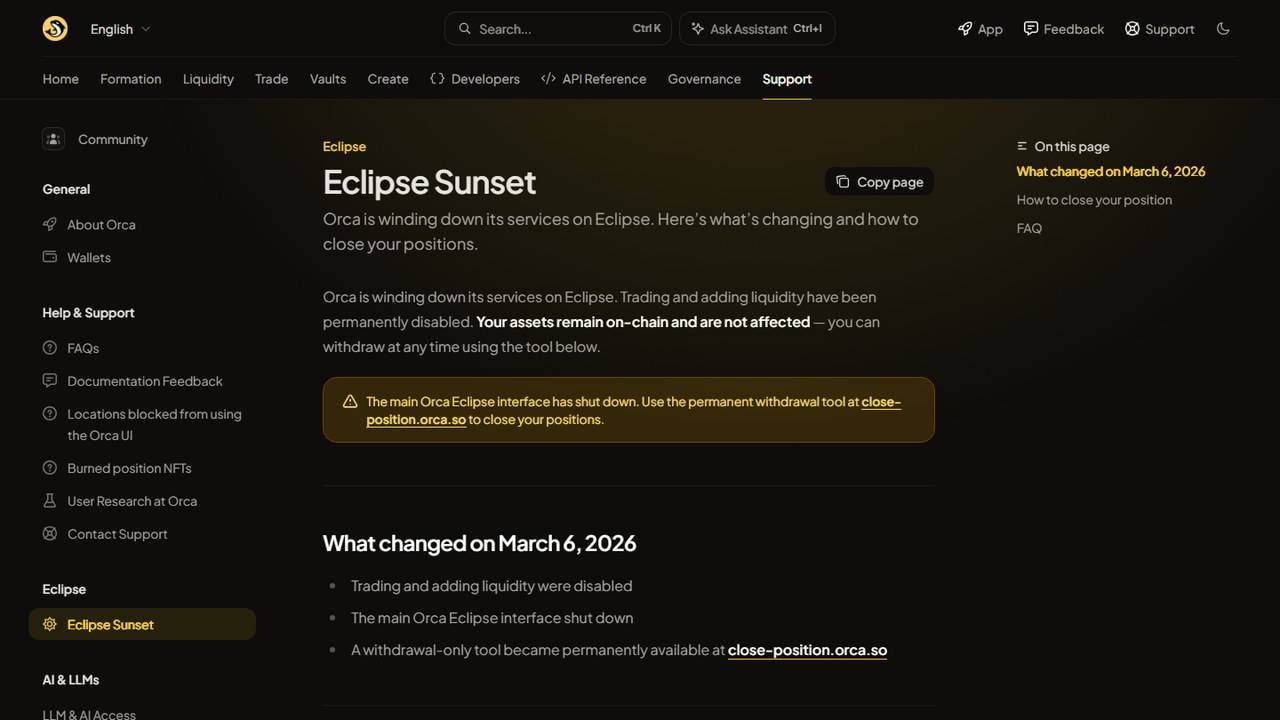
Orca used to run on a second network called Eclipse. The docs say that on March 6, 2026 trading and adding liquidity were disabled, the main Eclipse interface shut down, and a withdrawal-only tool became permanently available at close-position.orca.so. The docs say assets remain onchain and there is no deadline to withdraw, but anyone with an open position stays exposed to market risk. DefiLlama still lists Eclipse with only $8,255 of TVL. If you used Orca on Eclipse, this is a task for you.
The Merger: Orca and Loopscale Become Formation
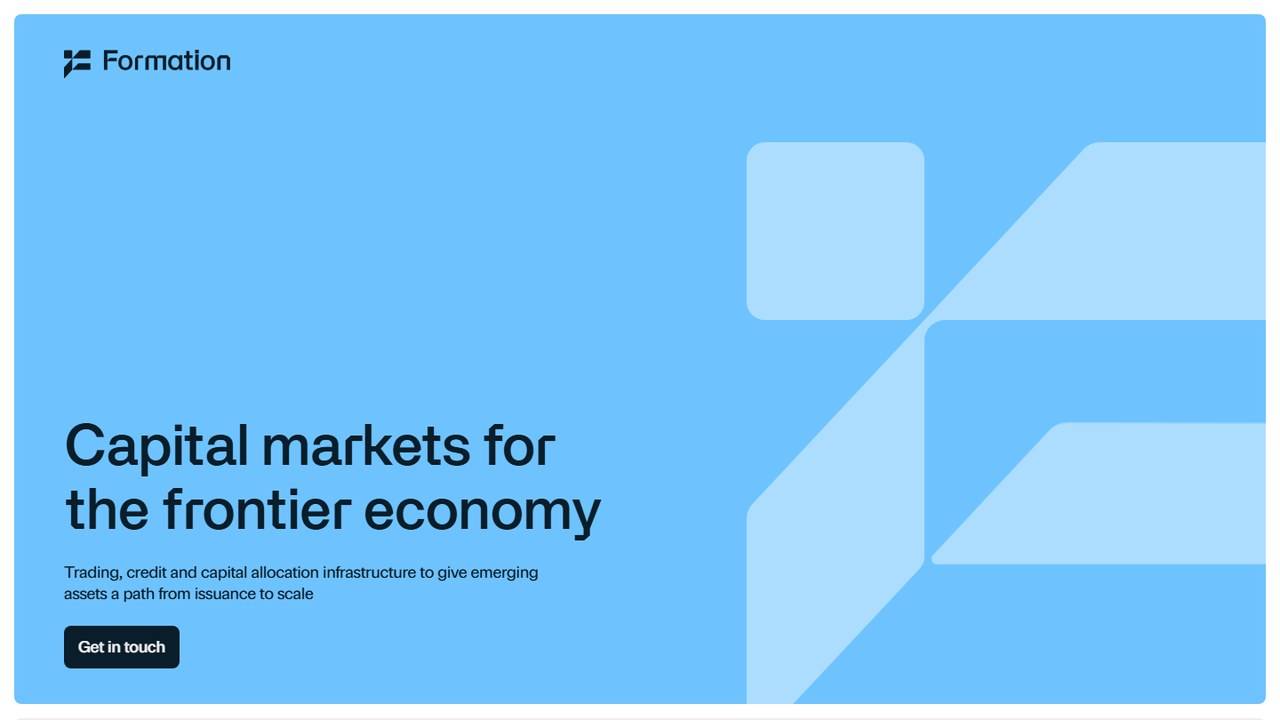
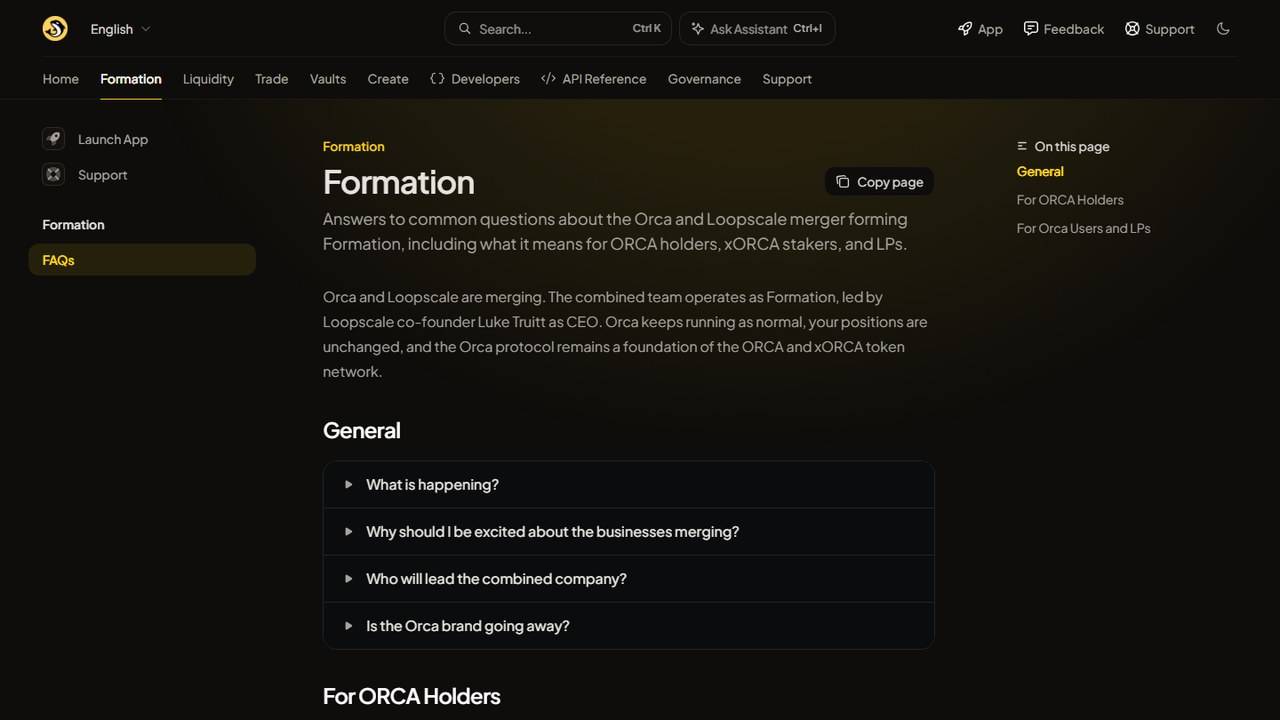
The docs and the Formation website say that Orca and Loopscale, a lending and vault company, are merging into a combined company called Formation. Formation is led by Loopscale co-founder Luke Truitt as CEO, and the site says the team is headquartered in New York City. Orca keeps running, and the Orca brand continues as a product under Formation.
What the docs and the Formation site say about your position:
| Question | Answer in the docs |
|---|---|
| Do Whirlpool positions change | No. Positions, fees and rewards stay as they are |
| Does the app keep working | Yes. Swaps, pools, vaults and other products continue |
| What happens to ORCA | No change in supply. The docs say there is no dilution and no new mint |
| Does xORCA staking change | No. Staking and unstaking work as before |
| Security, multisigs and bounty | The docs say they remain unchanged |
The Formation site says the company wants to bring tokenized real-world assets to market and names Figure, Shinhan Asset Management, Superstate, R3 and Securitize as partners it is already working with. It also says Orca provides trading infrastructure, including professional market-maker pools called Riptide. All of this is the company's own description, and we cannot verify the partner details. One thing to note for token holders: the docs say ORCA now represents all of Formation, including Loopscale's products. That is a bigger bet than the DEX the token started with. We found no date for the merger announcement in the pages we read.
The ORCA Token
ORCA is Orca's governance and utility token. The docs say it was launched on August 9, 2021 on Solana, has a fixed total supply of 75,000,000 and is used for governance votes and for xORCA staking.
| Metric | Value | Source and date |
|---|---|---|
| Price | $1.17 | CoinGecko, Nov 16, 2026 |
| Market cap | $71.0M | CoinGecko |
| Fully diluted value | $87.6M | CoinGecko |
| 24h volume | $8.25M | CoinGecko |
| Circulating supply | 60.80M | CoinGecko |
| Total supply | 75.0M | CoinGecko and docs |
| Max supply | 100M | CoinGecko (differs from the docs) |
| Rank | 315 | CoinGecko |
| Change 24h / 7d / 30d / 1y | -2.88% / -13.66% / -37.76% / -8.74% | CoinGecko |
| All-time high | $20.33 on Oct 2, 2021 | CoinGecko, now about 94.3% below |
| All-time low | $0.351 on Jun 19, 2022 | CoinGecko |
| Circulating share | about 81% of total supply | Our calculation |
Why the numbers differ. The docs say 75 million is the fixed total supply, and CoinGecko shows a total supply near 75 million but a "max supply" of 100 million. We do not know why. For this guide we use the 75 million figure from the docs and CoinGecko's own circulating number.
How to read this. The market cap of $71M is small next to the $253M of TVL on the DEX. About 81% of the supply is already circulating (our calculation), so there is less unlock pressure than in many tokens, although we did not check the full allocation. The staked amount of 10.42m ORCA shown in the app is about 17% of circulating supply (our calculation, as the app does not say how it counts). The price fell about 38% in 30 days. This is not investment advice.
The docs describe two treasuries, the Community ORCA Treasury and the Orca Fee Treasury, and a Climate Fund, which made a first donation of $550,000 to Ocean Conservancy, announced in November 2022 (docs say). We did not check the treasury wallets.
Governance
Orca's docs say governance has four steps: community proposals, a discussion period, voting with ORCA (on a platform called Realms) and execution by the team or the DAO Council. The Council is an elected body that handles routine operations and executes approved decisions. The docs list limits on what the Council cannot do, such as spending beyond approved allocations.
We did not vote or read any proposals. After the merger, the docs say ORCA represents all of Formation, which raises the question of how much a vote by token holders can influence the business. We do not know the answer, and the docs do not address it.
Fees and Costs
| Cost | What the docs say | What we saw |
|---|---|---|
| Swap fee | Set by the pool, from 0.01% to 2%, with Adaptive Fees in some pools | Pools showed 0.01% to 0.30% |
| Who gets the fee | 87% LPs, 12% DAO treasury, 1% Climate Fund | Not verified onchain |
| Position rent | About 0.0088 SOL, refundable when the position closes | Panel showed $0.73 refundable |
| Network fee | About 0.00001 SOL for a standard transaction | Not tested, we did not sign |
| Slippage | Default shown in the app | 0.5% on Trade and Autoswap, 2.5% liquidity slippage |
| Vault fees | Not stated on the pages we read | Not verified |
| Unstake delay | 7 day cooldown for xORCA | Not tested |
The vault fee row matters: we did not find a performance or management fee on the vault pages we opened, so check each vault yourself before depositing.
Security
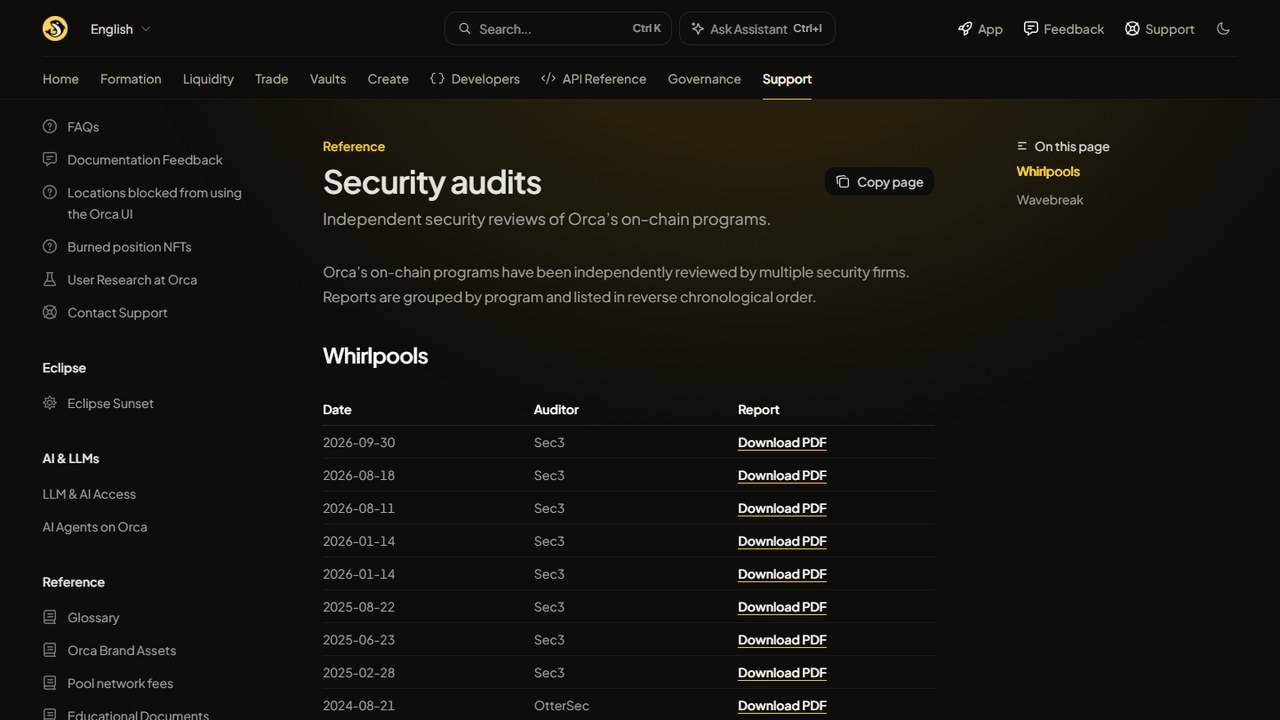
The security page in the docs shows a long list of independent reviews of the Whirlpools program, grouped by date, plus one for Wavebreak.
What the docs say
| Item | Detail | Status |
|---|---|---|
| Whirlpools audits | 11 reports: Sec3 (8, between Feb 28, 2025 and Sep 30, 2026), OtterSec (Aug 21, 2024), Neodyme (May 5, 2022), Kudelski (Jan 28, 2022) | Docs say |
| Wavebreak audit | Sec3, July 28, 2025 | Docs say |
| Bug bounty | Active program on Immunefi, amount not verified by us | Docs say |
| Exploit history | The docs say no protocol-level smart contract exploits since launch | Docs say |
| Open source | The docs say the contracts are open source | Docs say |
| Geographic blocks | A list of countries and regions is blocked from the UI. Users there may only close positions | Docs say |
| Wallet screening | Orca screens wallet addresses and may block ones linked to illicit activity | Docs say |
The most recent audit entries are very new (August and September 2026), which suggests the code is still being updated and checked. We cannot read the reports from here and do not know what they found. DefiLlama's hacks database has no entry for Orca as of November 16, 2026.
Risk Table
| Risk | What it means for you | Level in our view |
|---|---|---|
| Smart contract | A bug could lock or drain a pool | Low to medium, mitigated by audits |
| Impermanent loss | LP position can be worth less than holding | High for volatile pairs and narrow ranges |
| Out of range | Position earns nothing until the price returns | Medium |
| Thin pools | Small pools with huge yields can be moved by a few trades | High in the RWA and new-launch sections |
| Vaults | Strategy risk and counterparties such as Loopscale and Kamino | Medium to high |
| Tokenized assets | Issuer, legal and eligibility risk outside the code | Medium |
| Merger | Direction of the business and token can change | Medium |
| Token | ORCA is down about 94% from its high | High |
| Region and wallet blocks | You can be limited to withdrawals only | Depends on your location |
Orca vs Competitors
Figures are DefiLlama numbers for Solana-listed DEXs on November 16, 2026. Different DEXs have different designs, so the comparison is about size and activity and not about quality.
| DEX | TVL | Volume 24h | Volume per $1 of TVL (our calculation) |
|---|---|---|---|
| Raydium AMM | $829.0M | $110.9M | 0.13 |
| PancakeSwap AMM V3 | $640.3M | not captured | not captured |
| Sanctum Infinity | $134.4M | not captured | not captured |
| PumpSwap | $245.9M | $142.8M | 0.58 |
| Meteora DLMM | $124.9M | $119.7M | 0.96 |
| Orca DEX | $252.9M | $175.1M | 0.69 |
PancakeSwap AMM V3 is listed on several chains, so its TVL is not a Solana-only figure. Orca had the highest 24 hour volume of any DEX in DefiLlama's Solana ranking that day, about 13% of the chain's DEX volume of $1.35B (our calculation), but only the third or fourth largest TVL among the names above. Raydium has more than three times Orca's TVL and a lower volume. Meteora gets more volume per dollar of liquidity, which can mean more efficient use of capital or a more active, shorter-term crowd. We did not test any competitor in this review.
Orca's pitch is a clean interface, strong education tools (the simulator, the docs) and a long track record. Its weak points are a smaller TVL than the leader, a more complex vault offer that depends on partners, and a company direction that is now tied to the Formation merger. If you want to compare Orca with other Solana and DeFi products, read our Pump.fun review for memecoin launches, our Jupiter (JUP) price analysis for the largest Solana swap aggregator, our Polymarket review and our comparison of no-KYC DEXs and instant swaps.
Pros and Cons
Pros
- One of the largest DEXs on Solana by volume, with about $175M in the last 24 hours (DefiLlama).
- No exploit recorded on DefiLlama, and no protocol-level exploit since launch according to the docs.
- A long, recent audit list, with eight Sec3 reports and one OtterSec report for Whirlpools.
- Clear, polished app on desktop, tablet and phone, with no broken pages in our test.
- Useful learning tools: a position simulator, fee tiers explained, risk boxes on vaults and a detailed docs site.
- Open, free tools for developers, including SDKs, an API and an MCP server.
- Wallet connection worked smoothly, and we could browse every page without depositing.
Cons
- TVL is down about 82% from the 2021 peak and down about 15% in 30 days.
- The homepage fee claim ($500m+) is about double what DefiLlama shows ($245.8M).
- Thin pools with very high advertised yields in the RWA and new-launch sections.
- The newest vaults are small, and one vault showed a negative APY.
- ORCA is down about 94% from its high and about 38% in 30 days.
- The merger with Loopscale changes what the token represents.
- Orca on Eclipse was shut down in March 2026.
- Some regions and wallets are blocked from the interface.
Who Should Use Orca
- Curious readers and researchers: yes. You can browse all pools and vaults and use the simulator without a wallet balance.
- Solana traders who want a simple swap page: reasonable, but compare quotes with other apps, since we did not test any swap.
- Liquidity providers who understand price ranges: possible, with small amounts, after trying the simulator and learning about impermanent loss.
- Yield seekers using vaults: only with small amounts, and only after reading each vault's strategy, because some are small and risky.
- Complete beginners looking for safe yield: probably not. Providing liquidity has real loss risk, and several highlighted yields sit on tiny pools.
- Anyone in a blocked region: you may only be able to close existing positions.
Verdict
Score: 4.0 out of 5.
Orca earns points for a clean and mature app, strong volume, a recent and long audit list, no recorded exploit, and good teaching tools. It loses points for the drop in locked value since 2021, the gap between its fee claim and public data, thin high-yield pools, the small and partly negative vaults, a weak token and the uncertainty that comes with the Formation merger. We did not make a swap, deposit, stake or withdrawal, so we cannot score the real money experience. Treat Orca as a good place to learn how a modern Solana DEX works first, and keep any liquidity position to money you can afford to lose.
FAQ
Is Orca safe?
It has many audits and no recorded exploit, but safe is not guaranteed. Impermanent loss, thin pools, vault strategies and tokenized-asset rules are real risks.
Is Orca a wallet?
No. It is an app. You connect your own Solana wallet, and the app does not hold your funds for swaps.
What is a Whirlpool?
Orca's name for a concentrated liquidity pool, where you choose the price range your money works in.
What is impermanent loss?
The difference between providing liquidity and simply holding the tokens. The docs also call it divergence loss, and they point out it is not always temporary.
What happened to Orca on Eclipse?
The docs say it shut down on March 6, 2026. Trading and adding liquidity are disabled, and you can withdraw using close-position.orca.so.
What is Formation?
The company formed by the merger of Orca and Loopscale. The docs say Orca keeps running as normal.
Does Orca have a token?
Yes, ORCA, with a staked version called xORCA. The docs say unstaking has a 7 day cooldown.
Do I need a wallet to look around?
No. Pools, vaults and pool pages were visible before we connected. You need a wallet to see balances and to transact.
Why is the pool yield on a tokenized stock so high?
We do not know the cause in each case. In the pools we saw, the liquidity was very small, which can make the yield measure jump.
What did you not test?
Swaps, deposits, vault deposits, staking and unstaking, harvests, withdrawals, token creation, Wavebreak launches, the Eclipse withdrawal tool, eligibility checks for regulated assets and the developer code.
Quick Links
- Website: orca.so
- App: orca.so/pools
- Docs: docs.orca.so
- Security audits: docs.orca.so/reference/security-audits
- Formation: formation.so
- Eclipse withdrawal tool: close-position.orca.so
- DefiLlama: defillama.com/protocol/orca-dex
Disclaimer
This guide is for information only and is not financial advice. Providing liquidity, using vaults and holding tokenized assets carry a risk of loss, including impermanent loss, smart contract failure, strategy risk and token price falls. Figures were captured on 16 November 2026 from Orca's websites and docs, from DefiLlama and from CoinGecko, and they change constantly. Check the rules of your region before using any DeFi service.
Editorial credits
Checked by NFTenex QC Team before publishing on November 18, 2026 for headline accuracy, original value, factual consistency, metadata, commercial disclosure, authorship claims, review evidence and risk disclosure: our AI review system checks every article before it goes live, and our duty editor monitors it after publication. Report an error.
NFTenex uses AI for research, drafting and review. Our editorial team is responsible for every article and corrects or withdraws articles when needed. How we review.