Ripple is making a calculated bet on real-world asset tokenization, a market that a joint report with Boston Consulting Group projects will grow from $0.6 trillion today to $18.9 trillion by 2033. The move positions the payments company and the XRP Ledger as infrastructure for what could become one of the largest shifts in global finance this decade.
Ripple’s Tokenization Play: What the Company Is Targeting
Tokenization refers to the process of representing traditional financial assets, such as bonds, real estate, or private equity, as digital tokens on a blockchain. It enables fractional ownership, faster settlement, and round-the-clock trading of assets that have historically been illiquid or inaccessible to smaller investors.
Ripple and BCG published their tokenization report on April 7, 2025, projecting a base-case scenario of $9.4 trillion in tokenized assets by 2030 and $18.9 trillion by 2033, representing a 53% compound annual growth rate. A conservative estimate puts the figure at $12 trillion, while an optimistic scenario reaches $23.4 trillion.
The report outlines a three-phase adoption framework. Phase 1 covers government bonds and mutual funds already moving on-chain. Phase 2 expands into private credit and real estate. Phase 3 targets traditionally illiquid assets like private equity and infrastructure, where tokenization could unlock the most value.
Markus Infanger, SVP of RippleX, framed the shift in concrete terms:
“The market is transitioning from tokenized assets simply sitting on-chain to integrating into real economic activity.”
— Markus Infanger, SVP of RippleX
BCG’s Bernhard Kronfellner echoed that assessment, stating that “tokenization is no longer just a concept, it’s the foundation for the future of global finance.”
Ripple is not operating in a vacuum. Institutional heavyweights are already moving. JPMorgan’s Kinexys platform has processed more than $1.5 trillion in tokenized transactions with over $2 billion in daily volume. BlackRock’s tokenized U.S. dollar money market fund, BUIDL, neared $2 billion in assets under management as of the report’s publication and is already being used in DeFi protocols.
Why the RWA Tokenization Race Matters for XRP and Investors
The XRP Ledger offers native features relevant to tokenization, including a built-in decentralized exchange, escrow functionality, and the ability to issue custom currencies directly on-chain. These capabilities position XRPL as a potential settlement layer for tokenized assets without requiring smart contract complexity.
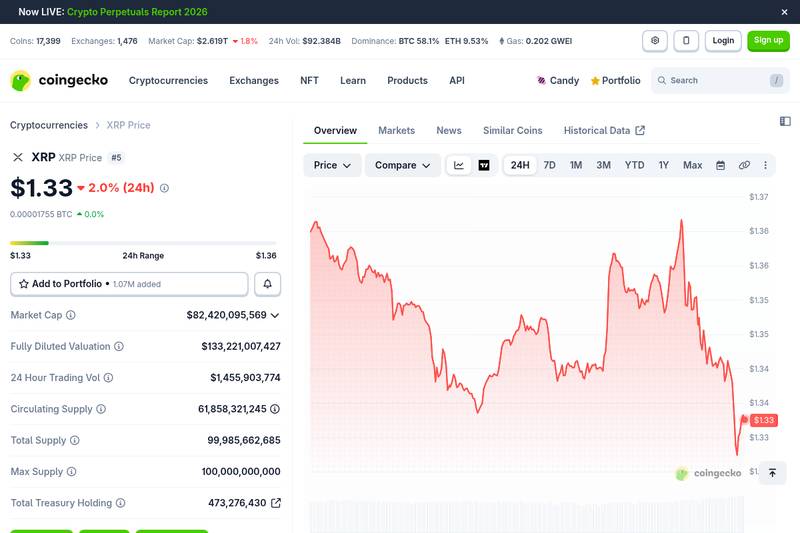
XRP currently trades at $1.33 with a market cap of approximately $82.3 billion, ranking it fifth among cryptocurrencies. The token is down roughly 63.5% from its all-time high of $3.65 reached in July 2025.
The competitive landscape is intense. Ethereum remains the dominant platform for tokenized assets, with projects like Ondo Finance and Centrifuge building RWA infrastructure on its network. Stellar and Polygon have also pursued institutional tokenization partnerships. For investors tracking XRP’s positioning relative to Ethereum, the tokenization race adds a new dimension to that comparison.
One overlooked detail from the report: focused tokenization projects can now launch for under $2 million, a threshold low enough to bring mid-tier financial institutions into the market. Full end-to-end institutional integrations, however, can still cost up to $100 million, creating a wide gap between experimentation and production-scale deployment.
If Ripple captures even a small percentage of the projected market, the implications for XRP utility could be significant. Tokenized assets require settlement infrastructure, and every transaction settled on XRPL would generate demand for XRP as a bridge asset. The recent wave of exchange infrastructure launches suggests the broader industry is preparing for this shift.
What to Watch: Milestones and Risks Ahead
The regulatory environment remains the biggest variable. Switzerland, the EU, Singapore, and the UAE have established comprehensive frameworks for tokenized assets. The U.S. regulatory landscape is expected to clarify further following Ripple’s SEC case resolution in August 2025, which unlocked greater institutional engagement with XRP in the American market.
India and China remain restrictive or undefined on tokenization rules, limiting two of the world’s largest financial markets from participating in the near term. The report warns that without interoperability standards, digital silos could replicate the same fragmentation that tokenization aims to eliminate.
According to unconfirmed reports, XRPL tokenized assets grew from $24.7 million to $567.9 million in 2025, a roughly 2,200% increase. If accurate, that trajectory would suggest early traction, though it remains a fraction of the multi-trillion-dollar opportunity Ripple is targeting.
The broader crypto market is currently in a cautious mood. The Fear & Greed Index sits at 34, firmly in “Fear” territory, which may influence how aggressively institutions commit capital to tokenization initiatives in the short term. For investors weighing macro allocation strategies, Ripple’s tokenization push represents a fundamentally different thesis from pure price speculation.
Carbon markets represent another specific growth vector identified in the report, with blockchain improving emissions credit traceability. This niche application could serve as a proving ground for tokenization infrastructure before larger asset classes follow.
The concrete milestones to monitor: XRPL on-chain tokenization volume, RLUSD stablecoin expansion, and whether Ripple secures additional institutional pilot programs. The gap between a $18.9 trillion projection and real adoption will be closed, or not, by execution on these specifics.
Disclaimer: This article is for informational purposes only and does not constitute financial or investment advice. Cryptocurrency and digital asset markets carry significant risk. Always do your own research before making decisions.