
OpenSea is useful when a buyer needs broad collection discovery and a familiar marketplace workflow, but it is not automatically the best venue for every NFT. Its practical value depends on the collection’s chain, liquidity, verification signals, final checkout cost, creator policy, and whether the asset has utility beyond the marketplace page.
A polished item page can still hide stale metadata, weak liquidity, an unsupported game use case, or a fee path that only becomes clear at checkout.
OpenSea at a glance
| Review area | What OpenSea is useful for | What the buyer still needs to verify |
|---|---|---|
| Discovery | Broad collection and item browsing | Official contract, chain, creator identity, and collection authenticity |
| Buying | A familiar listing and wallet checkout flow | Total price, currency, gas, royalties, approvals, and order expiry |
| Selling | Listing an owned NFT for public buyers | Net proceeds, approval target, cancellation path, and current demand |
| Creator presentation | Collection pages and item metadata | Whether the metadata and utility claims are controlled by the creator |
| Gaming assets | Finding game-related collections | Chain support, account entitlement, transfer restrictions, and actual in-game use |
OpenSea by the numbers
The published figures are useful for scale, but they are not a live dashboard. The two reference articles use different dates and definitions, so they should not be blended into one “current user count.” Each figure stays tied to its source date:
- Launch: OpenSea launched in December 2017, according to the CryptoNews review.
- NFT listings: CryptoNews reported more than 80 million NFTs available for trading in its review updated October 9, 2025.
- Blockchain coverage: The same review described support for more than 19 blockchains, but the live supported-network list should be checked before publishing.
- Collections: Investopedia cited more than 2 million collections on its page updated August 30, 2024.
- Users and daily volume: Investopedia cited more than 3 million active users and about $4.5 million in daily volume based on a January 2024 snapshot, not a live 2026 metric.
- Cumulative market volume: Investopedia cited more than $20 billion in market volume based on the same January 2024 snapshot, not a current-period figure.
These numbers support one clear conclusion: OpenSea had broad marketplace reach, but scale alone does not tell a buyer whether a specific collection has active demand. For that, inspect recent sales, unique owners, items listed, best offers, and the last completed transactions on the collection page.
Key features
| Feature | Useful for | Limitation |
|---|---|---|
| Search, filters, stats | Finding collections and comparing floor, sales, owners, listings, and offers | Visibility does not verify the creator or guarantee liquidity |
| OpenSea Studio | Creating collections, metadata, and creator drops | It does not create demand or prove utility |
| Multi-chain browsing and Pro tools | Comparing networks or using a more trading-focused workflow; CryptoNews reports OpenSea Pro aggregates 170+ marketplaces | Wallet, currency, gas, fees, and feature availability still depend on the exact transaction |
Casual collectors benefit most from context and item inspection; high-volume traders may prefer specialist execution tools. The OpenSea, Blur, and Magic Eden comparison explains that difference in more detail.
How OpenSea works in practice
OpenSea does not act like a crypto exchange that holds a balance for you. You connect a wallet, choose an item or collection, and approve the transaction in that wallet. The NFT and payment move through the relevant blockchain transaction, while OpenSea provides the search, listing, offer, and checkout interface. This non-custodial model is also described in Investopedia’s OpenSea overview, but it has an important consequence: losing wallet access or signing a malicious approval is not something OpenSea can simply reverse.
| Step | What to check before moving on |
|---|---|
| Find the collection | Match the official contract address and blockchain, not only the name or artwork. |
| Open the item | Check token ID, owner, traits, listing expiry, currency, and whether the item is actually the intended version. |
| Review the wallet prompt | Confirm the transaction method, amount, network, and approval target before signing. |
| Confirm settlement | Check the transaction hash and wallet ownership after the sale, then verify any game or membership entitlement separately. |
The same distinction explains why a collection page should not be treated as a product guarantee. OpenSea can show an image, token ID, owner, price, activity, and collection information, but the creator controls the contract and the product team controls any off-market utility. For a buyer, the practical sequence is:
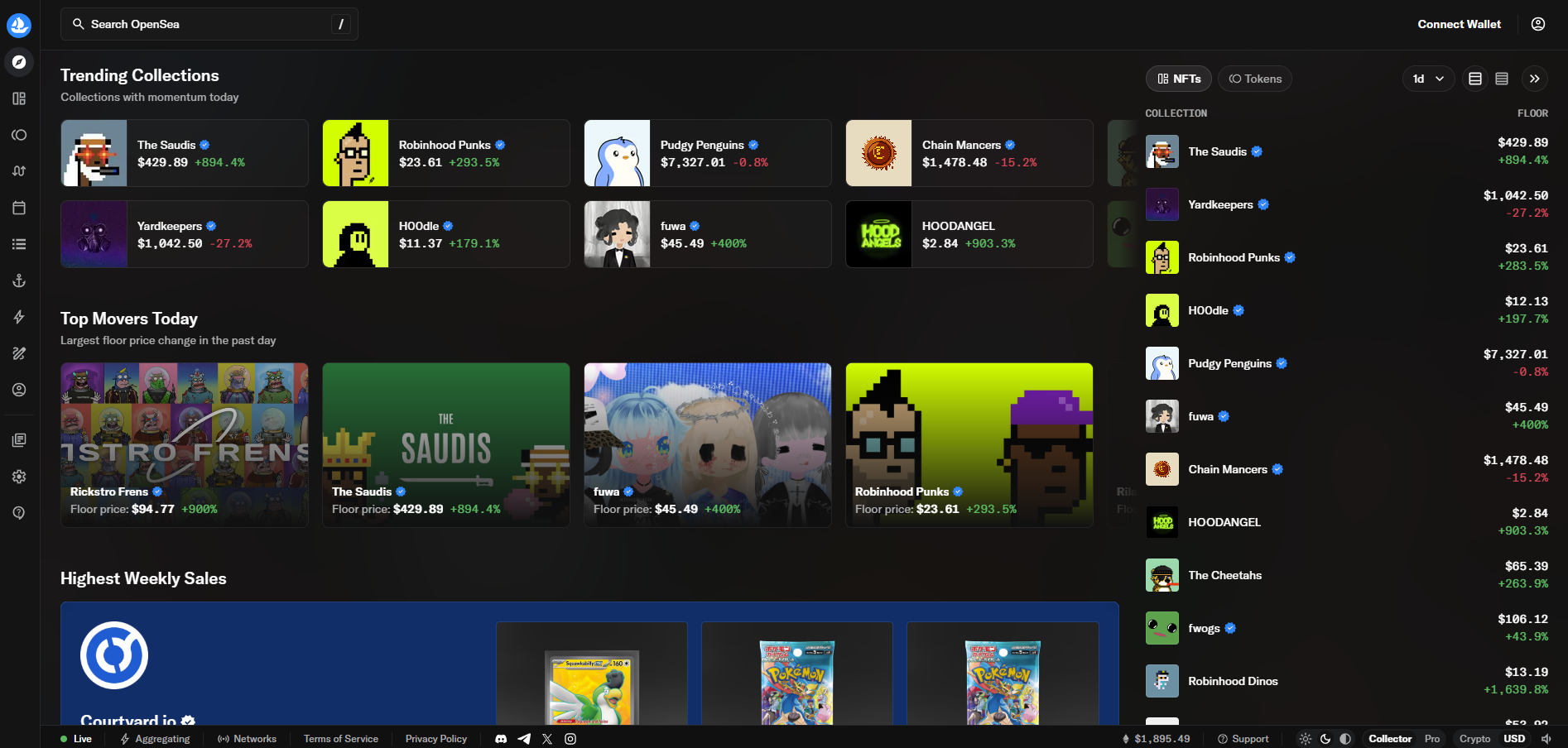
Discovery is the main OpenSea advantage
 decoding="async" referrerpolicy="no-referrer" decoding="async" src="/wp-content/uploads/2026/08/image-4-1024x489.png" alt="" class="wp-image-10355" title="">
The trade-off is that broad discovery creates more room for lookalike collections and incomplete context. Before clicking buy, match the collection contract and chain with the creator’s official site or a verified project channel. A badge, image, or familiar collection name should support the check, not replace it.
Buying an NFT on OpenSea
The buyer workflow should answer five questions before signing: which token is being purchased, who currently owns it, what currency is required, what will the total cost be, and what happens if the order expires or changes. A low displayed price is not enough if the asset has a different network, a large gas requirement, or a utility restriction.
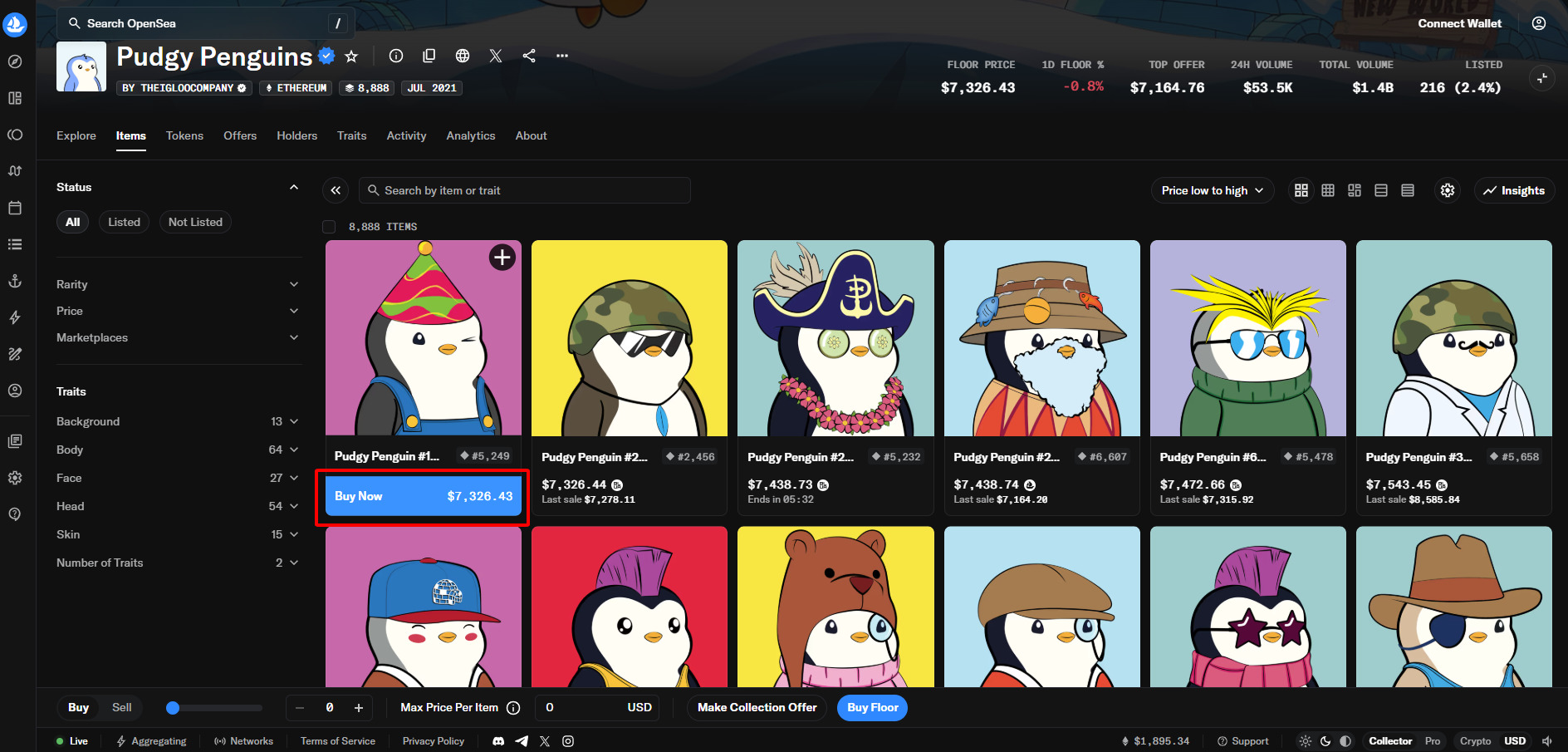
For a fixed-price listing, inspect the item page, collection address, token ID, seller, price, expiration, and wallet prompt. The wallet should show the method, spender, value, and network rather than asking the buyer to approve an unexplained action. The NFT marketplace safety checklist covers the approval and verification checks that belong here.
An offer may target one token or a collection, and the buyer should understand its currency, expiry, cancellation rule, and whether funds are committed. An accepted offer is not the same as a casual message to the seller; it is a transaction path with its own authorization and settlement risks.
Selling and creator economics
OpenSea can give a creator access to a large buyer surface, but listing an NFT does not create demand. The seller needs a clear collection identity, complete metadata, a realistic price, and a way to explain why the item matters. A game creator should show class, level, mode, transfer restrictions, and entitlement rules rather than relying on artwork alone.
Calculate expected proceeds before publishing the listing. Separate the visible sale price from marketplace charges, creator royalties, gas, currency conversion, and any cost imposed by the transfer route. The current fee treatment should be checked at the live checkout rather than copied from an old screenshot.
Creators should also distinguish immutable token data from changeable game state. A token can preserve an image and trait record while the game changes balance, eligibility, or item utility. The NFT marketplace infrastructure guide explains that storage boundary, while the best NFT marketplaces guide compares the platforms that expose the asset for sale.
For a seller, the important choice is not simply whether OpenSea allows a listing. It is whether the listing can reach the right buyer at a price that still makes sense after every deduction. A fixed-price listing gives the seller a clear target; an offer requires judging the buyer’s price, currency, expiration, and settlement conditions.
Before confirming either route, record the expected gross amount, the marketplace charge shown at that moment, creator earnings treatment, network cost, and the amount expected to arrive in the receiving wallet. Do not use an old review’s fee table as a promise of today’s checkout total.
A practical listing sequence looks like this:
- Open the NFT from the connected wallet and confirm the collection, token ID, chain, and current owner.
- Choose the sale type, set the price or auction terms, and select an expiry that matches the expected demand.
- Read the preview for marketplace charges, creator earnings, currency, and estimated proceeds before signing.
- Approve only the transaction required for the listing. A listing does not require a seed phrase or an unrelated unlimited approval.
- After a sale, check the transaction hash and receiving-wallet balance instead of relying only on the marketplace success message.
For example, a 1 ETH sale at a reported 2.5% marketplace charge produces 0.975 ETH before creator earnings, gas, or other costs. If the creator-earnings setting adds 0.05 ETH, the illustrative amount falls to 0.925 ETH before gas. The live listing preview remains the source of truth because fee treatment can change by collection, chain, product, or promotion.
OpenSea for gaming NFTs
Before recommending a gaming NFT, check the collection’s chain, token ID, game account connection, item restrictions, transfer state, and delivery process. If the game uses a separate entitlement service, the team should explain how a marketplace purchase becomes a usable inventory item. The in-game versus standalone market comparison covers this boundary in more detail.
Fees, liquidity, and marketplace risk
OpenSea’s visible listing price is only one part of the purchase decision. Compare it with the final checkout amount, recent completed sales, active listings, and collection-level demand. A floor price can be stale or represent an item with weaker utility than the buyer needs.
Liquidity should be measured at collection and trait level. A marketplace may show a large number of items while the exact class, token, or game mode has few buyers. A buyer who needs to exit later should inspect recent sales and bid activity instead of treating marketplace visibility as proof of resale demand.
CryptoNews also reports optional creator royalties in the 5% to 10% range. On a 1 ETH sale, a 5% creator-earnings setting would represent another 0.05 ETH before gas, but the actual treatment depends on the collection and current transaction terms. The seller should use the amount shown in the live listing or checkout flow before deciding on a price.
The main risks are not unique to one interface: counterfeit collections, malicious approvals, compromised wallets, stale metadata, failed transfers, and game entitlement mismatches. OpenSea can make the workflow easier to inspect, but the buyer remains responsible for verifying the contract, wallet prompt, final cost, and asset utility. The same collection may also appear on Magic Eden, Blur, or Rarible, so buyers should compare the exact item and order terms rather than assume that a second listing is a separate asset.
Where OpenSea fits against Blur and Magic Eden
OpenSea is the broad generalist. Blur is designed more around fast Ethereum trading, collection bids, and professional execution. Magic Eden is especially relevant when the collection is Solana-native, gaming-oriented, or tied to a curated launch ecosystem. The right choice depends on the job, not on which platform has the biggest brand. These fee figures are reported comparisons, not permanent rate cards.
| Decision factor | OpenSea | Blur | Magic Eden |
|---|---|---|---|
| Best starting point | Broad discovery and first-time collection research | Active Ethereum trading and rapid order execution | Solana-first discovery, gaming collections, and selected multi-chain activity |
| Buyer workflow | Item page, collection context, offers, and standard wallet checkout | Trading-focused interface with less beginner guidance | Collection discovery with strong chain-specific context |
| Seller priority | Public reach and simple listing exposure | Competitive execution and trader liquidity | Access to Solana and gaming-native audiences |
| Main cost question | A 2.5% standard sales fee is reported by CryptoNews; confirm current charge, creator earnings, and gas at checkout | 0% trading fee is reported by CryptoNews; verify the exact order and creator-earnings treatment | CryptoNews reports about 2% on Solana and 0.5% on Ethereum; verify chain-specific terms |
| Main risk | Broad coverage can include lookalike or low-liquidity collections | Faster execution can encourage buying before checking the asset | A strong gaming or Solana audience does not guarantee that the item works in the game |
This comparison is intentionally functional rather than a permanent ranking. A collector beginning with an unfamiliar collection will usually value OpenSea’s context and breadth; a high-volume Ethereum trader may prefer Blur’s execution tools; a Solana game community may be better served by Magic Eden’s ecosystem fit. Compare the same collection, token, currency, and final cost before treating two listings as equivalent.
Limitations to account for
- Broad coverage can make counterfeit or lookalike collections harder for inexperienced buyers to distinguish.
- A visible listing does not guarantee deep liquidity or a fair exit price.
- Marketplace ownership does not guarantee that an NFT works inside a game.
- Fees, royalties, chain support, and checkout behavior must be rechecked for the specific transaction.
Conclusion
OpenSea is still worth using when its broad discovery surface matches the buyer’s job and the collection passes independent verification. It is a reasonable general marketplace for comparing items, inspecting listings, and reaching public buyers, but it should not be treated as proof of authenticity, liquidity, or game utility. The strongest workflow is simple: verify the collection, inspect the exact order, review the wallet prompt, calculate the final cost, and confirm what ownership unlocks after settlement.
Frequently asked questions
Is OpenSea still good for buying NFTs?
It can be useful for broad discovery and familiar checkout, but suitability depends on the collection, chain, liquidity, fees, and wallet risk. Buyers should verify the contract before purchasing.
Does OpenSea guarantee that a gaming NFT works in the game?
No. The game must separately validate ownership, account eligibility, item rules, and inventory entitlement.
How should sellers calculate OpenSea proceeds?
Start with the expected sale price, then subtract marketplace charges, creator royalties, gas, currency conversion, and any collection-specific transfer cost shown at checkout.
Is the lowest OpenSea listing the best price?
Not always. The cheapest item may have weaker utility, different traits, a stale order, or a higher total checkout cost than the next listing.
Disclaimer: This article is for research and editorial comparison purposes only. It does not constitute financial, investment, legal, or tax advice. NFT tools, marketplaces, fees, chain support, and live availability can change quickly, so verify current conditions on the official platform before making any decision involving funds, assets, or private keys.