
UK Treasury Says Digital Assets Could Transform Financial Markets
- Stacey George
- May 13, 2026
- Policy
- 0 Comments
HM Treasury has declared that digital asset technology “has the potential to be genuinely transformative for financial markets,” launching a regulatory sandbox that could reshape how securities are traded and settled in the United Kingdom.
The statement appeared in a July 2023 consultation document proposing a Digital Securities Sandbox, a controlled environment for financial market infrastructure firms to test distributed ledger technology on real securities. The consultation ran from 10 July to 22 August 2023.
Unlike broad crypto advocacy, this is a formal policy signal from the department responsible for UK fiscal and economic policy. Treasury consultations carry institutional weight because they precede legislation, and the language used signals strategic intent rather than speculative enthusiasm.
In this context, “digital assets” refers not to retail cryptocurrencies but to tokenised versions of traditional financial instruments, including shares, bonds, and other securities recorded on distributed ledgers instead of legacy settlement systems.
From consultation to law in under six months
HM Treasury moved quickly after the consultation closed. By November 2023, the government confirmed its final approach to the DSS. The statutory instrument establishing the sandbox was laid on 18 December 2023, creating the legal basis for firms to apply.
The Bank of England and Financial Conduct Authority then issued a joint consultation on 3 April 2024, setting out the operational framework. The regulators confirmed the DSS will let firms use DLT in the trading and settlement of digital securities such as shares and bonds.
The sandbox is designed to last up to five years, with the possibility of extension. Critically, unbacked cryptocurrencies such as Bitcoin are explicitly excluded from its scope, keeping the focus on regulated financial instruments.
How tokenised securities could change market infrastructure
The core promise is in settlement. Traditional securities transactions pass through layers of intermediaries, including custodians, central securities depositories, and clearinghouses, often taking two business days to finalise. Tokenised securities on a distributed ledger could compress that process dramatically.
For institutional finance, faster settlement means less counterparty risk and lower capital requirements. Firms would not need to hold as much collateral while waiting for trades to clear, freeing capital for other uses.
Tokenisation also enables fractional ownership of assets that are currently illiquid or available only to large institutions. A bond issue recorded on-chain could be divided into smaller units and traded around the clock rather than during exchange hours. Projects like WLFI’s recent $55.57 million token unlock show how on-chain infrastructure is already handling large-scale asset movements.
UK Finance, the banking industry body, endorsed this direction in its consultation response, stating that it believes “the sandbox is a key component in building digital markets in the UK.”
“We believe that the sandbox is a key component in building digital markets in the UK.”
— UK Finance consultation response
What UK policy watchers should track next
HM Treasury’s Wholesale Financial Markets Digital Strategy, published on 15 July 2025, folded the DSS into a broader plan to digitalise UK wholesale markets. The strategy document states that sandboxes like the DSS will help legislation and regulation evolve alongside digital-asset innovation.
That progression, from a single consultation to a cross-regulator operational framework to a national digital strategy, suggests the UK is building a layered regulatory approach rather than issuing one-off pronouncements. Other jurisdictions are making similar moves; Vietnam recently announced plans for a regulated crypto asset market launching later this year.
For UK-based firms, the immediate watch items are the DSS application process and any guidance the Bank of England and FCA issue on eligibility criteria. The five-year window means early entrants will help shape the rules that eventually apply to the broader market.
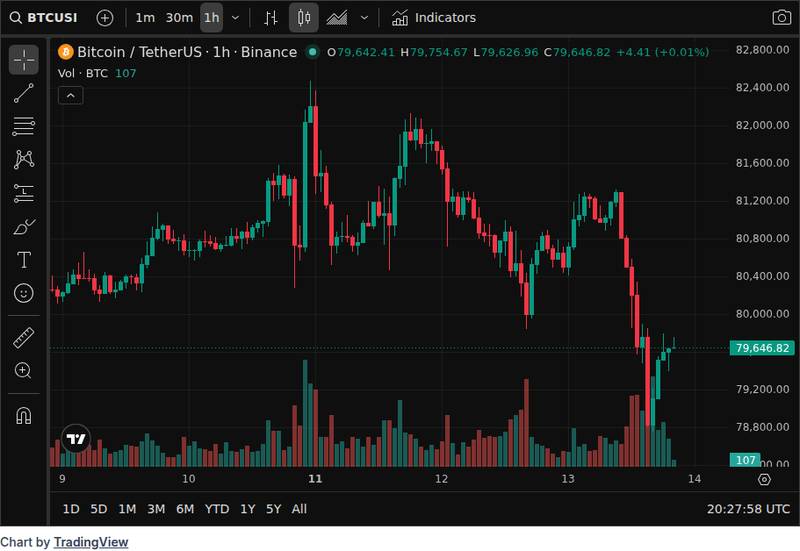
Bitcoin traded at $79,669 at press time, down 1.4% over the past 24 hours, while the Fear & Greed Index sat at 42, indicating a fearful market mood. The DSS explicitly excludes unbacked tokens like Bitcoin, but the broader regulatory clarity the sandbox brings could still influence how institutional capital approaches digital assets.
The gap between policy ambition and market reality remains significant. As Ledger’s recent decision to pause its U.S. IPO plans illustrates, even well-funded crypto firms are recalibrating amid uncertain conditions. Whether the DSS attracts enough participants to prove the Treasury’s thesis will depend on market appetite as much as regulatory design.
Concrete results from the sandbox’s first cohort of firms will be the clearest signal of whether the UK’s approach is working. Until those results emerge, the Treasury’s statement remains a policy aspiration backed by legislative machinery, not yet a proven outcome.
Disclaimer: This article is for informational purposes only and does not constitute financial or investment advice. Cryptocurrency and digital asset markets carry significant risk. Always do your own research before making decisions.