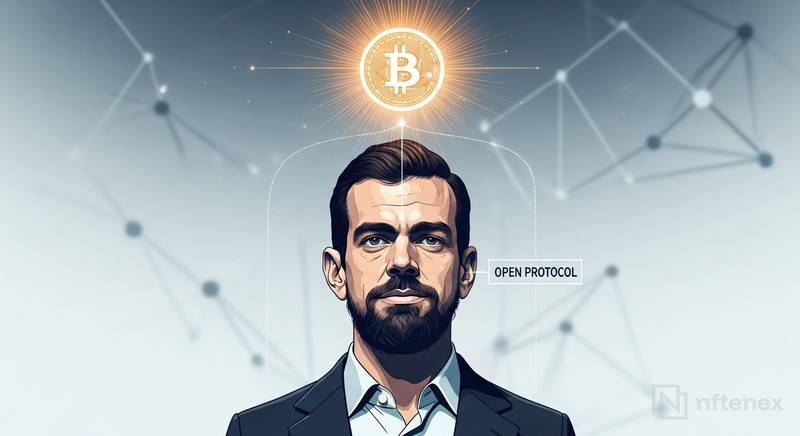
Jack Dorsey on Bitcoin as an Open Money Protocol
- Stacey George
- April 30, 2026
- News
- 0 Comments
Jack Dorsey, co-founder of Twitter and CEO of Block, has described Bitcoin as “an open protocol for money transmission” that “represents routing around the gatekeepers,” framing the network as infrastructure rather than a speculative asset.
The statement appears in connection with “The Six Billion Dollar Man,” a documentary by filmmaker Eugene Jarecki that examines Bitcoin through Dorsey’s lens of open, permissionless money movement.
What Dorsey Means by Calling Bitcoin an Open Protocol
TLDR KEYPOINTS
- Dorsey frames Bitcoin as a protocol layer for moving money, comparable to how TCP/IP moves data.
- The “open” label means no single company or government controls who can send or receive value.
- “Routing around the gatekeepers” positions Bitcoin against traditional intermediaries like banks and payment processors.
An open protocol, in the context of money, means a system anyone can use without needing permission from a central authority. Email runs on open protocols (SMTP, IMAP); Dorsey argues Bitcoin does the same for value transfer.
The phrase “routing around the gatekeepers” is pointed. It implies that legacy financial rails, controlled by banks, card networks, and licensed money transmitters, create bottlenecks that Bitcoin bypasses by design. For Dorsey, permissionless access is the feature, not a side effect.
This framing echoes a broader pattern among Bitcoin advocates who emphasize utility over price. Bitcoin Magazine covered Dorsey’s involvement with the Jarecki documentary, noting the intersection of technology advocacy and cultural storytelling around Bitcoin’s role.
Why the Open-Protocol Framing Matters for Payments
By calling Bitcoin a “money transmission” protocol, Dorsey shifts attention to a specific use case: moving value across borders and between parties without intermediaries taking a cut or imposing delays.
Cross-border remittances are a concrete example. Traditional wire transfers can take days and carry fees of 5% or more. Bitcoin transactions settle on a global network in minutes, with fees determined by network demand rather than institutional pricing. This is the practical meaning behind “routing around the gatekeepers.”
The framing also appeals to fintech builders. Block, Dorsey’s payments company, has integrated Bitcoin into its Cash App product, letting users buy, hold, and send Bitcoin directly. When a CEO with that track record calls Bitcoin an open protocol, it signals infrastructure investment, not just ideological alignment. This perspective parallels how Michael Saylor has described Bitcoin as an ideal capital asset, though Dorsey’s emphasis lands squarely on payments rather than store-of-value.
Reduced dependence on traditional intermediaries is the throughline. Whether for individuals sending money home or businesses settling international invoices, the protocol framing positions Bitcoin as plumbing, not portfolio decoration.
Why Dorsey’s Statement Carries Weight
Dorsey is not a casual commentator. He built two publicly traded companies (Twitter and Block), directed significant corporate resources toward Bitcoin development through Block’s Spiral initiative, and has consistently advocated for open-source Bitcoin infrastructure.
When he describes Bitcoin as a protocol rather than an asset, it draws a deliberate line. The protocol narrative focuses on what Bitcoin does: settle transactions without permission. The investment narrative focuses on what Bitcoin costs: its price on exchanges. These are fundamentally different conversations, and Dorsey is choosing the former.
Infrastructure Narrative vs. Speculation Narrative
The distinction matters because it shapes how builders, regulators, and users approach Bitcoin. If Bitcoin is primarily an investment vehicle, it invites securities-style regulation and speculative trading behavior. If it is primarily a protocol, it invites integration into payment systems and comparison to communication standards like HTTP or SMTP.
Dorsey’s endorsement gives the infrastructure framing credibility in mainstream tech circles. It also connects to adjacent developments in the Bitcoin ecosystem, such as how Tether has expanded its Bitcoin mining operations and how long-dormant crypto wallets continue to move assets on-chain, reinforcing that blockchain networks remain actively used infrastructure.
The documentary collaboration with Jarecki adds a cultural dimension. By participating in a film that explores Bitcoin’s societal implications, Dorsey is making the case beyond tech conferences and earnings calls, reaching audiences who may never read a whitepaper but understand the concept of open systems versus closed ones.
Disclaimer: This article is for informational purposes only and does not constitute financial or investment advice. Cryptocurrency and digital asset markets carry significant risk. Always do your own research before making decisions.