Fewer than one percent of major crypto projects publicly disclose market maker deals, leaving token holders with limited visibility into who is being paid to support liquidity and how those arrangements may shape trading conditions. A new April 2026 transparency study argues that this is one of the clearest blind spots in crypto investor relations.
In its April 2026 transparency report, Novora said it manually verified data for 150-plus protocols chosen from the top 200 by fully diluted valuation and found that less than 1% disclose market maker terms. For a market that increasingly sells tokens as investable digital property, that disclosure count suggests liquidity arrangements are still mostly hidden from public review.
What the Disclosure Gap Says About Crypto Transparency
One named example in a 150-plus protocol set
Novora said Meteora was the only protocol in the dataset with any public disclosure of its market-making arrangements, and Meteora’s investor-relations site links the 2025 Annual Token Holder Report that Novora cites in that classification. That one-example finding does not prove other projects have problematic agreements, but it does show public disclosure has not become standard even among the largest protocols.
The same Novora dataset found that 91% of protocols generate trackable revenue, while only 18% publish quarterly updates and 8% publish a token holder report. That 91% versus 18% and 8% split means many teams are visible on revenue but still sparse on shareholder-style communication, which makes undisclosed liquidity support harder for outsiders to evaluate.
KuCoin’s flash recap of the report quickly framed the study as a market-structure problem built around 91% revenue visibility and 8% token-holder reporting, rather than as a niche investor-relations note. That reaction matters because it shows traders are reading the data as an information gap that can affect how a token market is interpreted.
Why Market Maker Agreements Matter for Token Pricing and Perception
How nondisclosure can affect market confidence
Market maker agreements are the deals between a token issuer and a trading firm that keeps quotes on the book and supplies day-to-day liquidity. When public disclosure is this rare in Novora’s sample, outside investors have less ability to tell whether tight spreads and steady volume reflect organic demand, paid support, or a mix of both.
That matters more as token access and trading infrastructure expand. Readers tracking TRX’s Binance.US listing, Payward’s Bitnomial acquisition, and bitcoin and ether’s ETF-led gains are watching a market where distribution is getting easier and regulated rails are getting deeper, which raises the value of basic disclosure about who is shaping liquidity behind smaller tokens.
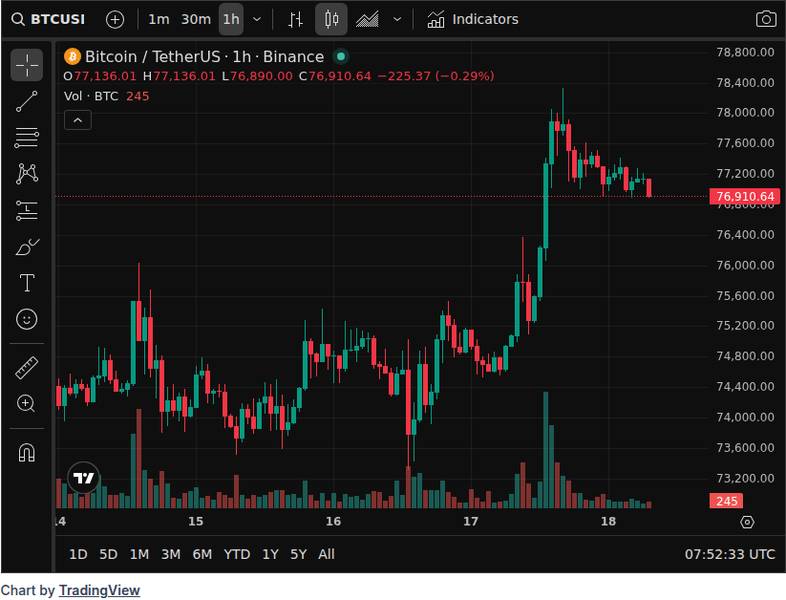
Bitcoin traded near $77,006 at the time of research, with a 24-hour gain of 2.71% and a market cap around $1.54 trillion, according to the market context gathered for this brief. Against that scale, opacity around liquidity agreements looks less like a minor disclosure gap and more like a structural weak point for token due diligence.
The broader backdrop was also cautious, with the Crypto Fear and Greed Index at 26, or Fear, when the report was compiled. When sentiment is already fragile, sparse disclosure can weigh more heavily on how traders judge smaller or less-established tokens.
What Investors and the Industry May Take From the Disclosure Gap
- Novora’s sample covered 150-plus major protocols, and it found only a single named public example of market-maker disclosure in that group.
- Trackable revenue showed up at 91%, but formal issuer communication lagged at 18% quarterly updates and 8% token holder reports.
- Token Transparency Framework adoption was 9%, with 13 filers and 6 on Solana, so standardized crypto IR remains early.
Novora said it presented the Token Transparency Framework to the SEC in June 2025, yet adoption was still 9% across the tracked universe in April 2026. Novora also said no base-layer, scaling, or infrastructure protocol in the sample had filed under the framework, which shows the push toward standardized token IR is still confined to a narrow part of the market.
For investors, the practical checklist is straightforward: look for a current investor-relations page, recurring token-holder reporting, and any explicit explanation of how outside market makers are engaged. Meteora’s public IR site stands out less because it proves a perfect model and more because it shows how unusual even basic disclosure still is.
If that gap persists while more projects chase exchange listings, ETF attention, and institutional trading rails, transparency standards will likely rise by pressure rather than by habit. The present data set from Novora’s April 2026 report makes the immediate point clear: crypto has built liquid markets faster than it has built public rules for explaining who helps create that liquidity.
Disclaimer: This article is for informational purposes only and does not constitute financial or investment advice. Cryptocurrency and digital asset markets carry significant risk. Always do your own research before making decisions.