What Is dYdX? The App-Chain Perp DEX Built for Serious Traders
- Stacey George
- May 19, 2026
- Reviews
- 0 Comments
DYdX is a decentralized exchange for crypto perpetual futures, but the better way to understand it is not “a DEX for leverage.” dYdX is an exchange that turned itself into a blockchain. Current dYdX operates on the dYdX Chain, a dedicated proof-of-stake network built for derivatives trading.
The product looks like a centralized futures exchange: order book, leverage, funding rates, liquidations, advanced orders, market depth, and account-level risk controls. Custody and settlement remain tied to decentralized infrastructure.
As of May 19, 2026, the dYdX Markets interface showed about $131.4 million in 24-hour trading volume, $53.3 million in open interest, and roughly $10,514 in 24-hour fees generated. BTC-USD led the venue with about $74.2 million in 24-hour volume, 23.2K trades, and around $27.4 million in open interest.
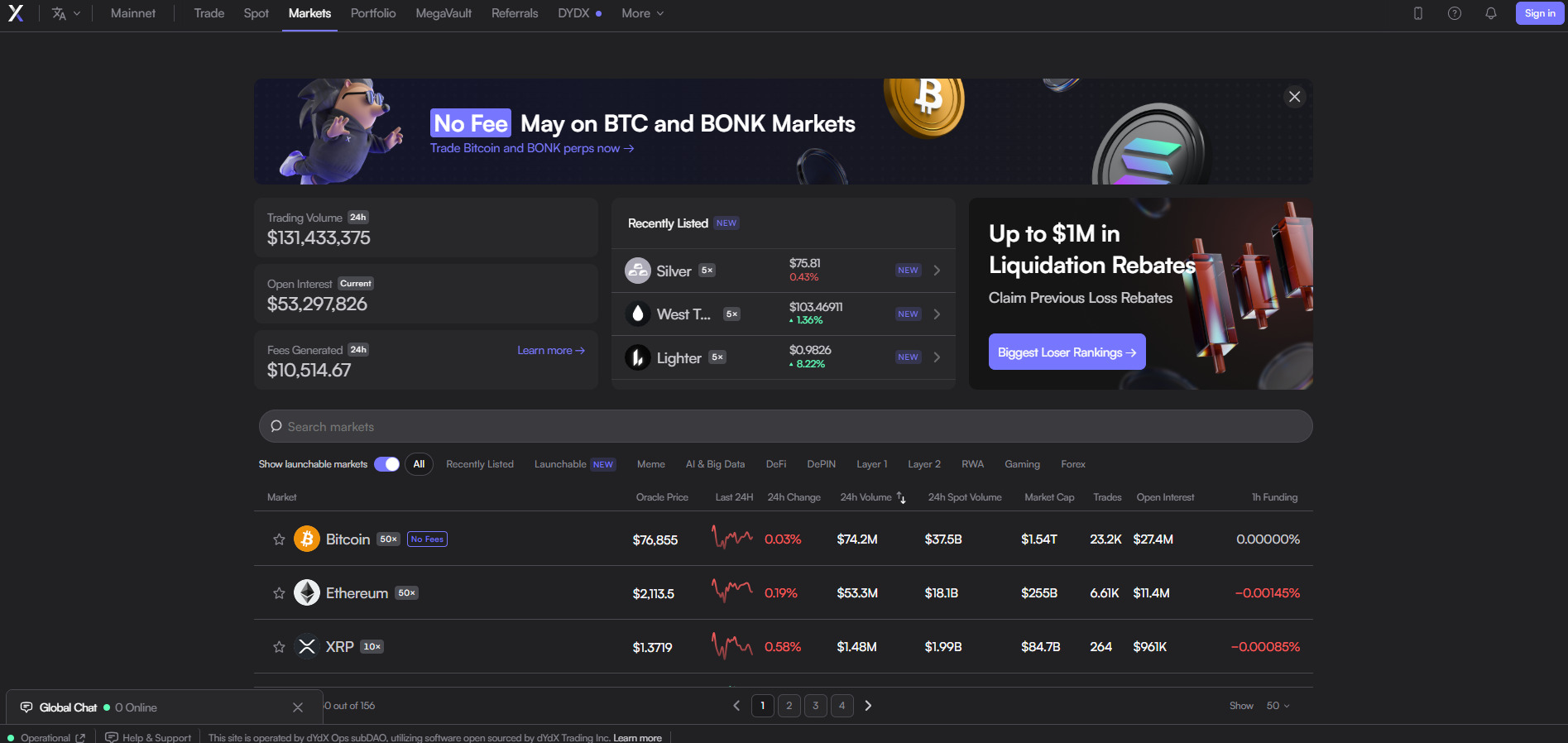
Those numbers make the platform more concrete. dYdX is not only a chain design or governance story. It is an active derivatives venue, but visible activity remains concentrated in a few major markets.
Table of Contents
What Is dYdX?
dYdX is a decentralized perpetual futures exchange. Traders use it to open long or short positions on crypto assets without handing custody to a centralized exchange.
Its main product is perpetual futures. These contracts track the price of an underlying asset but do not expire. Instead of settlement at a future date, perpetuals use funding payments to keep contract prices close to spot markets.
When a perpetual trades above the reference price, long traders usually pay short traders. When a perpetual trades below the reference price, shorts usually pay longs. Funding creates a balancing mechanism between bullish and bearish positioning.
The current version of dYdX runs on the dYdX Chain. Validators and DYDX stakers secure the network. Traders interact with a professional exchange interface, while positions, collateral, and settlement are handled through decentralized infrastructure.
The key point is simple: dYdX is not competing with spot-swap DEXs. It competes in the perpetual futures market, where liquidity depth, execution speed, funding rates, and liquidation design matter more than basic token availability.
Why dYdX Moved From Ethereum to Its Own Chain
dYdX began on Ethereum and later became known for its StarkEx-based perpetual exchange. That version proved demand for non-custodial derivatives, but also showed why perpetual trading is hard to run on general-purpose blockchains.
Perp exchanges need fast order placement, reliable liquidations, low trading friction, deep order books, constant oracle updates, real-time margin checks, and market-maker participation.
A spot DEX can tolerate slower execution. A leveraged derivatives venue cannot. If liquidations fail or order flow becomes too slow, traders lose confidence quickly.
The app-chain move gave dYdX control over the full trading environment. Governance can tune market parameters, validator incentives, trading rewards, and risk settings around one core product: perpetual futures. The dYdX 2025 ecosystem report shows how the protocol framed that transition around trading activity, governance, and market infrastructure.
The cost is complexity. dYdX users must evaluate more than smart-contract risk. They must evaluate app-chain security, bridge flows, validator behavior, oracle reliability, and market liquidity.
dYdX by the Numbers
dYdX’s 2025 ecosystem report said the protocol crossed $1.55 trillion in cumulative trading volume, generated $64.7 million in protocol fees, listed 386 markets, and reached about 98,200 DYDX token holders across its ecosystem history.
Historical scale matters, but current liquidity matters more for active traders.
| Metric | Data |
|---|---|
| Total listed markets | 295 |
| Active markets | 121 |
| 24-hour trading volume | ~$131.4M |
| Approximate open interest | ~$53.3M |
| 24-hour fees generated | ~$10.5K |
| Markets below $100K in 24h volume | 115 |
| BTC + ETH share of 24h volume | ~96% |
| BTC + ETH share of open interest | ~72.6% |
The data tells a more honest story than a simple product description. dYdX is not inactive. It still has meaningful trading activity. The strongest liquidity sits in BTC and ETH, while most long-tail markets are much thinner.
Top dYdX Markets by 24-Hour Volume
| Market | 24h Volume | 24h Trades | Approx. Open Interest |
|---|---|---|---|
| BTC-USD | ~$74.2M | ~23.2K | ~$27.4M |
| ETH-USD | ~$53.3M | ~6.6K | ~$11.4M |
| XRP-USD | ~$1.48M | ~264 | ~$961K |
| SOL-USD | ~$1.35M | ~1.2K | ~$4.9M |
| DOGE-USD | ~$162.6K | ~1.4K | ~$488K |
| Silver | ~$120.6K | ~15 | ~$90K |
| UNI-USD | ~$90.1K | ~222 | ~$558K |
| NEAR-USD | ~$72.8K | ~341 | ~$441K |
The gap between BTC, ETH, and the rest is the main analytical point. dYdX can serve major-market traders better than traders chasing every smaller narrative. Long-tail access exists, but execution quality may vary sharply.
That market concentration is not unique to dYdX. Liquidity also moves quickly across newer perp venues, as seen when Aster’s perpetual DEX volume surged and when whale activity shifted attention toward ASTER-linked liquidity.
Trading Experience on dYdX
The dYdX trading screen looks closer to a professional futures terminal than a typical DeFi swap page. The BTC-USD screen shows oracle price, 24-hour volume, 24-hour trades, open interest, one-hour funding, next funding time, and maximum leverage.
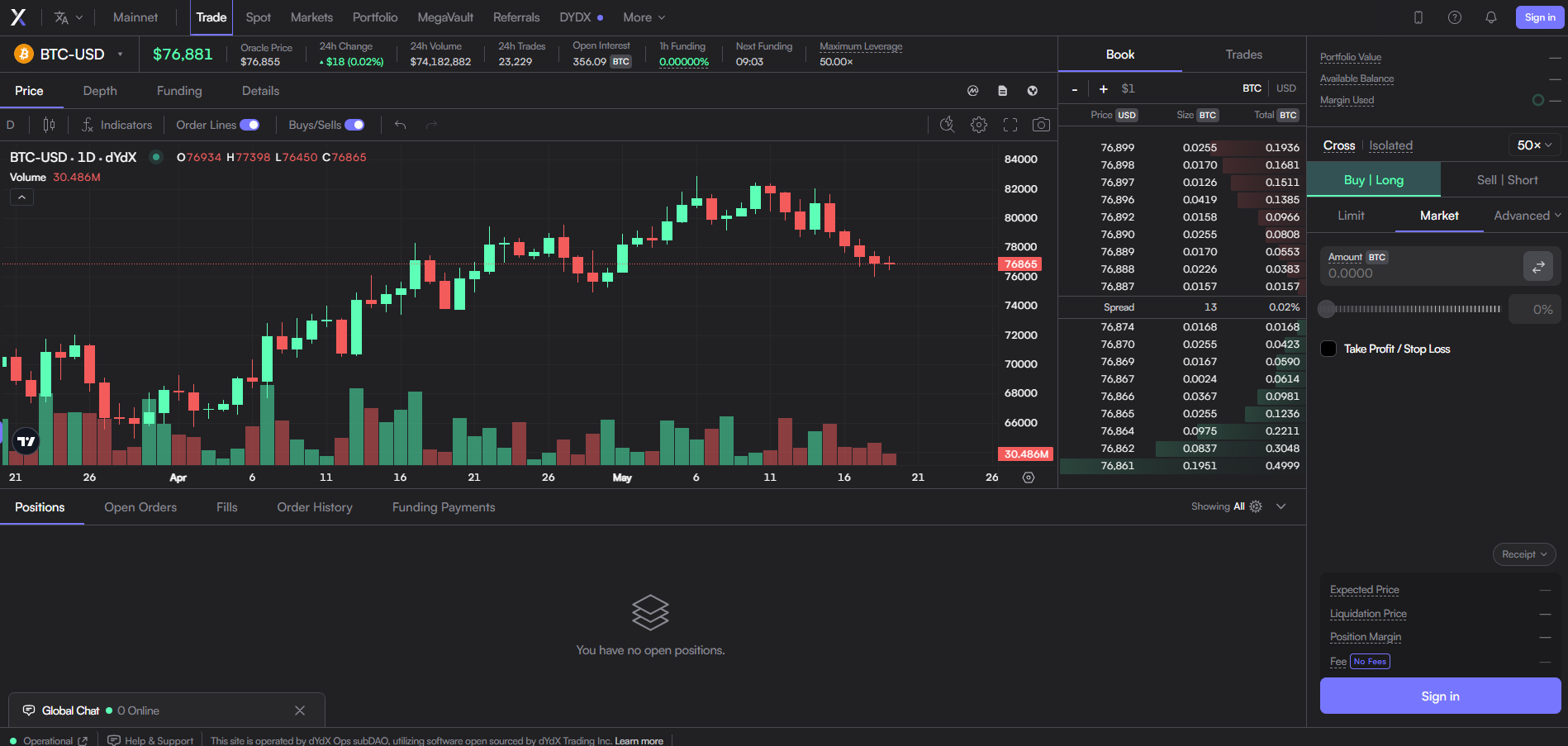
The same screen also shows a visible order book, market/limit/advanced order controls, cross or isolated margin, take-profit and stop-loss options, and liquidation-price fields.
For BTC-USD, the interface showed about 50x maximum leverage, roughly $74.2 million in 24-hour volume, around 23.2K trades, and a visible spread near 0.02%. Active traders look at these details before deciding whether a venue can handle real flow.
DYdX vs the New Perp DEX Market
dYdX used to be one of the clearest names in decentralized derivatives. The market is now more crowded. Hyperliquid has changed trader expectations around speed, liquidity, and product feel. Aster has shown how quickly perp DEX volume narratives can move.
GMX still represents a different AMM-style perp model. Drift and Jupiter show how Solana-based trading venues can compete on user experience and ecosystem flow.
dYdX now competes in a market where Hyperliquid has raised the bar for perp DEX execution, while Aster’s trading volume surge shows how quickly liquidity attention can shift. Older reputation is no longer enough. Traders compare venues by liquidity, execution, incentives, interface, uptime, market listings, and risk controls.
MegaVault: Liquidity Product or Risk Product?
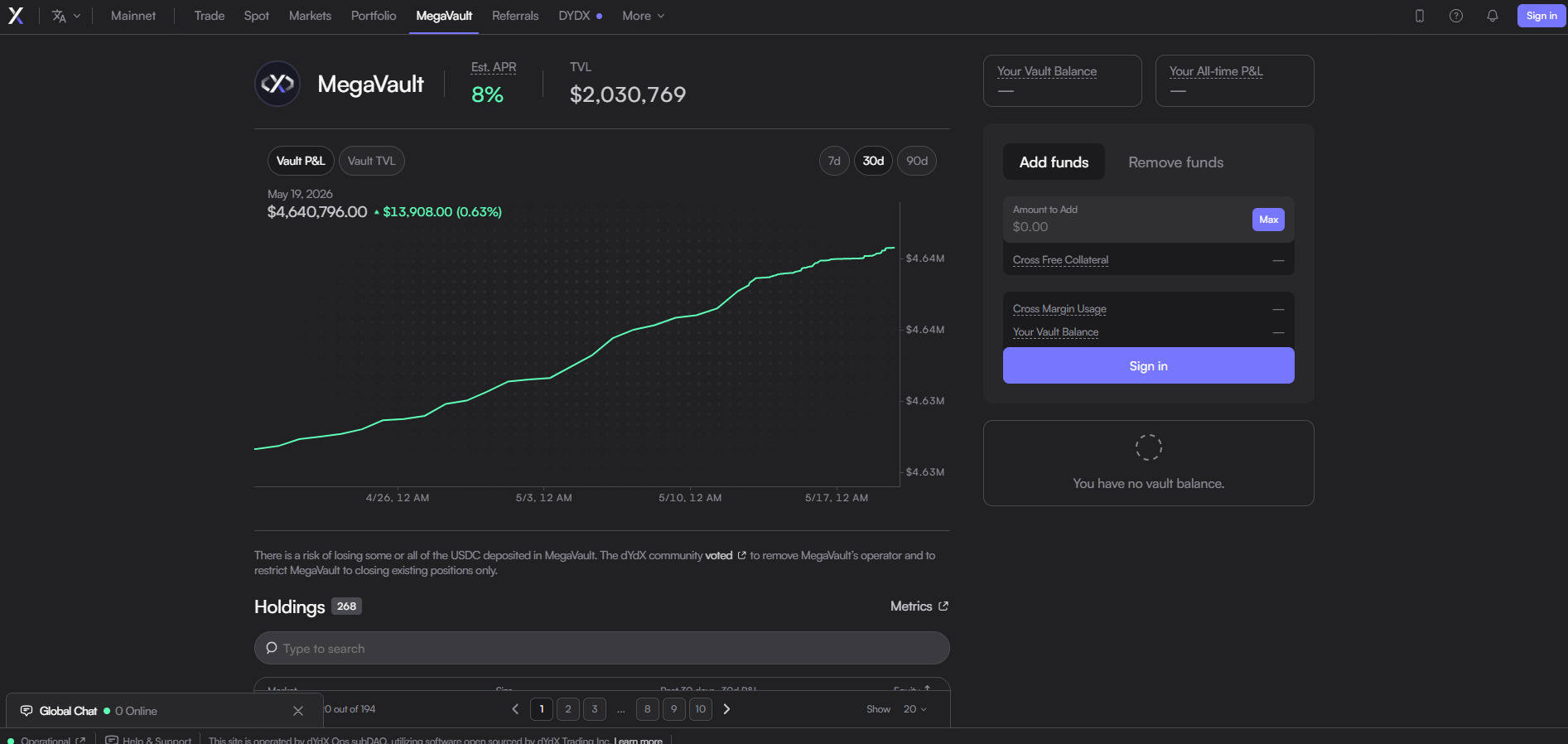
MegaVault is one of the most important parts of the current dYdX liquidity model. The interface showed an estimated 8% APR, about $2.03 million in TVL, and 268 holdings. The 30-day vault P&L chart showed roughly $4.64 million in vault P&L, with a positive daily move of around $13,908, or 0.63%, on May 19, 2026.
The product helps dYdX support market-making across many markets, especially long-tail pairs that may not attract deep organic liquidity. A vault-based system can bootstrap depth faster than waiting for organic market makers.
MegaVault should not be framed like a passive savings account. The interface warns that users can lose some or all deposited USDC. Depositors face strategy risk, market volatility, funding-rate exposure, and exchange-level risk controls.
Funding Rates: Where Arbitrage Enters the Picture
Funding rates are a core part of perpetual trading. dYdX also provides a funding comparison view across venues, including Binance, Kraken, Coinbase, and arbitrage spreads over different time windows.
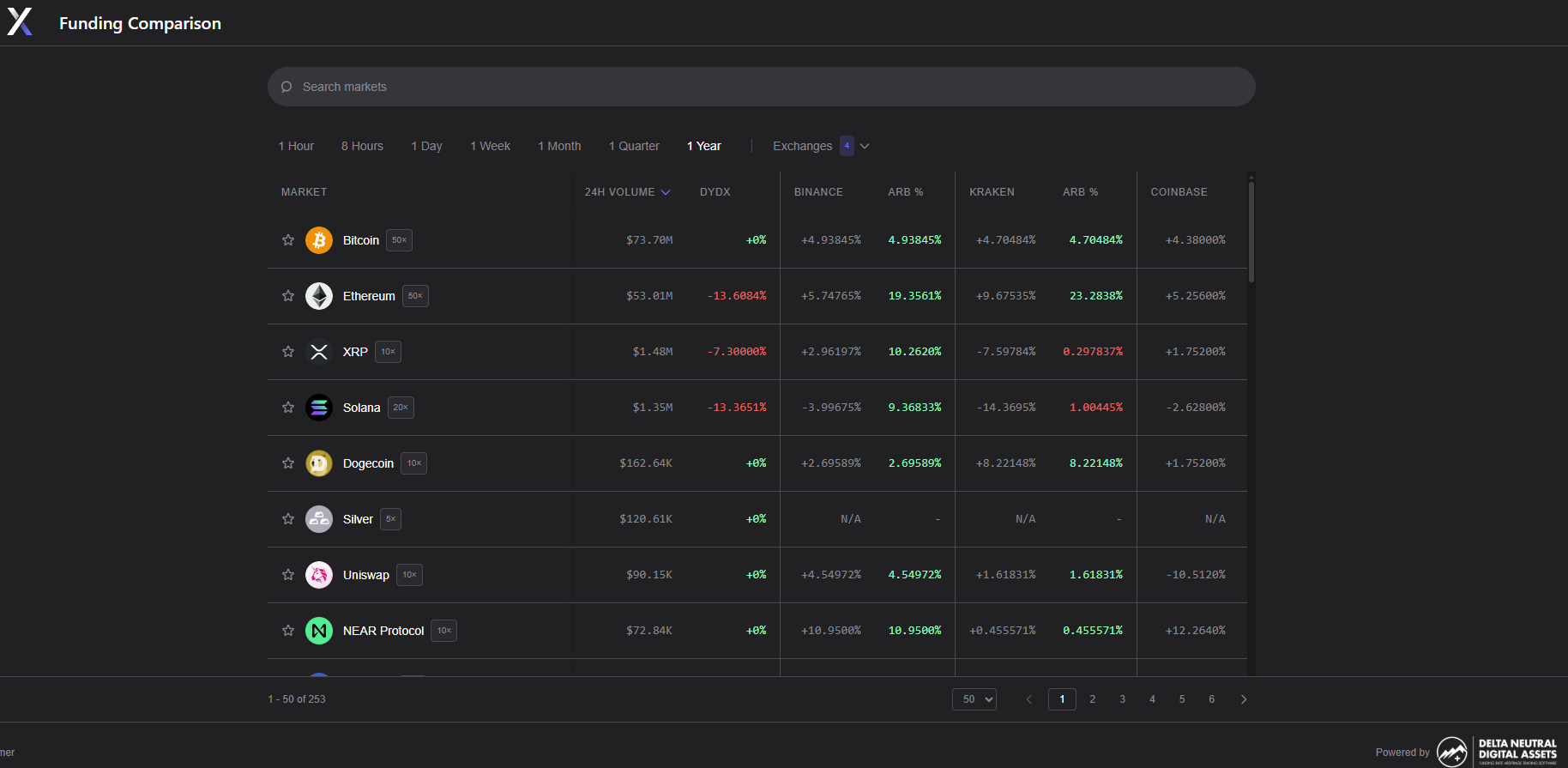
In the screenshot, BTC showed dYdX funding near 0% over the selected one-year view, while Binance, Kraken, and Coinbase showed positive funding figures. ETH showed negative funding on dYdX in the same view, while other exchanges showed positive funding. XRP and SOL also showed funding gaps across venues.
Professional traders do not only look at price. They compare funding across exchanges. If dYdX funding diverges from centralized venues, traders may use the gap for basis or funding arbitrage. Funding differences can also signal positioning imbalance, liquidity fragmentation, or venue-specific demand.
Regulated derivatives markets are now part of the same comparison set. Coinbase’s U.S. perpetual futures launch and 24/7 XRP, Solana, and ADA futures rollout show how centralized, compliance-focused venues are also expanding crypto derivatives access.
On-Chain Metrics: What the dYdX Chain Shows
Mintscan data adds another layer beyond the exchange interface. The dYdX Chain dashboard showed about 89.5 million blocks, 421.5 million transactions, around 4.71 transactions per block, and a block time near 0.58 seconds.
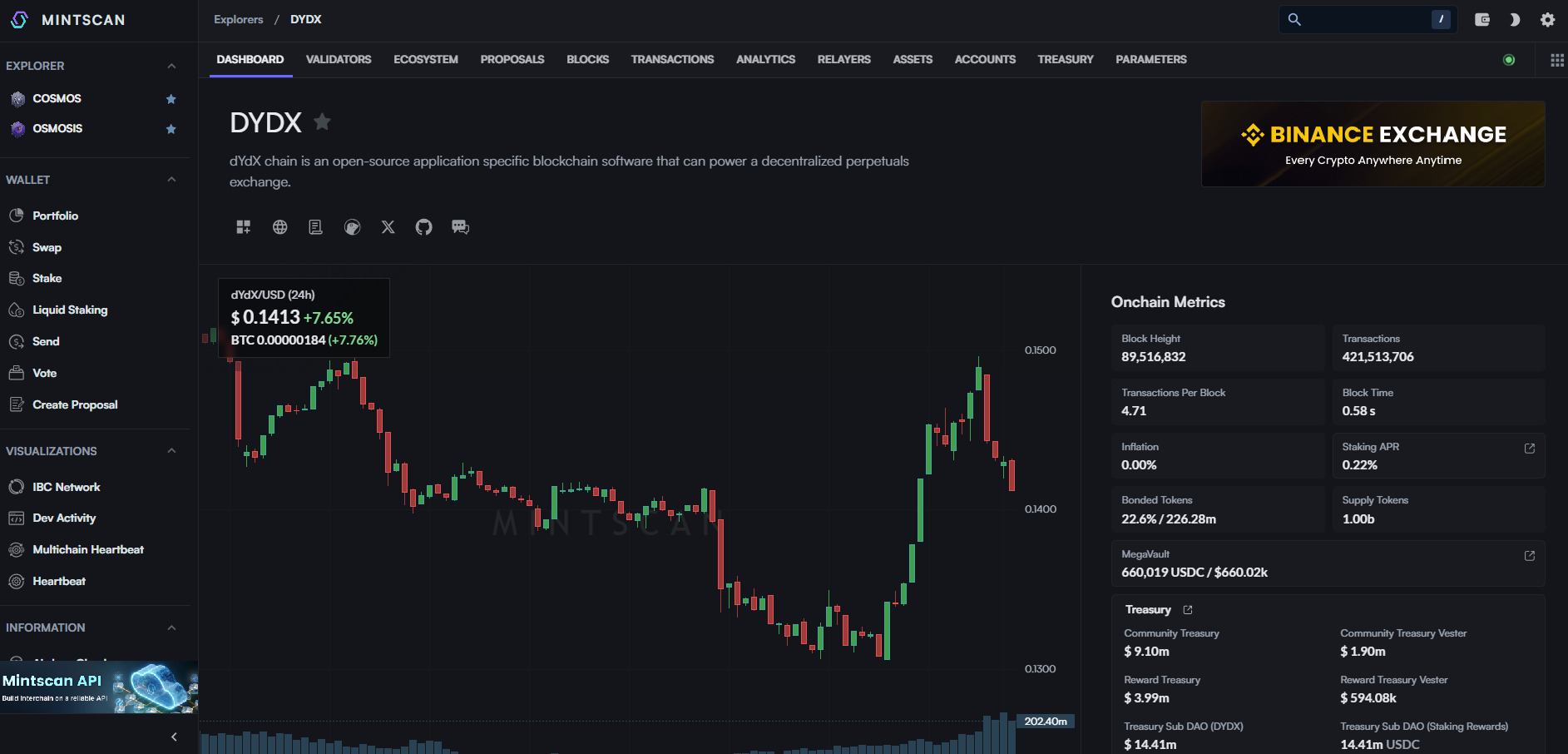
The same dashboard showed 1.00 billion supply tokens, about 22.6% bonded tokens, and a staking APR around 0.22%. Treasury figures were also visible, including roughly $9.10 million in Community Treasury, $3.99 million in Reward Treasury, and $14.41 million in Treasury SubDAO funds.
These figures help explain why dYdX is more than a trading interface. It is an exchange tied to its own chain economy, validator set, treasury structure, staking dynamics, and governance process.
Strengths vs Limitations
| Strengths | Limitations |
|---|---|
| Mature brand in DeFi derivatives | Liquidity is heavily concentrated in major markets |
| Professional order-book trading | Many listed markets remain thin |
| Non-custodial access to perpetual futures | App-chain security differs from Ethereum L1 security |
| Dedicated chain optimized for trading | Bridge and validator risks matter |
| Advanced order types and familiar interface | Leverage increases liquidation risk |
| MegaVault can support long-tail liquidity | MegaVault exposes depositors to strategy and market risk |
| DYDX staking and governance | Strong competition from newer perp DEXs |
Security Model and Trade-Offs
dYdX reduces custodial risk, but it does not remove trading risk. The dYdX Chain is secured by validators and DYDX staking. Users still need to think about validator concentration, software bugs, governance decisions, oracle behavior, bridge exposure, and market volatility.
Leveraged trading adds another layer. A trader can be right about market direction and still be liquidated if price moves sharply before the thesis plays out.
Security should be evaluated in layers: custody risk, chain security risk, bridge risk, oracle risk, liquidation risk, liquidity risk, governance risk, and user error risk. The biggest mistake is treating “decentralized” as a synonym for “safe.” dYdX changes the trust model. It does not eliminate risk.
Who dYdX Is Best Suited For
| Better suited for | Less suited for |
|---|---|
| Active derivatives traders | Complete beginners |
| Market makers | Passive spot investors |
| Traders focused on BTC and ETH liquidity | Users expecting deep liquidity across every small market |
| Users who understand margin and funding | Traders unfamiliar with leverage |
| Users who prefer self-custody | Users unwilling to manage wallet and bridge risk |
| DeFi users comfortable with app-chain trade-offs | Users in restricted jurisdictions |
dYdX is strongest for traders who already understand perpetual futures. It is not the easiest entry point for someone learning crypto trading from scratch.
Conclusion
dYdX is not just another DEX. It is a full-stack attempt to build a decentralized derivatives exchange around its own chain. That model gives dYdX real advantages: professional order-book trading, non-custodial access, app-chain customization, MegaVault liquidity support, and a long track record in DeFi derivatives.
The data adds nuance. dYdX still has meaningful BTC and ETH activity, but liquidity is highly concentrated, and many long-tail markets remain thin.
The best way to frame dYdX is not “leader” or “laggard.” It is a mature perp DEX with strong infrastructure, concentrated liquidity, and serious competition. Traders who value self-custody and professional execution may still find it useful. Traders who want the deepest liquidity across every market should compare venues carefully before opening size.
FAQs
What is dYdX?
dYdX is a decentralized exchange focused on perpetual futures trading. It uses an order-book model and runs on the dYdX Chain.
Is dYdX different from a regular DEX?
Yes. Regular DEXs usually focus on spot swaps through AMM pools. dYdX focuses on leveraged perpetual futures through an order book.
Is dYdX still liquid?
dYdX has meaningful liquidity in major markets such as BTC and ETH. Many smaller markets are much thinner, so traders should check depth before trading.
What are the main risks of using dYdX?
The main risks include liquidation risk, liquidity risk, bridge risk, validator risk, oracle risk, governance risk, and user error.