
U.S. Banking Groups Push Tighter Stablecoin Rules Before May 14 CLARITY Act Markup
- Stacey George
- May 11, 2026
- Policy
- 0 Comments
Six of the largest U.S. banking trade groups sent a joint letter to Senate leaders on May 8 demanding tighter restrictions on stablecoin yield payments in the Digital Asset Market Clarity Act, warning that the current language could shrink consumer and small-business lending by one-fifth or more ahead of a scheduled May 14 committee markup.
The letter, addressed to Senate Banking Committee Chairman Tim Scott and Ranking Member Elizabeth Warren, was signed by the American Bankers Association, America’s Credit Unions, the Bank Policy Institute, the Consumer Bankers Association, the Independent Community Bankers of America, and the Mid-Size Bank Coalition of America.
Six trade groups want Section 404’s yield loophole closed
The coalition’s core argument is that Section 404 of the CLARITY Act, as currently drafted, could permit payment stablecoin issuers to offer interest or other yield to holders. The groups contend this would accelerate deposit flight from banks and credit unions into stablecoin products that sit outside traditional prudential supervision.
Their specific redline requests target the bill’s qualifying language. The letter asks lawmakers to remove the word “solely” from Section 404(c)(1)(A), strip the phrases “on a payment stablecoin balance” and “on an interest-bearing bank deposit” from Section 404(c)(1)(B), replace “economically or functionally equivalent” with “substantially similar,” and delete subsection (3)(B) entirely.
Each proposed change would narrow the circumstances under which stablecoin issuers could structure yield-like returns without triggering the bill’s anti-interest provisions. The banking groups argue that the current limiting words create loopholes large enough for issuers to design products that function like interest-bearing accounts while technically falling outside the statutory definition.
Reserve and supervision demands
Beyond the yield question, the letter frames the fight as one about prudential parity. The trade groups warned that widespread use of yield-bearing stablecoins could reduce consumer, small-business, and agricultural lending by one-fifth or more. That estimate rests on the assumption that deposits would migrate to higher-yielding stablecoin products, draining the funding base banks rely on for loan origination.
The stablecoin sector currently carries a market capitalization of roughly $293 billion, with USDC alone accounting for approximately $77.6 billion. Those figures give weight to the banking lobby’s concern that even a modest shift in deposit preference could have outsized effects on credit availability.
Why the May 14 markup is the immediate pressure point
The Senate Banking Committee has scheduled an executive session for Thursday, May 14 at 10:30 AM to consider H.R. 3633, the Digital Asset Market Clarity Act of 2025. A markup is the stage at which committee members propose amendments, negotiate final language, and vote on whether to send the bill to the full Senate floor.
The timing is not accidental. A May 1 compromise between Senators Tillis and Alsobrooks on stablecoin yield language removed the main obstacle that had stalled the bill, making a mid-May committee vote possible again. Baker McKenzie noted on May 5 that this compromise reopened the path to markup, which is precisely why the banking groups moved quickly with their May 8 letter.
Why pre-markup lobbying matters
Once a bill enters markup, the text that emerges from committee typically sets the boundaries for floor debate. Amendments adopted during markup are far more likely to survive than those introduced later. The banking groups’ letter is a calculated effort to shape the bill’s final language before senators lock in their positions on May 14.
The letter’s specificity, targeting individual words and subsections rather than broad principles, signals that the trade groups believe the current draft is close to passage and that narrow textual changes are the most realistic path to tightening the yield restrictions. This kind of regulatory maneuvering around digital asset legislation echoes the broader pattern of institutional players seeking to influence crypto policy at critical junctures, similar to how Morgan Stanley’s recent $194 million Bitcoin ETF inflows reflect traditional finance deepening its crypto exposure even as it lobbies for guardrails.
What tighter stablecoin rules could mean for issuers, banks, and crypto markets
For stablecoin issuers, adopting the banking groups’ proposed changes would effectively prohibit yield-bearing payment stablecoins under federal law. That would force projects currently exploring interest features, or those structured to pass through Treasury-bill returns, to either restructure as securities or abandon yield entirely.
For banks and credit unions, the payoff is straightforward: preserving their deposit base. The six trade groups represent institutions that collectively hold the majority of U.S. consumer deposits. If yield-bearing stablecoins were permitted, the competitive threat to deposit funding would be direct and immediate, particularly for community banks and credit unions with thinner margins.
For crypto markets broadly, the outcome of this fight will set a precedent for how U.S. law treats the boundary between payment instruments and investment products. A stricter Section 404 could push innovation toward non-U.S. jurisdictions, while a looser standard could attract more capital into dollar-denominated stablecoins. The market’s current sentiment sits at a Fear and Greed Index reading of 48, reflecting a neutral stance as participants wait for regulatory clarity.
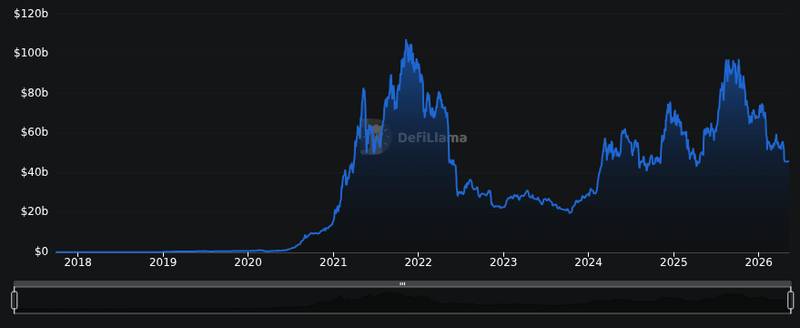
The broader DeFi ecosystem, where stablecoins serve as the primary liquidity layer, would also feel the effects. Tighter rules could reduce the utility of stablecoins within decentralized lending protocols, a dynamic that recalls the kinds of protocol-level risks highlighted by incidents like the recent LayerZero-Kelp DAO exploit. Meanwhile, emerging infrastructure projects like KnoxNet’s dual-domain Layer-1 network illustrate how the industry continues building despite regulatory uncertainty.
What to watch after the markup
The May 14 executive session will reveal whether any senator introduces amendments reflecting the banking groups’ requests. If the committee adopts language removing “solely” or striking subsection (3)(B), it would represent a significant victory for the traditional banking lobby and a setback for stablecoin issuers seeking to compete on yield.
If the bill advances without those changes, the fight shifts to the Senate floor, where the same trade groups will likely press for amendments through sympathetic members. Either way, the May 14 vote marks the first concrete legislative test of whether U.S. stablecoin policy will prioritize banking-sector stability or open the door to yield competition from digital-asset issuers.
Disclaimer: This article is for informational purposes only and does not constitute financial or investment advice. Cryptocurrency and digital asset markets carry significant risk. Always do your own research before making decisions.