
Spot Crypto Volumes Drop Nearly 20% in March
- Stacey George
- April 10, 2026
- Market
- 0 Comments
Spot crypto volumes dropped nearly a fifth in March, a broad slowdown that hit every major centralized exchange in the sample and suggested traders were either stepping back from risk or shifting activity elsewhere. For nftenex readers, the sharper market-structure question is whether ownership and execution are moving further toward wallet-first venues even while bitcoin still anchors overall crypto pricing.
- The March spot-volume slump was broad-based, with Upbit down 39.4%, Bitget down 31.2%, and Crypto.com down 23.4%.
- Derivatives volume fell 2.9%, but Coinbase derivatives volume rose 41.4% and MEXC rose 36.6%, suggesting positioning shifted rather than disappeared.
- CoinGecko’s $5.4 trillion top-10 CEX spot tally for 2025 Q1 alongside $700.7 billion in top-10 DEX volume points to venue rotation during the slowdown.
How Severe Was the March Drop in Spot Crypto Trading?
Bitcoin.com reported a 19.4% month-on-month drop in March spot crypto volumes from February across major exchanges, and it said every major venue in the dataset posted lower activity.
The hardest hit venue was Upbit at 39.4%; Bitget fell 31.2% and Crypto.com fell 23.4%, showing the retreat was not isolated to one exchange or region.
Why Spot Volume Matters as a Market Health Signal
Spot volume is one of the simplest checks on whether buyers are still committing fresh capital, because it measures direct trading rather than leverage alone. In this case, that signal mattered precisely because all major spot venues in the report moved lower in the same month.
The decline was milder in futures and perpetuals: total derivatives volume slipped 2.9% month on month, while Coinbase derivatives volume rose 41.4% and MEXC rose 36.6%. That split suggests some traders kept exposure through leveraged products even as cash-market conviction faded.
Traffic data backed up the softer participation story. Exchange website traffic fell 2.34% in March, led by Upbit’s 21.5% decline, although Bitget traffic rose 17.16%, which again points to redistribution rather than a uniform freeze.
The underlying exchange table is still only partially confirmed in this brief: a single source reported that Wu Blockchain compiled the original March dataset, but that Medium post could not be read directly because of an anti-bot challenge. No direct exchange-issued statement was included in the evidence pack, so the March figures here remain anchored to secondary reporting plus broader market context.
What Likely Drove Spot Crypto Volumes Lower in March?
Confirmed Facts vs. Reasonable Interpretation
The confirmed backdrop is weaker participation, not a named regulatory shock. Cointelegraph reported that crypto-wide daily trading volume had dropped 63% from a $440 billion February peak to $163 billion on March 12, 2025, and it described that slide as a sign of trader exhaustion.
The same report tied the softer tape to recession fears and global trade tensions, which matches the brief’s finding that no direct regulatory catalyst was identified for the March exchange slowdown. The most defensible interpretation is therefore a macro risk-off cooldown layered on top of post-rally fatigue, not a single exchange-specific event.
That matters for digital ownership markets because thinner spot liquidity usually weakens conviction in more speculative corners before it fully shows up in flagship assets. Readers following nftenex coverage of quantum-safe Bitcoin transaction design, the Treasury’s cybersecurity information-sharing initiative for digital asset firms, and cross-border crypto fraud enforcement have already seen how infrastructure, security, and trust concerns can shape where users prefer to trade and custody assets.
What the March Volume Slump Could Mean for the Crypto Market Next
CoinGecko’s 2025 Q1 report put top-10 CEX spot volume at $5.4 trillion, down from $6.4 trillion in 2024 Q4, while top-10 DEX volume rose to $700.7 billion from $660.0 billion. That combination suggests March was not only about weaker demand, but also about some trading activity moving away from centralized order books.
Bitcoin’s market size shows why the slowdown does not automatically confirm a long-term bearish turn. In the brief’s live market snapshot, bitcoin was trading near $71,831, up roughly 1.13% over 24 hours, with a market capitalization around $1.44 trillion and roughly $39.68 billion in 24-hour volume.
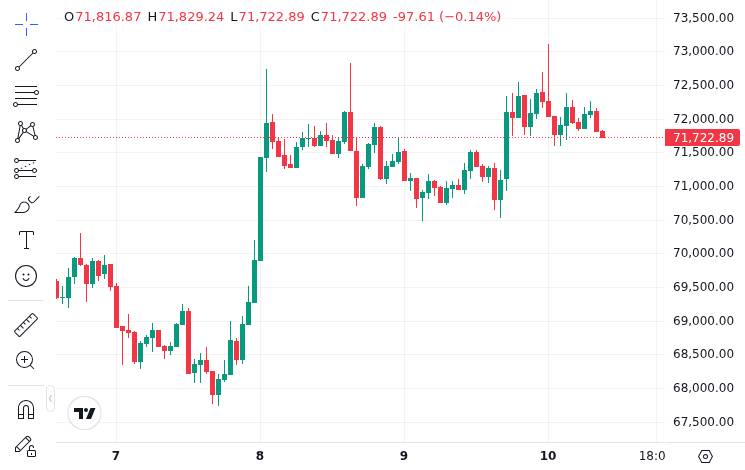
Lower spot activity can still make price moves less trustworthy, because thinner cash participation means breakouts depend more on positioning than fresh demand. That is why the contrast between weak March spot trading and pockets of derivatives growth at Coinbase and MEXC matters more than the headline alone.
For NFT-native and wallet-based traders, the practical takeaway is that March looked like both a demand pause and a venue shift. If DEX turnover keeps rising while CEX spot activity cools, liquidity, custody, and execution will keep moving closer together across crypto’s ownership stack.
Disclaimer: This article is for informational purposes only and does not constitute financial or investment advice. Cryptocurrency and digital asset markets carry significant risk. Always do your own research before making decisions.