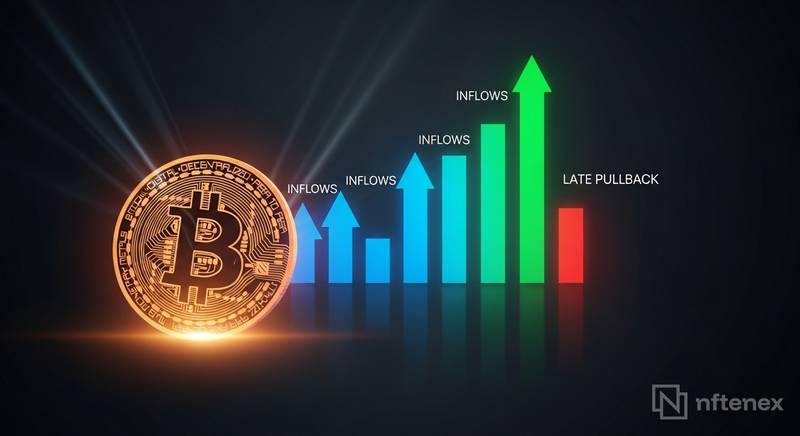
Bitcoin ETFs Log Weekly Inflows Despite Late Pullback
- Stacey George
- March 23, 2026
- Investment
- 0 Comments
Spot Bitcoin ETFs closed the week with net positive inflows, extending a multi-week accumulation streak even as late-week selling pressure tested institutional conviction in regulated digital asset products.
Bitcoin ETFs Post Weekly Net Inflows as Institutional Demand Holds
U.S. spot Bitcoin ETFs recorded net positive weekly flows, with early- and mid-week sessions drawing consistent institutional buying. BlackRock’s iShares Bitcoin Trust (IBIT) and Fidelity’s Wise Origin Bitcoin Fund (FBTC) continued to lead the category in attracting capital, a dynamic that has persisted since the product class launched in January 2024.
The positive weekly result extends what has become a recurring pattern: large allocators treating Bitcoin exposure through regulated ETF wrappers as a strategic portfolio position rather than a short-term directional bet. This institutional posture aligns with a broader shift toward tokenized asset adoption that BlackRock CEO Larry Fink has compared to the early internet, framing digital assets as foundational financial infrastructure.
For the on-chain Bitcoin ecosystem, sustained ETF accumulation acts as a macro confidence signal. The same institutional sentiment that drives ETF inflows underpins interest in Bitcoin-native digital assets, including Ordinals inscriptions and BRC-20 tokens, which depend on robust Bitcoin network demand to remain economically viable.
Late-Week Selloff Tests ETF Resilience
While the week opened with steady inflows, the final trading sessions saw a reversal as Bitcoin’s price weakened heading into the weekend. The pullback coincided with broader risk-off sentiment across equity markets, a pattern that has periodically triggered short-term ETF outflows throughout 2025 and into 2026.
Despite the late-week pressure, cumulative flows remained in positive territory for the full period. This resilience echoes a pattern seen repeatedly since early 2025, where single-day outflows during price dips have been absorbed by stronger inflow days earlier in the week.
The dynamic highlights a structural divergence between price-sensitive traders and longer-horizon institutional allocators. ETF flow data increasingly suggests the latter group uses pullbacks as accumulation windows rather than exit triggers, reinforcing the thesis that Bitcoin’s current price environment continues to attract institutional positioning.
Infrastructure providers are also building around this institutional momentum. Companies like BitGo have begun launching programmatic access tools for digital asset management, underscoring the operational buildout supporting institutional crypto engagement.
What Sustained ETF Flow Momentum Means for Bitcoin Digital Assets
Beyond headline price movements, the persistent ETF inflow trend carries implications for Bitcoin-native digital ownership. The Ordinals protocol and BRC-20 token standard have introduced asset creation and transfer directly on the Bitcoin blockchain, and their economic viability correlates with overall network demand.
When institutional sentiment strengthens, as reflected in persistent ETF accumulation, it tends to support broader on-chain activity. Higher Bitcoin valuations increase the incentive to inscribe Ordinals and transact in BRC-20 tokens, since both compete for Bitcoin block space. The Runes protocol has further expanded the range of fungible tokens native to Bitcoin, deepening the link between macro capital flows and on-chain ecosystem health.
The risk profile differs significantly between these two forms of Bitcoin ownership. ETF holders can exit positions in seconds during market hours, while on-chain Ordinal and BRC-20 holders face the liquidity constraints of nascent secondary markets. The late-week ETF pullback illustrates this distinction: regulated fund investors repositioned quickly on price weakness, while on-chain Bitcoin asset holders remained largely static.
Regulatory developments in adjacent sectors may further shape how institutional digital asset ownership evolves. Legislative efforts such as the Delaware bipartisan stablecoin bill signal growing political engagement with blockchain-based financial products, a trend that could extend clearer frameworks to Bitcoin-native assets over time.
The ETF flow trend will remain a closely watched barometer for institutional Bitcoin conviction. Whether the current inflow streak holds through the next bout of macro volatility will indicate whether institutional accumulation has shifted from opportunistic to systematic, with direct downstream effects on Bitcoin’s on-chain creator and collector economy.
Disclaimer: This article is for informational purposes only and does not constitute financial or investment advice. Cryptocurrency and digital asset markets carry significant risk. Always do your own research before making decisions.