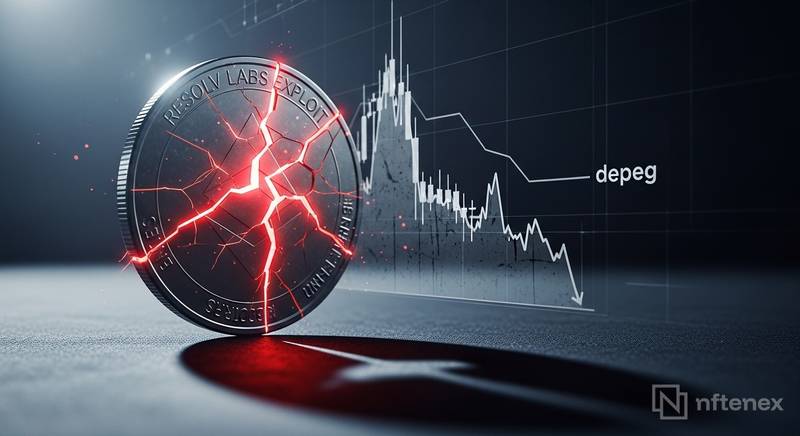
Resolv Labs Pauses Protocol After $23M Exploit Triggers USR Stablecoin Depeg
- Myah Barker
- March 22, 2026
- News
- 0 Comments
A $9.6 million exploit targeting DeFi lending protocol Resupply has raised fresh questions about stablecoin integration risk, with early reports conflating the incident with Resolv Labs and its USR stablecoin. The confirmed breach hit Resupply’s wstUSR market on June 26, 2025, prompting the protocol to pause affected contracts, though Resolv’s own platform showed no signs of a separate exploit or protocol halt.
What the Confirmed Exploit Hit and How It Worked
The attack targeted Resupply’s wstUSR market, a lending pool built around wrapped staked USR tokens. Security firm BlockSec Phalcon independently flagged the exploit at roughly $9.5 million, while reporting from multiple outlets placed the final figure near $9.6 million.
Cybersecurity researcher Meir Dolev described the attacker’s method: “By inflating the share price, they borrowed $10 million reUSD using minimal collateral.” The share-price manipulation allowed the exploiter to extract funds far exceeding the collateral they deposited.
Resupply confirmed the breach, paused the impacted wstUSR market, and stated the wider protocol continued operating normally. Only the single market was affected, limiting the blast radius.
Why Early Reports Confused Resupply With Resolv Labs
The original headline circulating on social channels attributed a $23 million exploit to Resolv Labs and claimed USR itself had depegged. Reviewed evidence does not support either claim. No credible source located during research confirmed a $23 million loss figure or a direct Resolv protocol pause.
Resolv’s official project page describes the protocol as live, citing over 50,000 users, $344 million in total value locked, and more than $1.7 billion in cumulative mints and redemptions. No pause notice or exploit disclosure appeared on the reviewed pages.
The confusion likely stems from the connection between USR (Resolv’s stablecoin) and wstUSR (the wrapped staked version used as collateral in Resupply). When Resupply’s wstUSR market was exploited, some observers attributed the incident upstream to Resolv itself, inflating both the protocol scope and the dollar figure.
What the wstUSR Breach Signals for Stablecoin Integration Risk
The Resupply incident highlights a growing concern in DeFi: wrapped and staked derivatives of stablecoins can introduce exploit vectors that the original stablecoin protocol never anticipated. When third-party protocols build lending or leverage products around derivative tokens, a vulnerability in one integration can trigger market confusion across the entire token stack.
This pattern has played out repeatedly. Exploits in downstream protocols shake confidence in the underlying asset, even when the base-layer stablecoin remains fully functional. For USR holders, the distinction between a Resupply market breach and a Resolv protocol failure matters enormously, but in fast-moving crypto markets, that nuance often gets lost.
DeFi protocols that accept wrapped or staked stablecoin collateral face a compounding risk problem. Each layer of wrapping adds smart contract surface area, and each integration partner adds a potential failure point. The Resupply case shows that even when the base stablecoin holds its peg, a downstream vulnerability can still drain millions.
What Markets Should Watch Next
Resupply’s decision to pause only the affected market, rather than the entire protocol, suggests the team identified the exploit’s scope quickly. Whether stolen funds can be recovered or whether the attacker has already bridged assets to other chains remains unclear from reviewed sources.
For the broader stablecoin sector, the incident reinforces that protocol-level audits alone are insufficient. Integration audits, covering how derivative tokens behave when used as collateral in third-party systems, are becoming a critical gap in DeFi security posture.
Resolv has not issued a public statement addressing the misattribution as of the latest reviewed sources. Investors monitoring USR should distinguish between verified Resupply-specific risk and unverified claims about the Resolv protocol itself before making any decisions based on headline-level reporting.
Disclaimer: This article is for informational purposes only and does not constitute financial or investment advice. Cryptocurrency and digital asset markets carry significant risk. Always do your own research before making decisions.